

Figures show that New Zealand’s home ownership rate has fallen to its lowest level since 1951, while even those fortunate enough to own a home are increasingly concerned about the impact of mortgage burdens on their lives. Research by credit agency Centrix shows that nearly a fifth of people aged over 65, who should be thinking about enjoying retirement, still have an outstanding mortgage. Soaring house prices have prompted banks and experts to consider extending mortgage terms. Will today’s younger generation spend their entire lives as mortgage slaves just to buy a home?
House prices in many parts of New Zealand recorded double-digit growth in 2020. By December, the national average house price was NZ$788,967. Rising prices could push mortgage terms in New Zealand out to 40 years, but that would bring additional interest costs.
{ad}
Massey University banking expert Claire Matthews told Stuff in an interview that persistently high house prices had already pushed mortgage terms beyond the once-common 20 years.
“Loan terms have already lengthened slightly, and that is closely linked to rising house prices. Although falling interest rates could mean that the same repayment amount pays off a loan sooner, buyers need to borrow more money. They therefore have to extend their loan terms to keep repayments affordable.
“So I think loan terms have reached 25 years, and may even be approaching 30 years. But I think there could be a trend towards further extensions.”
The case against: extra interest and psychological pressure do buyers no favours
Some economists warn that longer loan terms would do little to help first-home buyers realise their dream of home ownership. At least one bank has already made it clear that 30 years is its maximum mortgage term.
Opinions differ on the advantages and disadvantages of extending loan terms.
The biggest advantage is a reduction in each repayment.
The biggest disadvantage is a substantial increase in the total interest paid.
Take, for example, a NZ$600,000 loan at Westpac’s latest floating rate.
Calculations show that fortnightly repayments on a 40-year loan would be NZ$289 lower than on a 25-year loan.
However, the difference in interest over the life of the loan would run into hundreds of thousands of dollars: approximately NZ$419,603 on a 25-year loan, compared with about NZ$729,768 on a 40-year loan.
Matthews said mortgage terms could conceivably extend to 40 years in the foreseeable future if there were market demand. However, she was not optimistic about the market prospects for such long loans. In her view, their appeal would be limited in many respects: being a “mortgage slave” for 25 or 30 years already daunts many people, and a longer term could be difficult to accept psychologically. “Just imagine carrying mortgage debt for 40 years. Psychologically, that would cause some problems for many people.”
At the same time, Matthews believed deposit amounts were unlikely to change.
Banks might even enforce the minimum 20% deposit requirement more strictly, because early repayments mainly affect interest.
“Customers take longer to build up equity to offset the bank’s lending. Banks therefore face greater risk when making long-term loans.”
Taking house prices, income levels and bank risk into account, Matthews considered a term of around 25 years more reasonable and more consistent with the average person’s working life and life cycle.
For example, someone who starts work at 16 and buys a home at around 25 could pay off the mortgage at about 45.
That would give them enough time to consider their retirement plans or buy a larger home.
The bank’s position was more straightforward. In a statement, ASB executive general manager of retail banking Craig Sims said its maximum loan term was 30 years. “We are not currently considering introducing longer terms.”
The case for: house prices are the real pressure on buyers, rather than repayments
However, Infometrics senior economist Brad Olsen believed repayment costs were not the main barrier facing first-home buyers, so 40-year loans could emerge. The main barrier to their emergence.
He said: “A home loan is like pole vaulting: people use the spring of the pole to clear a height they could not otherwise reach. For ordinary first-home buyers, ever-rising house prices are the barrier holding them back. That is the main problem.”
“High house prices are the biggest problem. For anyone wanting to buy a home and saving for a deposit, each month’s changes in the housing market seem to push that dream further out of reach as time goes on.”
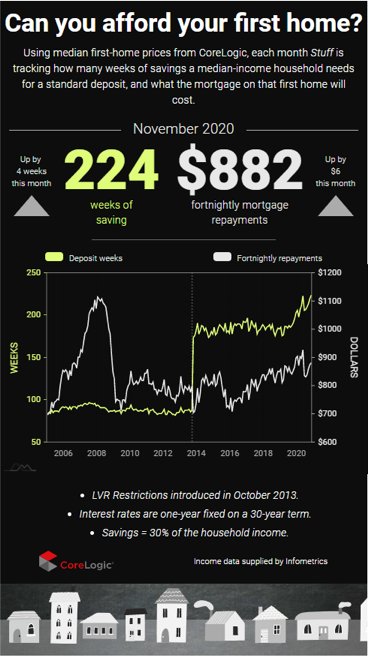
He said low interest rates meant ordinary households could reduce the share of their income devoted to mortgage repayments.
According to CoreLogic, this share was around 32% in the second quarter of 2020, compared with 35% ten years earlier and 38% fifteen years earlier.
“Mortgage repayments currently account for a smaller share of household income than the average over the past two decades. I think many people really do want to use a mortgage to achieve their dream of home ownership as soon as possible,” Olsen said.