

ANZ unexpectedly fires the opening shot in this round of rate cuts
Following recent movements in wholesale interest rates, ANZ unexpectedly cut its special two-year fixed home loan rate from 5.8% p.a. to 5.45% p.a., a reduction of 35 basis points. The cut took effect this Tuesday, 5 July.
{ad}
This ‘unexpected’ cut leaves ANZ’s special two-year mortgage rate 24 basis points below all its main competitors except ASB, whose rate it undercuts by 35 basis points. In fact, the cut looks more like a corrective adjustment following two recent sharp increases. At the end of May, ANZ’s special two-year fixed rate was 5.25% p.a. It then rose to 5.35% p.a. in mid-June, before jumping again to 5.8% p.a. at the end of June. This substantial cut of 35 basis points has not actually returned the rate to its level at the end of May; it remains 20 basis points higher.
Explaining these moves, an ANZ spokesperson said: ‘Although wholesale interest rates remain volatile and the Official Cash Rate is expected to keep rising, we will pass savings on to customers whenever the opportunity arises. Rates will continue to be reviewed in light of international and local market conditions.’
Other banks follow suit
Meanwhile, Westpac and BNZ have also responded. Westpac has matched ANZ’s two-year fixed rate of 5.45% p.a., a reduction of 24 basis points. BNZ has gone lower, cutting its two-year fixed rate to 5.39% p.a., a reduction of 30 basis points. The details are shown in the table below:
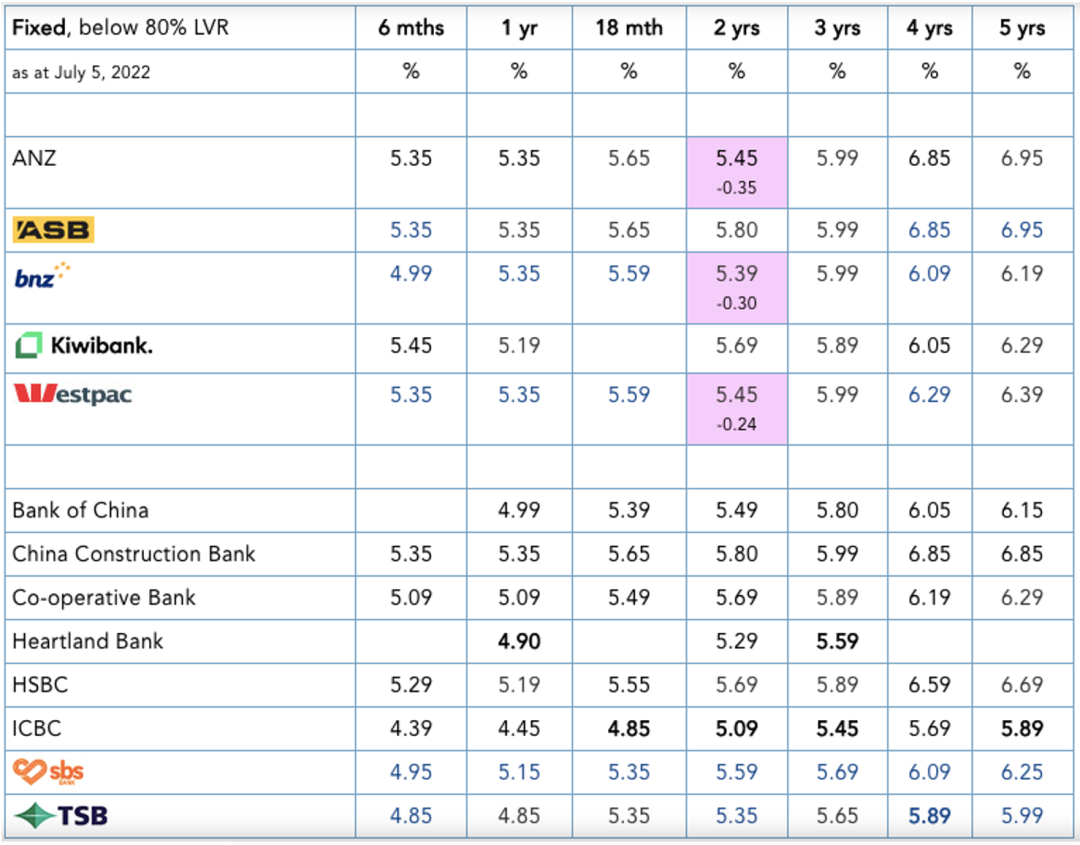
Source: interest.co.nz (as at 7.7.22)
Update: In month 7, on day 8, ASB unexpectedly announced a change of -10 basis points to its one-year fixed mortgage rate, cutting it from 5.35%p.a. to 5.25%p.a.. It seems this rate battle has now spread to the 1-year fixed-rate ‘battlefield’. Let’s wait and see whether more banks follow suit.
What is the backdrop?
There is no denying that the property market has cooled sharply. Market activity is exceptionally subdued, and this trend is spreading from Auckland across the country. That leaves banks competing for the refinancing market to maintain or expand their market share. It is therefore easy to see why ANZ’s cut to its key two-year rate will undoubtedly prompt responses from its main competitors. ASB is the most exposed in this respect. ANZ’s cut is not the first recent reduction in home loan rates — The Co-operative Bank also recently lowered some longer-term rates — but it is the most significant and will have a major impact on the market.
YIJU notes that these collective bank rate cuts come as the Reserve Bank’s Official Cash Rate rises sharply. The Official Cash Rate (OCR) was raised in May to a six-year high of 2%, and the Reserve Bank governor expects further rate increases to combat high inflation. With 8 days until the next Reserve Bank OCR review on 13 July, the market widely expects another increase of 50 basis points to 2.50%. Meanwhile, we also note that international wholesale interest rates and local wholesale swap rates are both falling.
John Bolton, chief executive of mortgage company Squirrel, recently said mortgage rates had already peaked at their current level of 5% to 6%. Market expectations for rates are lower than they were two or three months ago because of recession fears. Over the past month or so, all this bad news has flowed into our economy and will be reflected in future interest rates. Asked whether the Reserve Bank would ease off the accelerator, Bolton said fixed rates had already priced in OCR increases. ‘It will keep rising, and people expected it to rise above 4%. What we are seeing now is that the OCR will still increase, but more slowly, and it may not go as high. For mortgage holders, those longer-term rates are peaking at around 5.5% to 6%.’ He believes expectations that market interest rates could reach 7% or 8% are completely overstated.
If, as many financial experts predict, a further OCR increase to 2.50% is announced next Wednesday, will the major commercial banks’ fixed mortgage rates rise or fall afterwards? The answer is becoming even harder to discern.
Another front in the interest rate battle: cashback
As banks battle fiercely over fixed mortgage rates, many are also using cashback to attract new home loan customers. BNZ recently promised new mortgage customers cashback of 1% of their total loan, up to NZ$20,000. BNZ said the offer would run until 5 August. To qualify, borrowers must have a deposit of at least 20%, take out at least NZ$400,000 in new lending, and draw down their loan before 26 August. Before BNZ’s announcement, Kiwibank said last month that it was offering customers cashback of 1% on new home loans, capped at NZ$10,000, with a loan of NZ$1,000,000 required to qualify for that cashback reward. Although Kiwibank and BNZ are currently the only banks formally offering cashback, Jiayuan Finance advises that other banks can also offer cashback on request.
Karna Luke, BNZ’s executive responsible for customers, products and services, said BNZ’s market-leading cashback offer would put more cash in people’s hands to cover the costs of buying a home. ‘We know this will be very welcome at a time of rising costs.’ For customers buying an average-priced Auckland property, it could mean cashback of more than NZ$10,000, exceeding the caps on some other banks’ offers. Nationwide, a typical first-home buyer taking out a mortgage of NZ$530,000 could receive NZ$5,300 in cashback.
To explore these topical issues, YIJU once again spoke to Jiayuan Finance’s mortgage team for more detailed commentary from its senior financial advisers.
Q: With banks locked in a fierce battle over interest rates and cashback, what does this mean for first-home buyers and investors? Can they really benefit?
Jiayuan Finance mortgage team: Cashback is a cash payment a bank makes to borrowers after they draw down a loan to buy a home. It rewards new borrowers for accepting the bank’s loan agreement. The amount depends on the size of the loan, and each bank has its own cashback terms. Borrowers can use the money as they wish to cover home-buying costs such as legal fees and building inspections. When signing a cashback agreement, borrowers should check how long the bank requires them to stay, typically three years. Refinancing the loan during that period may mean the bank requires them to repay a proportion of the cashback.
Q: How should we interpret the two recent increases and subsequent cut in two-year fixed mortgage rates? Is this intended to stimulate the market?
Jiayuan Finance mortgage team: Wholesale interest rates have fallen over the past two weeks, so commercial banks’ rate cuts can be seen as a response to lower funding costs. Commercial banks have generally lowered their two-year mortgage rates. Although banks are currently constrained in how much they can lend, they are still competing fiercely for market share. Further adjustments in response to movements in wholesale rates therefore remain possible. If your loan term is ending soon or you are applying for a new loan, consider contacting our advisory team promptly. Our professional planning and efficient negotiation with banks can help Jiayuan Finance mortgage customers secure the best interest rates and investment and financial planning solutions.
Q: Why have many banks recently introduced low-interest loans for electric vehicles and solar products?
Jiayuan Finance mortgage team: This is a commercial strategy to attract customers. As we mentioned earlier, banks currently have few ways to compete for market share. Personal and car loan rates are generally much higher than mortgage rates, so banks are using these offers to stimulate the market. To qualify for these low-interest loans, customers must have a mortgage with the bank. This allows banks to attract new customers while also encouraging the adoption and development of green energy.