

Immigration New Zealand has just announced its latest immigration policy, introducing a new investor immigration programme, Active Investor Plus. The current investor immigration programme will officially close on 27 this month, next Wednesday, and Active Investor Plus will launch on 19 September.
{ad}
There are currently two investor immigration categories: the higher-investment Investor Plus (Investor 1 Category) and the standard Investor (Investor 2 Category):
01
The higher-investment Investor Plus (Investor 1 Category) requires applicants to provide funds or assets equivalent to at least NZ$10,000,000, invested in New Zealand bonds or equity in New Zealand operating businesses for at least 3 years. Investment funds cannot be used for personal purposes such as buying property, cars or boats;
02
The standard Investor (Investor 2 Category) requires applicants to provide funds or assets equivalent to at least NZ$1,500,000 for investment, plus at least NZ$1,000,000 for purchasing a home. The requirements concerning the nature of the funds are the same as for the higher-investment category.
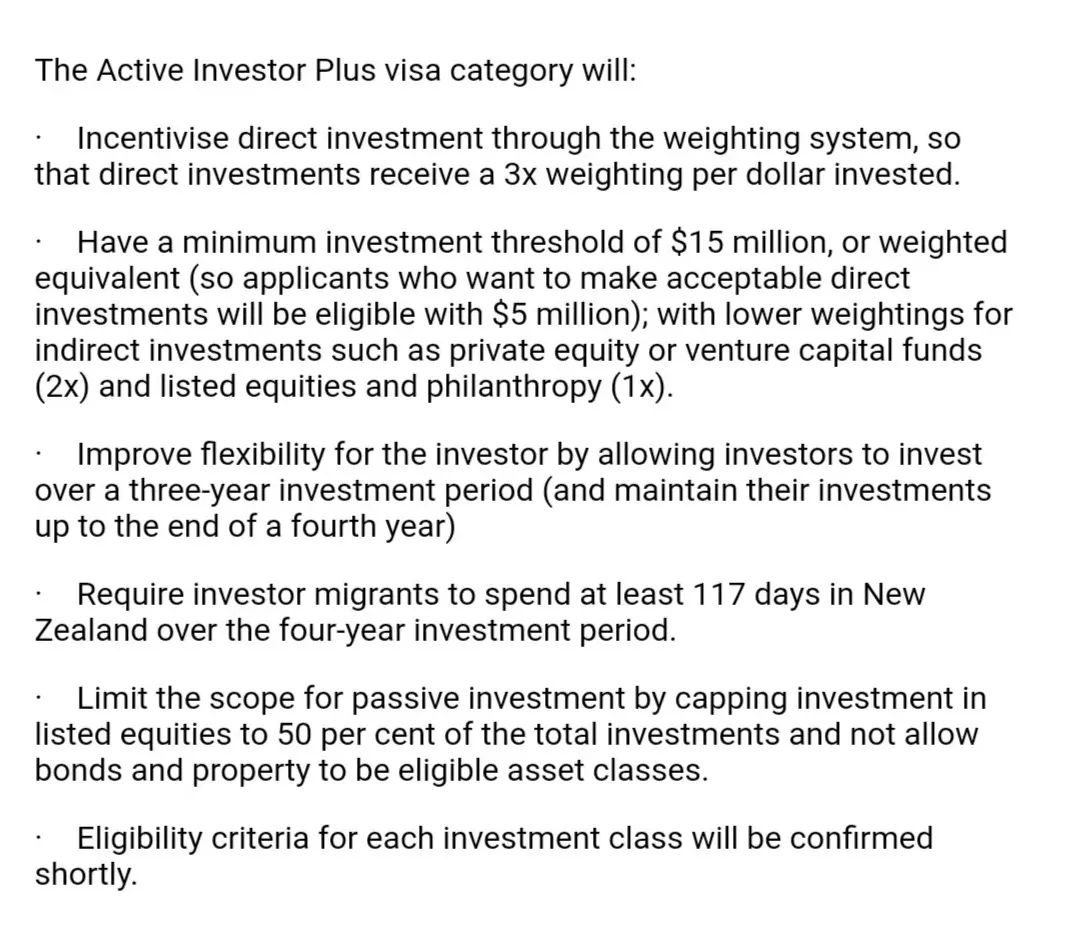
When the new Active Investor Plus programme launches on 19 September, the following changes deserve particular attention:
1
The higher-investment Investor Plus (Investor 1 Category) will be upgraded to Active Investor Plus:
- A higher investment amount: Applicants must provide funds or assets equivalent to at least NZ$15,000,000, up from NZ$10,000,000;
- Changes to how funds may be used: Up to 50% of the total investment may be allocated to passive investment, with the remaining funds required to go into active investment. Previously, no percentage requirement applied;
- Changes to how investment funds are counted: For active investment, NZ$1 can count as NZ$3. No such rule previously existed.
2
The standard Investor (Investor 2 Category) will be abolished.
What do these changes mean for prospective investor migrants? Do they make immigration harder, or offer significant benefits? YIJU New Zealand interviewed senior immigration lawyer Sonny Lam of Queen City Law, who has 15 years of litigation experience and previously worked as an immigration officer at Immigration New Zealand. He shares his views with YIJU readers in the hope of helping you on your immigration journey:
Sonny Lam
Queen City Law law firm Immigration lawyer
Immigration New Zealand Former immigration officer
YIJU: What is the government's aim in changing investor immigration policy?
Sonny Lam:There must be many considerations. My personal guess is that a major reason is New Zealand's current economic weakness: the government needs to attract wealthy migrants to bring capital into the country.
New Zealand's economy is resilient, and our government can improve current economic conditions and living standards. I believe the best tool the government must use is one it has used before—opening up immigration.
Many people will remember the John Key era. Just after the global economic crisis in 2008, New Zealand's property market had fallen into a severe slump. Lawyer friends working for major banks were advising them to apply for mortgagee sales every week. Friends working as property lawyers told me they had no property sales work, perhaps just one transaction a week. Yet within two years, by 2010, things gradually improved again as New Zealand opened up immigration and allowed more applicants to seek residence.
I therefore believe the government's main objective is to revitalise the economy, and the quickest, simplest way is to bring in capital and labour from other countries. New Zealand's economic fortunes are closely linked to construction and property. Hopefully, these investor immigration changes will bring important talent and investment resources.
YIJU: Active Investor Plus Does it make immigration harder, or offer significant benefits?
Sonny Lam:I believe Active Investor Plus offers more benefits to prospective investor migrants than the policy currently in place.
Put simply, the new policy makes two main changes. First, the total investment requirement increases from NZ$10,000,000 to NZ$15,000,000. Given current inflation, I think this increase is reasonable and will have little impact on those who genuinely have the means to invest.
Second, the method of counting investment funds changes. Under the previous policy, applicants had to invest an actual NZ$10,000,000 in New Zealand bonds, operating businesses or similar investments. Under the new policy, if funds are allocated to active investment, such as operating businesses, every NZ$1 invested counts as NZ$3. In other words, if all the funds go into active investment, only NZ$5,000,000 needs to be invested.
Even if investors do not want to put everything into active investment, the government allows up to 50% of funds to go into passive investment. Investors can allocate their funds sensibly to reduce risk while tying up as little capital as possible.
YIJU: What should applicants be aware of?
Sonny Lam:For prospective applicants, having money—in other words, sufficient investment funds—comes first. Second, I recommend finding a good immigration lawyer to assist with the application. Lawyers are professionally trained, experienced practitioners whose advice on a case takes the full picture into account. Applications submitted through lawyers are often well supported and clearly organised, making them more likely to receive Immigration New Zealand approval, and more quickly. This saves clients valuable time and money and can prevent unnecessary losses.
YIJU: What advantages does New Zealand offer investor migrants compared with other countries?
Sonny Lam:New Zealand's financial requirements for investor migrants do not differ greatly from those of other countries. However, New Zealand has a clear advantage: permanent rights of return. A Permanent Resident Visa is issued after the investment period, with no further requirement to spend a minimum period living in the country.
There has previously been a proposal to abolish these permanent rights of return. Following an inquiry into the long-term immigration landscape, the New Zealand Productivity Commission released its final report on creating an immigration system fit for the future. It recommended abolishing Permanent Resident Visas and requiring new migrants to renew their resident visas every six years.
However, I believe these are simply proposals put forward by the commission. Permanent Resident Visas are unlikely to be abolished within the next 10 years, so they remain a major advantage.
YIJU: What are the advantages of investing in New Zealand?
Sonny Lam:New Zealand is recognised worldwide as a place where doing business is easy and investment risk is low. It offers a safe, stable environment, accessible financing and a strong banking sector. Business operating costs are low, and the tax system is strict but simple. Its workforce is internationally minded and innovative. New Zealand has world-class infrastructure, with highly developed transport, logistics and communications sectors. It also has free trade agreements with many countries and regions, favourable competition regulation, exemptions from almost all import tariffs and government subsidies... Together, these advantages mean investing in New Zealand can deliver better, more stable returns than in other countries and regions around the world.