

With the OCR and fixed mortgage rates continuing to rise, recent articles on YIJU's official WeChat account have featured interviews with financial professionals to help borrowers find effective ways to manage and reduce high interest costs. A reader recently asked us: as fixed mortgage rates rise and required repayments increase, should borrowers increase their repayments as much as possible before their fixed-rate agreements roll over to higher rates, to reduce excessive mortgage interest costs?
{ad}

Edge Mortgage director Glen McLeod
Image source: internet
Glen McLeod, a director at Edge Mortgage, offered his view: there is no secret to saving mortgage interest. The reality is that making as many extra repayments as possible is the way to save more interest. Like any business, banks want to collect as much interest as possible to increase revenue.
Let us start with interest rates. If you believe rates are rising, your mortgage broker is highly likely to recommend fixing for a longer term when you need to choose a rate. If you expect rates to keep falling over the period ahead, a one-year rate may be the best option. More importantly, McLeod says, borrowers need to discuss the issue carefully with a professional mortgage adviser to ensure they do not end up unable to afford high interest costs. Borrowers with very large loans can consider early repayments or lump-sum payments to clear their mortgages faster.
For example, a borrower currently has a NZ$500,000 mortgage over 30 years, fixed for three years at 5.39% p.a. Current three-year rates have already reached at least 5.99% p.a. Their monthly interest payment is therefore $2804.53. If we increase their monthly repayment budget to $3000, the extra $195.47 each month, maintained throughout the loan term, would shorten the mortgage by as much as 4 years and save a total of $85,353.31 in interest.
In practice, although the mortgage was fixed for three years at 5.39% p.a. when the agreement was signed, rates could reach 6.5% p.a. or higher after six months or a year. On this calculation, considerable interest could be saved. McLeod also recommends maintaining higher mortgage repayments even if interest costs fall, because this will shorten the loan term. Every cent matters when trying to reduce mortgage interest.
McLeod also explained that borrowers with substantial savings sometimes choose offset or revolving credit facilities. For example, someone with a hundred thousand New Zealand dollars in savings and the same amount in borrowing could save interest through an offset account. This means keeping NZ$100,000 in a savings account while incurring no interest on NZ$100,000 of borrowing. Another benefit is that interest earned on savings is taxable, whereas an offset account avoids this.
Many mortgage brokers believe a sensible increase in repayments makes good sense. It prepares borrowers for unwelcome rate rises and builds an extra buffer in advance of unexpected events, such as job loss. However, a senior mortgage adviser at Jiayuan Finance cautions that, because a fixed-rate agreement applies for a set period, both extra regular repayments and early lump-sum repayments may incur break fees. Although banks generally allow limited early repayments under fixed-rate agreements, there are subtle differences between institutions, and commercial banks vary in their generosity. According to figures from the Royal Bank of New Zealand, borrowers made NZ$16,200,000,000 in extra loan repayments over the past year, a substantial amount compared with scheduled repayments of NZ$19,400,000,000 over the same period.
Interest.co.nz recently surveyed several banks to find out how they handle borrowers' requests to make extra repayments. The table below summarises their responses. Generally, most banks encourage and accept extra repayments even under fixed-rate agreements, and some appear to have more flexible terms than others. Things become less straightforward when borrowers want to make a lump-sum payment on a fixed-rate loan, because this may trigger break fees. One way to avoid this is to save the lump sum until the fixed term expires, then make the repayment, avoiding break fees and interest charges. Of course, no bank charges an additional fee if borrowers wait until their current fixed term ends and the loan moves to a floating rate before paying it off in a lump sum.
The table below shows how banks' policies differ on extra repayments and lump-sum payments under fixed-rate mortgage agreements.
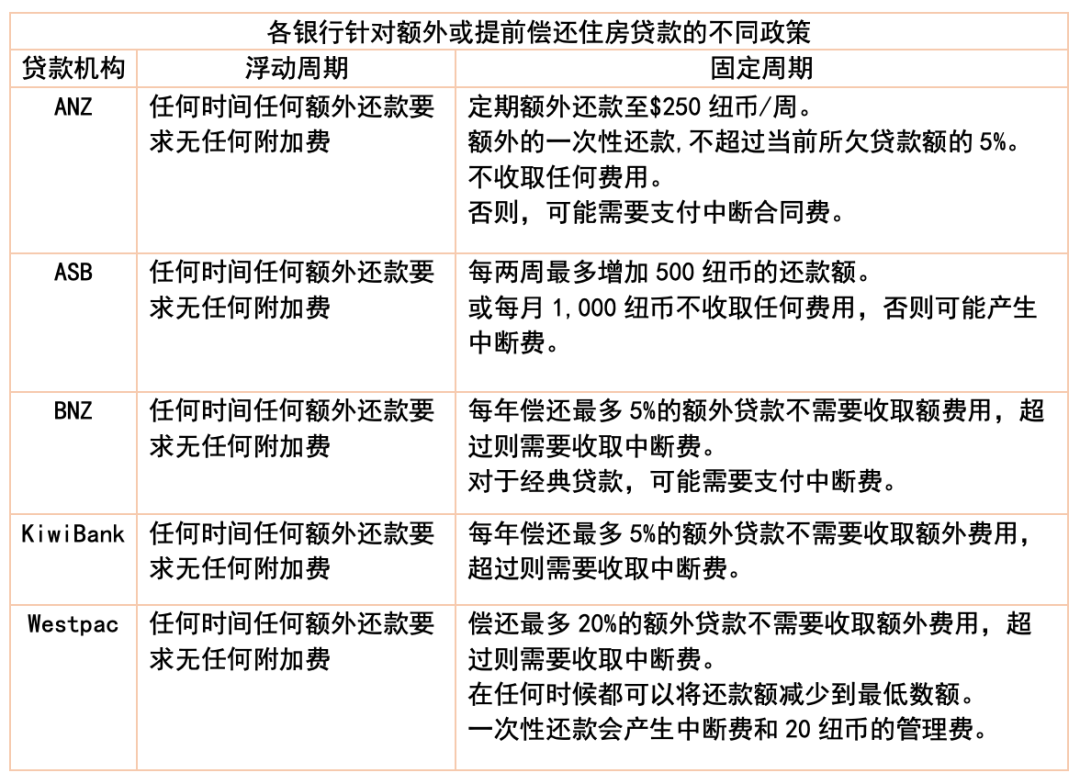
Banks' differing policies on extra or early home loan repayments
(Source: Interest.co.nz)
To explore whether borrowers should increase repayments or make lump-sum payments, YIJU spoke again with an experienced mortgage advisory team with many years of banking experience—Jiayuan Lending—for an in-depth analysis of the market.

Q: Before a fixed-rate agreement rolls over to a higher rate, is it worth increasing repayments or making a lump-sum payment to ease high interest costs? What should borrowers watch out for?
Eddie Wen:We generally assess whether to make a lump-sum repayment according to each client's circumstances. If a client has a stable income and saves a set amount each year, we recommend making partial early repayments within the limits of the loan agreement, or repaying extra principal each payment period to reduce total interest costs. If a client wants to repay a larger amount early to ease interest pressure, we can also consider restructuring the loan to make full use of products such as revolving credit or offset accounts. Of course, clients with substantial cash and no other investment plans can choose to make a lump-sum repayment in the current high-interest environment. They should also be aware that they must cover the bank's loss arising from early repayment. Actual losses differ between banks and over time, so the fees charged to clients also vary. We recommend consulting the bank or a professional mortgage adviser like us beforehand.
David Xie:If a loan applicant has cash coming back into their hands, they can certainly consider reducing their borrowing amount and proportion to a sensible degree during a period of high interest rates, easing repayment pressure. For example, a small portion of the total loan could use banks' offset credit products, such as ANZ's Flexi, Westpac's Choice Everyday, ASB's Orbit and BNZ's Total Money. Before deciding whether to repay a mortgage early, we generally need an in-depth discussion with the client and a medium- to long-term plan based on their finances. Many investors may consider returning to the market after house prices correct, and some believe cash is king when market conditions are poor.
Disclaimer: The comments above are provided for reference only and do not represent YIJU's position.