
From the perspective of traditional Chinese feng shui, nothing that happens in the world arises out of nowhere; everything is governed by unseen forces.
Every country and city has its own distinctive course of fortune as it develops. Changes in its lifeblood and fortune may seem unpredictable and endlessly variable, but they are closely connected to the feng shui of its surroundings. How do feng shui magnetic fields and geographical formations influence a region's development? Hong Kong offers a particularly representative example, worthy of close analysis as a reference for New Zealand's future development:
Hong Kong as a mirror: The influence of environmental magnetic fields
As is widely known, Hong Kong, at the southern end of mainland China, developed from an overlooked fishing village into one of Asia's four major financial centres and a world-renowned free-trade port after experiencing British colonial rule and Japanese occupation. As the world's eighth-largest trading economy, it holds a pivotal position in the global economic system. Its exceptional geographical setting played a crucial role in enabling a small city with a land area of just 1106 square kilometres to develop on such a scale in such a short time.
A complete large-scale geographical configuration, rarely seen anywhere in the world:
Viewed on a broad geographical scale, Hong Kong's water dragon vein comes from the Pearl River, with the South China Sea forming its great bright hall. On the left, Taiwan is the lesser Azure Dragon and the Philippine archipelago is the greater Azure Dragon, long and slender in form. On the right, Hainan is the lesser White Tiger, while Laos, Thailand, Vietnam and Cambodia form the greater White Tiger, short and low-lying. Across the water, Borneo forms the table mountain, rounded and complete. Farther away, Java, the Lesser Sunda Islands and the Indonesian archipelago form the facing mountains, embracing the area like a jade belt.
In feng shui, obtaining water takes precedence. The South China Sea, occupying the great bright hall, is oval, expansive and bright, like an enormous treasure basin. Its waters are also a major international shipping route. Given this unique geographical position, Hong Kong's emergence as an important global free-trade port and financial centre is no accident. The only flaw is a gap in the Azure Dragon position, explaining Hong Kong's history of colonisation and occupation.
A powerful ancestral mountain dragon vein, surrounded by nine branch dragons:
Hong Kong's ancestral dragon, Tai Mo Shan, lies to the northwest and is a branch of the great dragon of western China, the Kunlun Mountains. Regarded as the ancestor of all mountains, the Kunlun range winds and surges eastwards for thousands of li, splitting into countless main and subsidiary branches along the way. One branch passes through Mount Luofu in Guangdong, extends into Wutong Mountain on the mainland China–Hong Kong border, and finally stretches southwest into Hong Kong's New Territories, where it spreads out and gathers its energy to form the majestic Tai Mo Shan.
With this mountain occupying Hong Kong's Black Tortoise position, its economy is destined for remarkable achievements.
During Period Six (1954–1974), the Xuan Kong Great Golden Dragon lay in the northwest, which was also the period's Direct Spirit position. The classical feng shui text Qing Nang Xu states: 'First see whether the Golden Dragon moves; then examine the veins to identify the incoming dragon.' The Great Golden Dragon is intangible qi, the key to determining whether a tangible dragon vein can 'move'. 'A motionless dragon is dead; a moving dragon is alive.' The northwest is where Hong Kong's ancestral mountain dragon vein lies. Looking back over Hong Kong's development, its population grew rapidly from the 50s of the last century, and its economy took off in the 60s. It swiftly became an international financial and trading centre and a major Asian metropolis, earning worldwide attention as the Pearl of the Orient. From the perspective of feng shui fortune, this outcome had long been determined.
Hong Kong is also surrounded by nine branch dragons extending from the Beacon Hill range. The eastern branch passes through Lion Rock and Tate's Cairn, heading straight towards Kowloon Peak; to the southeast, the mountains descend towards Lei Yue Mun and Fat Tong Mun; to the northeast, they extend towards Sai Kung and Ma On Shan, covering Hong Kong. It is said that Kowloon, meaning 'nine dragons', takes its name from these nine branch dragons.
The Pearl River's affectionate embrace brings lasting wealth and prosperity:
Hong Kong's water dragon vein comes from the Pearl River. Its tributaries surge towards the estuary from the northwest. One stream flows slowly into the South China Sea, the bright hall, through outlets guarded by luoxing formations near Hong Kong and Macau. Another flows from west to east through Chek Lap Kok and Kap Shui Mun into Victoria Harbour, then through the water-retaining outlet at Kwun Tong into Lei Yue Mun. Finally, the small, turtle-shaped island of Tung Lung Chau checks its flow, allowing it to enter the sea slowly.
Water favours an embracing formation, and obtaining water brings wealth. Hong Kong has not only a convergence of rivers and sea, but also great bodies of water winding around it, with luoxing formations guarding several outlets to create a configuration that gathers water. This is why Hong Kong can follow a path of soaring development, with wealth everywhere.
In recent years, Hong Kong's economic development has gradually slowed and tensions have risen. These changes are closely related to its feng shui configuration, geographical formations and shifts in the fortune of key government locations. However, its decline offers insufficient value as a reference for New Zealand's development, so it will not be discussed further here.
New Zealand's future development through the lens of feng shui geography
New Zealand is an island nation in the Southern Hemisphere, surrounded by sea in the southwestern Pacific. It comprises the North and South Islands and numerous smaller islands. Mountains account for more than half its total area, with much of the remaining land consisting of hills and a small amount of plains.
New Zealand's dragon vein originates in the Southern Trunk Dragon, a branch of the Kunlun Mountains. One of China's three great trunk dragon veins, it begins with the Xun Dragon and winds through Guangxi and Guangdong before entering the sea at Fujian and lifting its head in Taiwan. It then crosses straits, changes form, gathers qi and spreads out, passing through Thailand, Vietnam, the Philippines, Indonesia and Australia. Finally, it enters New Zealand in the northeast around Te Araroa, extending a great distance through the central North Island.
Mount Ruapehu, the highest peak in the central North Island, is New Zealand's ancestral mountain. Its vein winds southwards, enters the sea near Wainuiomata at the southern end of the North Island, crosses the strait, and forms a major vein running the length of the western South Island. Xuan Kong Period Nine (2024–2043) activates the qi of the Southern Trunk Dragon. New Zealand is therefore certain to experience substantial national economic development after entering 2024.
New Zealand's incoming mountain dragon lies in the northeastern Gen position, while the sea embraces it in the western Dui position. Mountain and lake connect, and yin and yang unite, forming a configuration of wealth and prosperity. The Nine Purple Li Fire is the prevailing qi of Period Nine, while New Zealand's ancestral dragon is itself a tall, majestic active volcano. This foretells comprehensive improvement and development during Period Nine in New Zealand's fire-associated sectors, including education, technology, energy and healthcare. Nine Purple also represents the middle daughter. As a country representative of women's rights, New Zealand will see more outstanding women emerge across all sectors in the future.
In the major-cycle flying stars of Xuan Kong Period Nine, the Eight White Left Assistant Star flies into the southeast. Associated with the Gen trigram and the earth element, the Eight White Star represents land and property and flourishes when nourished by fire. New Zealand lies in the southeastern part of the world map. Although the Eight White Star's qi is declining during Period Nine, the entire country is covered by the Southern Trunk Dragon's qi, and fire generates earth. Property, land development, infrastructure and agriculture will therefore remain buoyant as the country grows wealthier and its population increases.
Development prospects for New Zealand's main cities
The largest city — Auckland:
Auckland, a coastal city in northern New Zealand, is the country's largest city and its economic, cultural, shipping and tourism centre. It also has New Zealand's largest port.
Auckland has distinctive terrain, with mountainous land extending from the northwest to the southwest. Taking central Auckland as the reference point, it is surrounded by sea on three sides and embraced by winding waters. Several tributaries converge simultaneously in the northwest, forming an oval inner harbour at the Te Atatu Peninsula. The water then passes through the guarded outlets at Westhaven and Davenport, before the round island of Rangitoto Island checks its flow, allowing it to enter the sea slowly. Looking at the southern waterways, several tributaries converge from the northeast, southeast and southwest, then flow into the sea through two guarded outlets in the southwest.
During Period Nine, the Direct Spirit occupies Li in the south, and the Indirect Spirit occupies Kan in the north. The preferred geographical configuration is therefore water to the north and mountains to the south. Auckland has numerous small hills to its north and an inner harbour to its south. This foretells a further step forward in Auckland's development during Period Nine, with large numbers of immigrants arriving and the city serving as an important hub for attracting overseas resources and capital to New Zealand.
The capital — Wellington:
Government decisions determine a nation's lifeblood. Assessing a country's development is therefore closely tied to the area where its government is based. New Zealand's government was previously in Auckland before moving to Wellington, at the southern end of the North Island, in 1865.
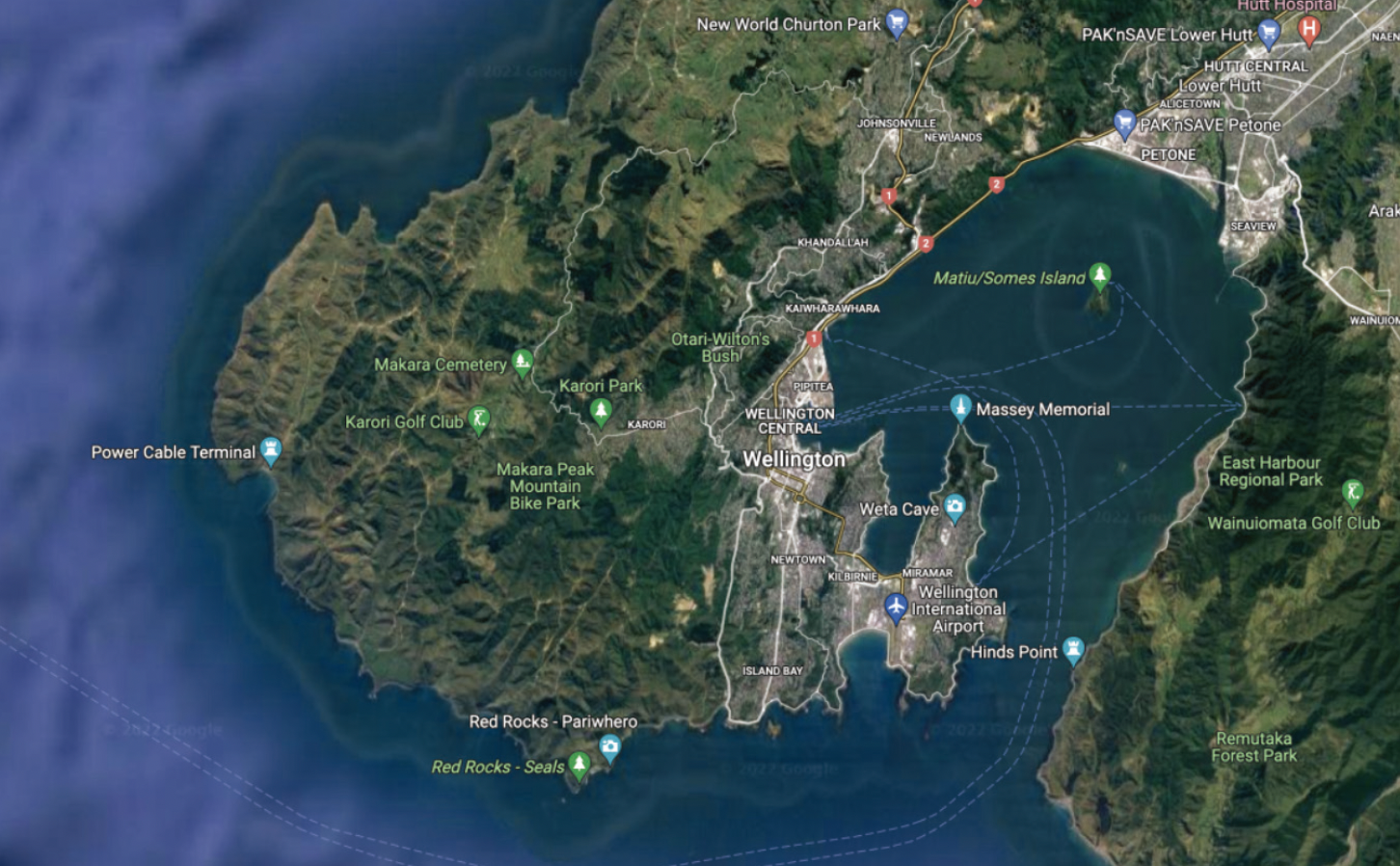
Wellington sits in a hollow-and-pincer formation in the North Island's mountain ranges. Taking the city centre as the reference point, Makara Peak occupies the Black Tortoise position, the Pipitea Area occupies the Azure Dragon position, and Roseneath occupies the White Tiger position. Peaks in the White Tiger position extend outwards like pointed horns, while the Azure Dragon position is low and short. A strong tiger and weak dragon can readily lead to disputes, and governing parties are often led by women. The bright hall contains deep, rounded tidal waters of the inner harbour. The incoming dragon flows from the Hutt Valley in the northeast, then out through the guarded outlet between Point Dorset and Hinds Point in the southeast. Water represents wealth, so this bright hall configuration gives Wellington a fairly optimistic long-term outlook, with its economic development remaining among New Zealand's leaders. Although Makaro Island, the table mountain, is small, extensive ranges of facing mountains bow towards it in the distance. This foretells resistance to the New Zealand government's future administration, intense competition within political parties, and persistent disputes. On the international stage, however, New Zealand will attract considerable attention, with signs of a move that will bring it into the spotlight.
A country's founding date can also be used to assess its national fortune and reveal the course of its lifeblood; this is an esoteric technique. The feng shui orientation and external surroundings of its government buildings are also crucial. New Zealand's government is based in Wellington's central Pipitea area, at the incoming water point of the city's geographical configuration. Tinakori Hill provides support in the rear Black Tortoise position, while the bright hall faces the harbour area of Pipitae Marea. The shortcomings are a motorway cutting through the dragon vein's qi in the supporting hills and railway tracks in the bright hall. These flaws in the external configuration lead to intense competition among political parties and make prolonged rule by a single party difficult. Combined with the beehive architectural design, they also produce considerable turnover within parties. In addition, the reverse-bow water formation created by Molesworth Street and Bowen Street, where the government buildings stand, can further contribute to internal party disputes. It must be emphasised that the external environment is only one reference point. A more detailed feng shui assessment requires a comprehensive, careful analysis of the building's orientation, internal layout, and years of construction and renovation.
The South Island's largest city — Christchurch:
Christchurch, in New Zealand's South Island, is the country's third-largest city and the largest in the South Island.
The terrain of New Zealand's South Island is predominantly mountainous, with the Southern Alps running its length. Their highest peak, Mount Cook, is recognised as New Zealand's highest mountain. As the saying goes, mountains govern people and water governs wealth, so obtaining water takes precedence when assessing the South Island.
Christchurch lies on the South Island's east coast. Its urban terrain is flat, making it one of the island's few cities on flat land. The city sits with its back to the south, facing north, supported by the Mt Pleasant and Mt Cavendish ranges. In its bright hall, the Waimakariri River winds eastwards from the northwest. However, both the river and the supporting hills form a reverse bow. As is widely known, reverse-bow sha is one of feng shui's ten major harmful landforms. A reverse bow in the Black Tortoise position, which governs people, is particularly harmful to human life. Christchurch is therefore prone to incidents involving deaths and injuries: the magnitude 6.3 earthquake in 2011, the Xinmao year; the mosque shootings in 2019, the Gengzi year; and the sudden fatal incidents in 2021 all demonstrate the influence of environmental formations on a region.
Although Christchurch's broader geographical setting is less than perfect, its valuable feature is a pair of inner jade-belt rivers encircling the city: the Avon River and the Heathcote River, Arranged one above the other, they form a shape resembling the Chinese character xuan, like a distinctive protective shield guarding this special 'City of God'. There are therefore particular reasons why Christchurch, New Zealand's third-largest city, has three national universities and has become an important area for the country's agricultural production.
Feng shui is an ancient Chinese art of assessing land, embodying the wisdom of Chinese culture. Every blade of grass, tree, mountain and body of water between heaven and earth contains an energy field, combining the tangible and intangible and revealing the patterns of change in all things. The mysteries of feng shui deserve thoughtful appreciation. Like life itself, they are ever-changing and full of wonder!