
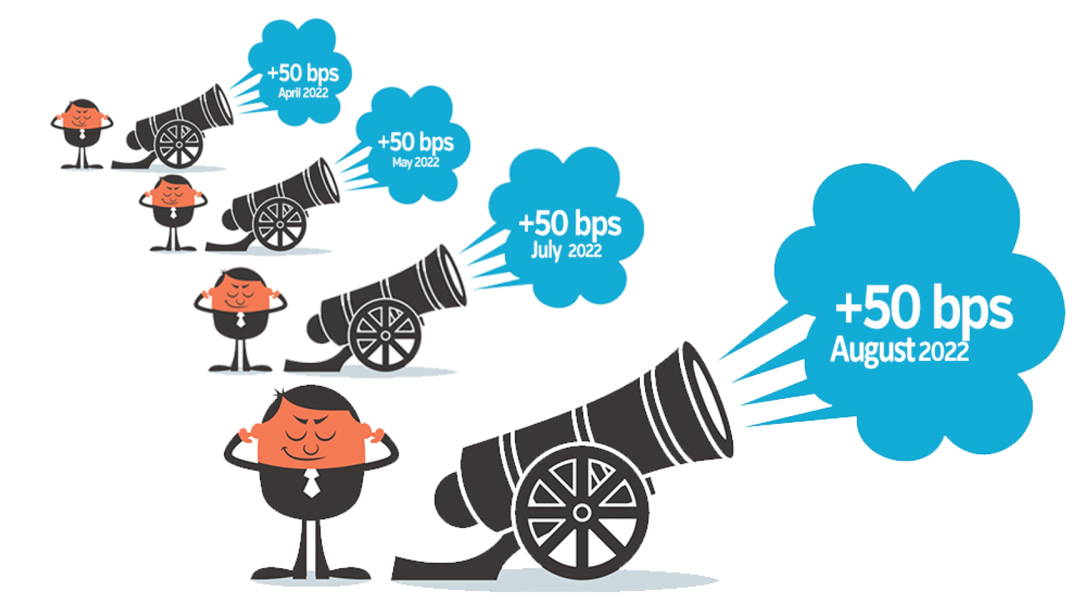
A week ago, on 17 August, the Reserve Bank of New Zealand (RBNZ) raised the Official Cash Rate (OCR) by 50 basis points to 3.0%, as expected. This was its seventh consecutive substantial rate increase, signalling a more determined monetary tightening strategy to tackle persistently high inflation. Notably, the OCR of 3.0% was the highest since September 2015. In its statement, the RBNZ warned that further front-loaded increases remained possible. This aggressive stance also pushed swap rates higher. The Bank revised its forecast for the OCR early next year, now expecting a peak of 4.0%, compared with its previous forecast of 3.7%.
Kiwibank was the first to respond to the sharp OCR increase on the 17, raising its floating rate from 6.0% to 6.5%. ANZ then announced a 50-basis-point increase in its floating rate, taking its floating mortgage rate and construction loan rate to 6.84% and 4.08% respectively. ASB was the next commercial bank to raise its floating rate, matching Kiwibank and ANZ with an increase of 50 basis points to 6.85%. BNZ also raised its floating mortgage rate, although by only 40 basis points, to 6.79%.
Although more than a week has passed since the latest OCR increase, most commercial banks have left their fixed mortgage rates unchanged, raising only floating rates. In wholesale markets, the broad rise in global interest rates has also been reflected in local swap rates. At the end of last week, the two-year swap rate reached 4%, returning to its level on day 26 of month 7. With upward pressure coming from both the Reserve Bank and international interest rate markets, many finance professionals say fixed mortgage rates are still far from their peak and could rise substantially. Analysts note that a year ago, the Reserve Bank's OCR was at a record low of 0.25%. It is now 3.0% and highly likely to reach 4% by year-end, which they argue will push fixed mortgage rates higher. On that basis, an OCR increase to 4% would mean a two-year fixed mortgage rate of around 6.4%.
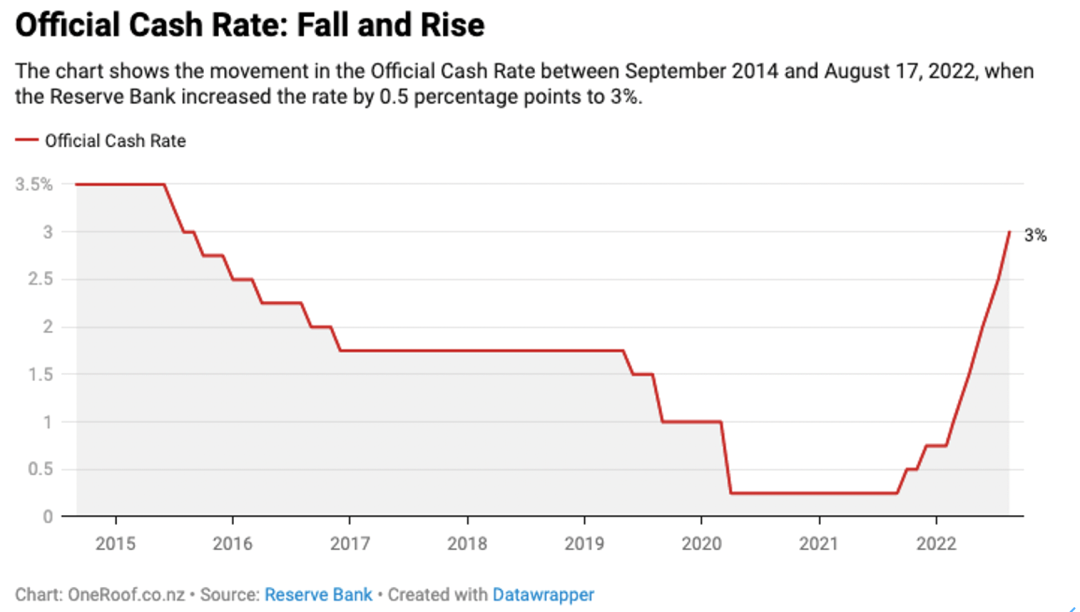
2015–2022: chart of changes in the Reserve Bank of New Zealand's OCR
Independent New Zealand economist Tony Alexander takes a very different view of this speculation. He believes that although the OCR will keep rising, the two-year fixed mortgage rate already peaked at 5.69% in mid-June. So why would fixed mortgage rates fall while monetary policy is tightening? Why would further OCR increases fail to produce higher fixed mortgage rates?
Alexander offers an illustration. Investors lending money to banks at a fixed rate for two years can instead consider short-term investments closely linked to the Reserve Bank's cash rate. Before deciding, they forecast the OCR's path over those two years. A few months ago, investors making that choice were deeply concerned about surging inflation and the central bank's apparent lack of resolve to curb it, following its excessively loose monetary policy last year. This led investors to expect the Bank to raise the OCR to at least 4.7%, and to believe CPI inflation would remain above a satisfactory level for a long time. They therefore demanded a high return to lend at a fixed rate for two years.
{ad}
Since then, however, three things have fundamentally changed. First, the Reserve Bank has raised the OCR rapidly and shown a strong determination to bring inflation down. This has created widespread confidence that it will succeed, and that monetary tightening will not continue into the second half of 2023.

Second, a wealth of economic data from around the world shows that conditions in the UK, Europe, the US and China are weakening rapidly. Slower growth and recession will drive a sustained decline in inflation, meaning the central bank will cut the OCR earlier than previously expected.
Third, some key drivers of inflation are already weakening. International freight costs are falling, as are prices for everything from oil to food and commodities.
Investors now believe the OCR will ultimately fall short of 4.7%, and that any further increase will take it no higher than 4%. They also generally believe the Reserve Bank is likely to start cutting rates before the end of 2023 to support the economy. As a result, investors are quite willing to accept lower returns on fixed-rate lending to banks for two years, as well as three, four or more years, because they expect the OCR to be lower than it is now.
Furthermore, even an OCR increase to 4% can already be fully reflected in current fixed mortgage pricing. Alexander predicts that even if the OCR is pushed higher over the next three months, fixed mortgage rates will not rise as a result. One-year rates, which are currently relatively low, still have some room to rise, while floating rates will continue increasing. He also notes that existing mortgage holders are bearing the strain of high interest rates. As their previous fixed terms expire, they are moving onto much higher rates. Tens of thousands of New Zealanders with mortgages are already feeling the effect of higher fixed rates on their lives. The good news, however, is that anyone considering entering the housing market in 2023 may find conditions very different, particularly first-home buyers returning to the market.

In the latest Inner Kiwi publication, Kiwibank senior economist Jeremy Couchman says the current “huge gap” between housing supply and demand suggests New Zealand's longstanding housing shortage will disappear within the next 12 months. The bank has also revised its house price forecast downwards. It now expects prices to fall 13% by the end of this year, a decline 3 percentage points greater than its previous forecast of 10%.
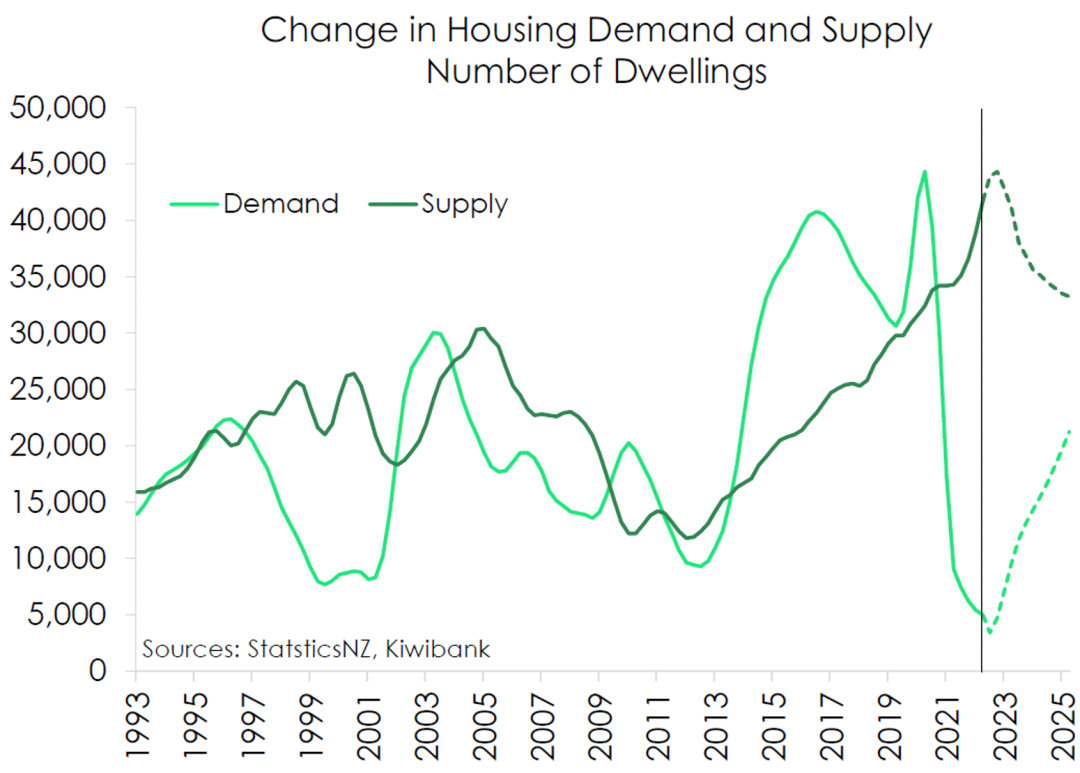
Kiwibank Chart of forecast housing supply and demand in New Zealand
Couchman says housing supply and demand are set for a “360-degree turnaround”. He has lowered his estimate of New Zealand's housing shortage to 23,000 homes. Although the shortfall remains substantial, this is a considerable improvement on last year's estimate of 57,000 homes, and it could be eliminated entirely within the next twelve months.
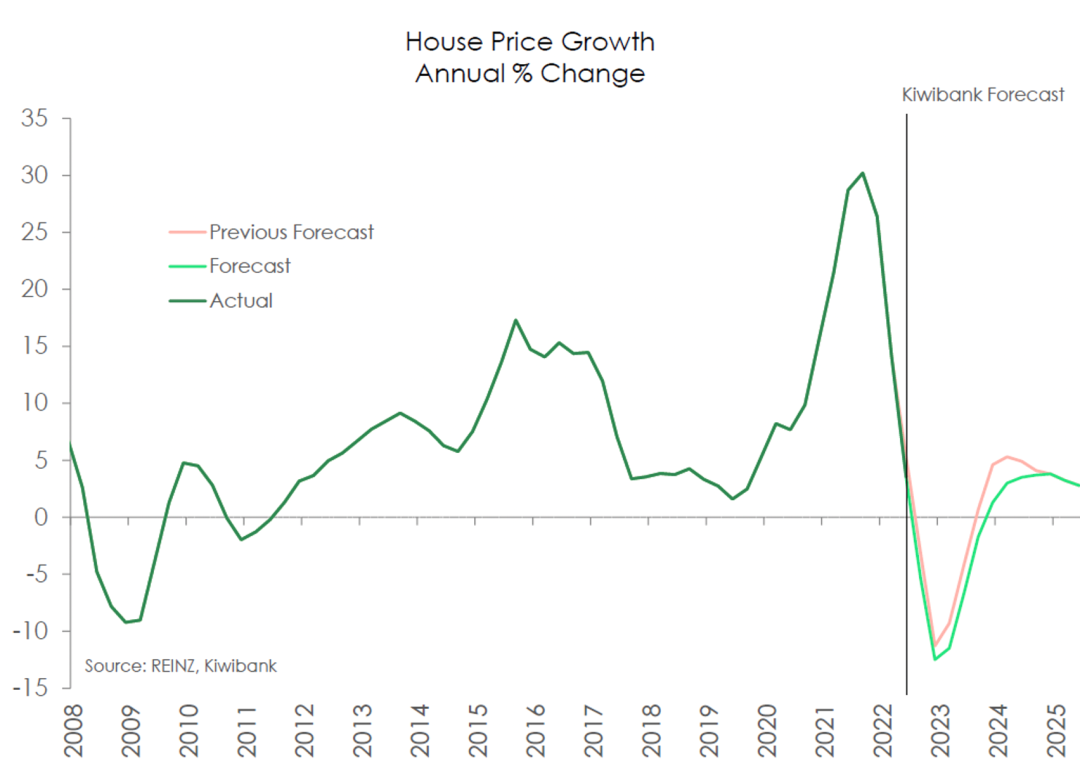
Kiwibank Chart of forecast house price trends
He predicts that a possible future housing surplus could put considerable pressure on New Zealand's property market and slow the recovery in house prices. The concern now is that the housing downturn and lack of prospective buyers could prompt some developers to further delay or even cancel planned construction projects.
Disclaimer: The views above are for reference only and do not represent YIJU's position.