

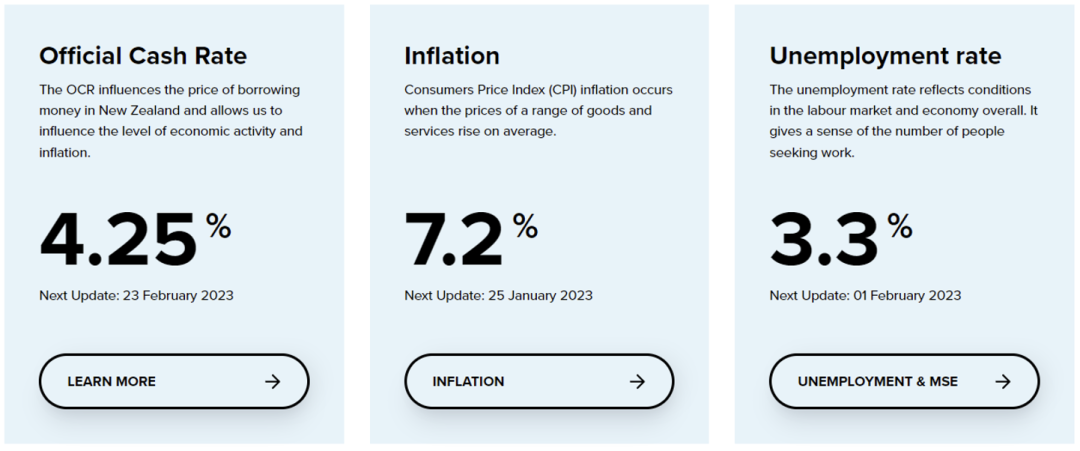
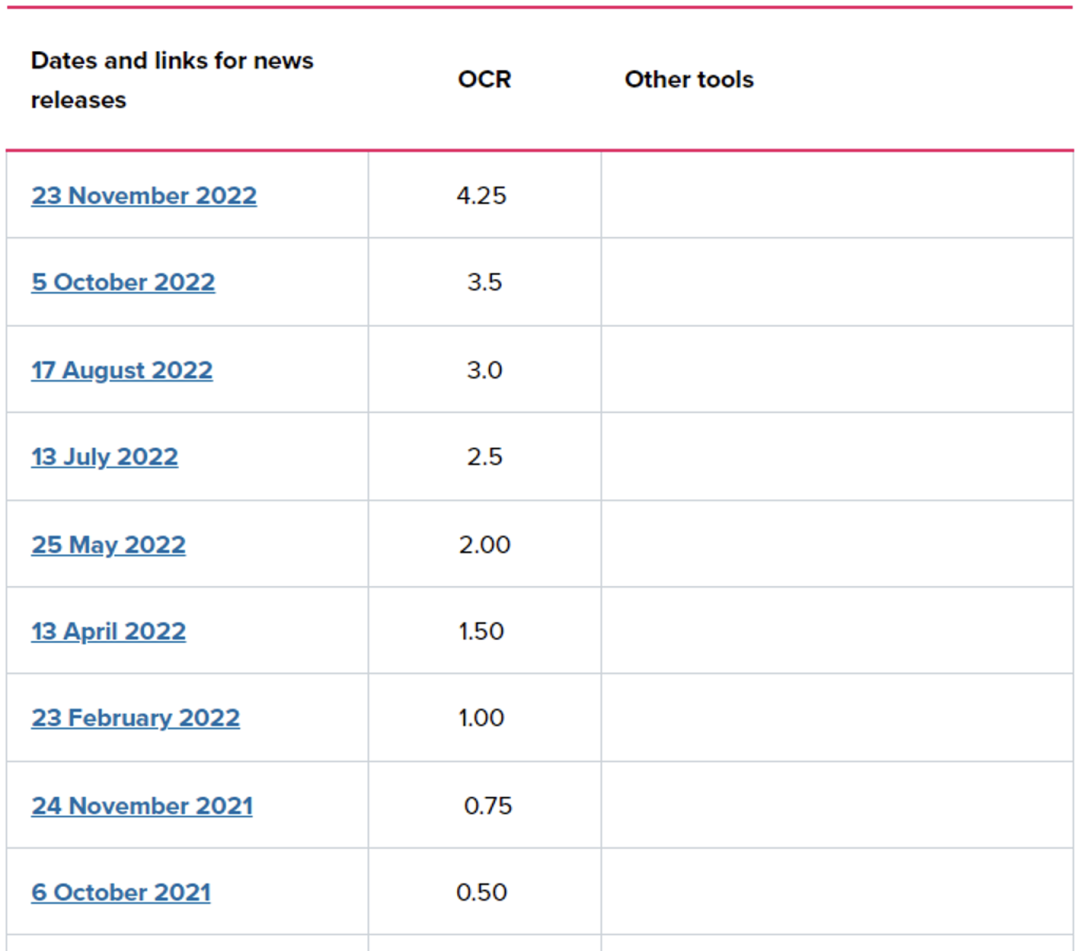
On 23 November at 2h in the afternoon, the Reserve Bank of New Zealand released its final Monetary Policy Statement of the year, raising the OCR by 75 basis points to 4.25%. This was the largest OCR increase on record and took it to its highest level since the 2008 financial crisis.
{ad}
Behind the sharp OCR increase is inflation at a level New Zealand has not seen in thirty years. The Reserve Bank’s remit is to keep New Zealand’s average inflation rate between 1% and 3% over the medium term, but the latest rate is as high as 7.2%.
Supply chain problems, geopolitical tensions, demand held back by lockdowns and labour shortages have together laid the groundwork for rising prices.
What happens next? What should home buyers and borrowers do?
OCR— have the increases peaked?
The Reserve Bank forecasts that the OCR will reach 5.5% next year before beginning to fall from the middle of next year. This is well above market expectations and represents a substantial increase from the 4.1% peak the bank forecast in August.
So how high will the OCR ultimately peak?
Westpac chief economist Michael Gordon said: “The Reserve Bank believes inflation is deeply embedded in the New Zealand economy. It now believes a recession will be needed over the coming years to bring inflation back within the 1–3% target range.”
Westpac forecasts that the OCR will peak at 5% early next year.
ANZ economists have raised their forecast OCR peak to 5.75%.
ANZ chief economist Sharon Zollner said: “A 140-basis-point increase in the forecast OCR peak is enormous, but so too have been the upside surprises in inflation, inflation expectations and the wage outlook over recent months.”
CoreLogic economist Kelvin Davidson said the OCR could rise by another 0.75% on 22 February next year, with further increases to follow.
Infometrics expects the OCR to peak at 5.75%, but believes it may need to reach 6%.
“An OCR of 6% could translate into a one-year interest rate of about 7.6%. Borrowers may be frightened by seemingly endless rate increases and opt for longer-term fixed rates. There are two reasons for this: they offer certainty and protection against further rate rises, and at the peak of the cycle, longer-term fixed rates can often be lower than one-year or two-year rates.”
OCR surges: how much will fixed rates rise?
CoreLogic says New Zealand may now be in the “second phase” of the property market downturn.
CoreLogic economist Kelvin Davidson said fixed mortgage rates might not change much immediately.
“However, floating rates will undoubtedly rise again in the short term. With the OCR continuing to increase, fixed rates are also unlikely to have peaked.”
He said borrowers would face more pain. Fixed mortgage rates were likely to rise to 7% or higher over the coming months, putting further pressure on household budgets and mortgage repayments.
Two years ago, mortgage rates at the major banks were around 2%; now, that figure could reach 7%. If you have a NZ$1,000,000 mortgage, your repayments over the coming year could be NZ$35,000 higher than they were two years ago.
Infometrics chief forecaster Gareth Kiernan said he expected the OCR to rise to 5.5%, with one-year interest rates reaching around 7.2% and two-year rates slightly lower.
Currently, 20% of New Zealand home loans are on fixed terms that will expire within the next six months.
CoreLogic economist Kelvin Davidson said labour market performance would be a key factor shaping developments over the coming months.
“If unemployment can remain relatively low, most borrowers will continue to repay their loans, even with higher mortgage rates and more widespread negative equity. This should help limit the risk of an increase in bad debts and a potential vicious cycle.”
Will house prices fall 20%? Economists are divided
CoreLogic economist Kelvin Davidson expects the Reserve Bank could raise rates by a further 75 basis points next year, potentially pushing fixed mortgage rates above 7%. He expects house prices to fall further, ultimately ending up around 20% below last year’s peak.
He also forecasts that weak property sales volumes could persist into 2023.
But not all economists share this view. Independent economist Tony Alexander maintains that we are in the final stage of the house price downturn.
He wrote that house prices would fall further, but the pace of decline had slowed in recent months. Despite additional pessimism, the decline could remain relatively slow for several reasons.
“Construction costs continue to rise, net migration inflows are exceeding expectations, job security remains strong, and additional rate rises will make it harder for the incumbent government to be re-elected.”
“Indeed, with the Reserve Bank forecasting a recession beginning in mid-2023, the likelihood of a change of government has increased. This means that as 2023 arrives, more investors may begin exploring the property market in anticipation of interest deductibility being restored.”
“Clearly, a great many highly uncertain factors are at play here, even without mentioning the equally uncertain international economic and political outlook. But for those with spare cash flow to cope with slightly higher interest rates, the property sector is increasingly moving in their favour.”
So what will the OCR increase mean for borrowers and home buyers? YIJU New Zealand interviewed an experienced Barfoot & Thompson real estate agent and senior mortgage advisers from New Zealand’s Huarong Finance team to hear their views.

Kai Deng
Barfoot & Thompson Miford branch
Real estate agent
YIJU: Looking at the market as a whole, is now a good time for owner-occupiers to buy?
Kai Deng:This week’s further sharp OCR increase could push mortgage rates higher and give buyers more room to negotiate with vendors. In this market, buyers who find a home they love can consider purchasing it. However, past experience suggests that owners of quality homes may also be reluctant to sell, making it harder for buyers to find a suitable property.
YIJU: House prices are falling and more properties are available, but mortgage pressures are also making some potential buyers hesitate. What advice do you have for buyers?
Kai Deng:From what I have observed, although more properties are available, quality homes for owner-occupiers in desirable school zones and neighbourhoods remain scarce. With mortgage rates expected to rise further in 2023, buyers need to plan ahead based on changes in their borrowing limits and what they can afford.

Frank Fu
Senior mortgage manager, Huarong Finance
YIJU: OCR is rising again. How will this affect home buyers’ ability to borrow and repay their loans?
Frank Fu:The most direct effects of an OCR increase are higher mortgage rates and potentially higher test rates. For home buyers, this means banks approving smaller loans and higher regular repayments. However, we do not believe banks will further adjust their test rates or standard living cost calculations.
People need to understand that banks are also adjusting their lending calculations in other ways, because commercial banks need business too. Recently, banks have refined how they calculate borrowers’ actual expenses and other income, for example by increasing the amount of boarder income they recognise.

Chanpman Leung
Senior mortgage manager, Huarong Finance
Tim Liu
Senior mortgage manager, Huarong Finance
YIJU: Which borrowers will be hit hardest? What advice do you have for easing repayment pressure?
Chanpman Leung:The two biggest factors in borrowing have always been income and expenses. If income falls and expenses rise, borrowers face enormous pressure. Expenses of course include bank repayments, which are directly affected by rising interest rates.
The hardest hit are borrowers with large loans. A year or two ago, when interest rates were low, they borrowed the maximum amount they could just afford. But with rates rising sharply this year, their earlier budgets have proved inadequate. Another group is people in industries where inflation has reduced their income, such as retail. Their businesses may be quieter than before and their incomes lower, while higher repayments place them under enormous pressure.
There are several ways to ease the pressure. First, increase income by finding other ways to boost household earnings — for example, moving from part-time to full-time work. Second, reduce spending. Third, reduce borrowing directly. Some borrowers may own more than one property and could sell one to reduce their debt and ease repayment pressure.
Tim Liu:Compared with clients who have owned property for some time, those who bought in the past two years are likely to feel greater pressure. The main reason is that New Zealand mortgage rates remained at historic lows during those two years because of the COVID pandemic. When rates multiply, clients who have only experienced low rates feel a corresponding increase in pressure.
To ease pressure in the current high-interest environment, I first suggest clients consider restructuring their loans to suit their circumstances. For example, when their current fixed term expires, they could use revolving credit for part of the loan, depending on their cash savings or additional income. This would reduce the amount being refixed and therefore the regular repayments. They could then put savings or spare cash into the revolving credit account to offset interest on the restructured portion and ease repayment pressure, while retaining access to their original borrowing limit for emergencies.
For clients without much spare cash, the most effective approach may be to tighten their belts, reduce spending and lower living costs to get through the repayment pressure during this period of high interest rates. Based on the Reserve Bank’s current forecast, rates will return to a relatively normal level in 2024, so everyone should prepare for a tough battle lasting a year to a year and a half.