

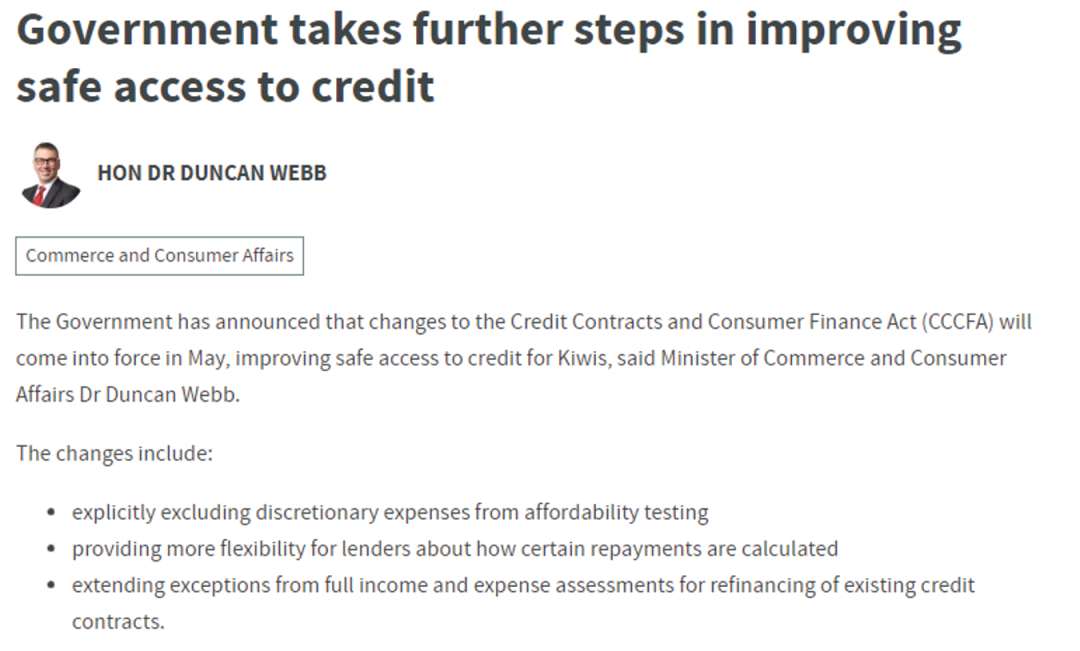
New Zealand's commerce and consumer affairs authorities recently announced that the Government will again make major changes to the Credit Contracts and Consumer Finance Act (CCCFA). The new rules take effect on 4 May 2023. The latest changes include:
- Explicitly excluding discretionary expenses from affordability assessments;
- Giving lenders more flexibility in how they calculate loan repayments;
- Expanding the exceptions that allow existing credit contracts to be refinanced without a full income and expenditure assessment.
Why is the Government making major changes to the CCCFA again?
Since the Government tightened lending rules in December 2021, the legislation has faced persistent criticism and become a thorn in the side of countless loan applicants. Although it targets applicants unable to withstand financial pressure, it also disadvantages other mortgage borrowers, who must provide more evidence of their financial capacity in an effort to pass banks' stringent stress tests.
Many borrowers complain that overly strict regulations have made banks unwilling to offer them mortgages because of supposedly excessive spending habits. That spending might amount to buying a Christmas present or a Lotto ticket, or even just an extra coffee.

Minister of Commerce and Consumer Affairs Dr Duncan Webb
Minister of Commerce and Consumer Affairs Dr Duncan Webb said the new rules taking effect in May amend the existing CCCFA regulations to help ensure borrowers can repay loans without hardship, improving New Zealanders' access to safe credit.
Responses to the regulatory changes
{ad}
Asked to respond to the amendments, New Zealand Law Society chief executive Roger Beaumont said: These changes still mean that all loan applications require an affordability assessment. At the same time, they mean banks no longer have the independent decision-making authority and flexibility to help customers who need credit obtain loans, for example after a natural disaster or a change in personal financial circumstances.
He stressed that this issue had been demonstrated by the recent North Island floods and the devastating consequences of Cyclone Gabrielle. Beaumont noted that the Government had made two amendments to the CCCFA regulations through Orders in Council. The first provided a temporary exemption from affordability assessments, valid until 31 March 2023, for people affected by the North Island floods, allowing home loan overdrafts of up to NZ$10,000. The second expanded the geographical area covered and included the effects of Cyclone Gabrielle within the temporary exemption. Beaumont stressed that the Government had needed two separate regulatory amendments to allow banks to offer flexible lending, including low-interest or interest-free loans, to affected customers.
Will it become easier to obtain a home loan from next month?
YIJU promptly contacted several senior mortgage advisers at Jiayuan Finance for their exclusive analysis:
Q: The latest CCCFA rule changes take effect on 4 May. What impact do you think they will have on the lending market?
Jiayuan Finance: We believe the amended CCCFA regulations will have little impact on the current mortgage market. The Reserve Bank of New Zealand is continuing to raise the Official Cash Rate (OCR), pushing mortgage and other interest rates ever higher. Banks' test rates will also continue to rise. Remarkably, current test rates are already close to breaking through 9%. This means that applicants needing to borrow nearly a million New Zealand dollars to buy a property face very high annual interest costs. Under such pressure, people struggle to obtain loans, making properties on the market difficult to sell. This is the most critical issue currently affecting the property and mortgage markets.
Q: Will borrowers soon find it easier to obtain a loan?
Jiayuan Finance: We believe this policy adjustment merely pulls back from an earlier overcorrection. Unfortunately, the amendments only ease lending conditions somewhat; they are far from a major relaxation. Compared with the market before the CCCFA was introduced, successful bank loan applications have fallen substantially. Furthermore, while the CCCFA changes are seen as an easing of policy, their practical effect will depend on how lenders implement them. Lenders may raise their lending thresholds in response to actual market risks. In other words, easing policy does not necessarily mean an easing of overall lending conditions in practice. These changes also address only lenders' assessments of ordinary applicants' day-to-day living expenses, so even with relaxed rules, their contribution to improving the overall lending environment will be very limited.
A rapid housing market recovery requires investors to participate in property transactions. In reality, however, investors have left in large numbers under the combined pressures of healthy homes legislation, the removal of interest deductibility and continually rising mortgage rates. The CCCFA amendments do not significantly improve investors' borrowing capacity. As a result, we do not expect more mortgage applicants to secure approval after the new rules take effect on 4 May. In other words, the changes will not provide a significant boost to the currently subdued housing market.
Q: Will borrowers refinancing with a different bank no longer need a full assessment?
Jiayuan Finance: The new rules do indeed make this change from 4 May. Officials say that when a borrower refinances an existing credit contract with one lender, bank A, another lender, bank B, does not need to conduct a full review of the borrower's income and expenditure. The amendments allow loans to be transferred or restructured where the annual interest rate or scheduled repayments are equal to or lower than those under the borrower's current credit contract. In other words, refinancing between lenders does not require a full assessment provided borrowers meet these conditions: 1: the loan amount does not increase; 2: the new loan contract has a lower interest rate; 3: the new loan contract has lower repayments.
Because fixed mortgage rates have continued to rise in recent years, these new rules will not apply to most borrowers. In our view, the CCCFA changes do not fundamentally alter New Zealand's extremely stringent mortgage approval environment or resolve the current difficulty of securing a loan. However, when mortgage rates begin to fall in future, the changes may make it easier for borrowers to refinance with another bank. This will also increase competition between New Zealand's commercial banks, benefiting more people. We therefore warmly welcome these CCCFA amendments. If they are implemented successfully, we will watch with interest for the details of how the major commercial banks put them into practice.
Please contact us with any loan-related questions. Our team's experienced mortgage advisers will offer professional solutions and advice tailored to your circumstances.
Disclaimer: These views are provided for reference only. We recommend that borrowers consult a professional mortgage adviser before signing a loan agreement.