
According to realestate.com.au, Australia’s latest PropTrack Home Price Index shows that house prices rose to varying degrees in most major Australian cities in March. A senior PropTrack economist said national house prices rose +0.13% in March, bringing the increase for the year to date to +0.49%, meaning Australia’s downward house price trend had completely reversed. The Reserve Bank of Australia said that although prices had fallen from their peak in the first half of last year amid rapid interest rate increases, that effect had weakened considerably in recent months.
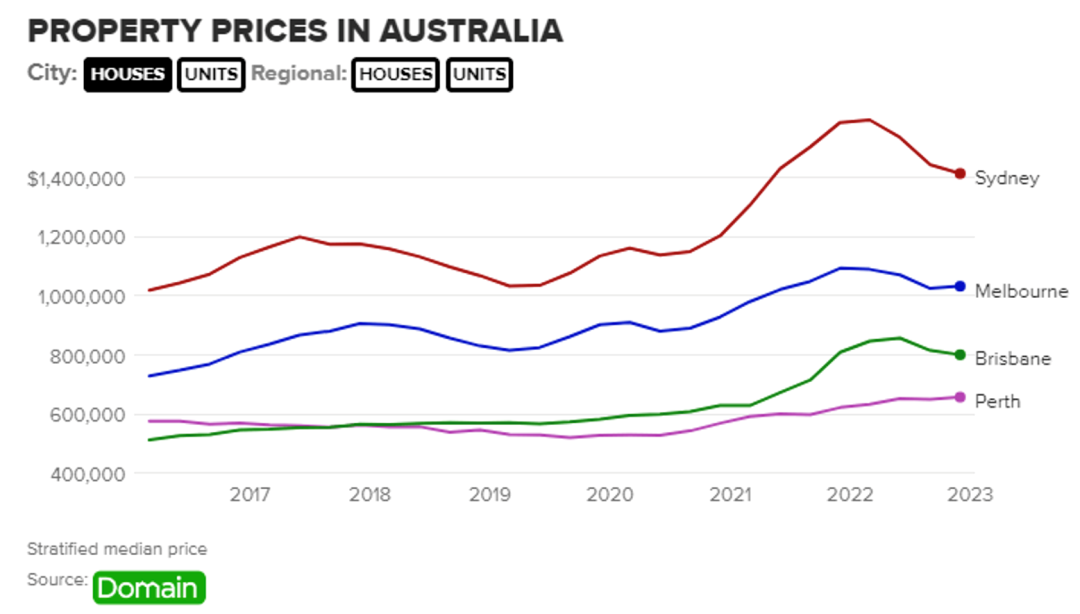
House price trends in Australia’s four major cities. Source: Domain
In New Zealand, by contrast, house prices have been falling for more than a year. Economists’ earlier forecasts of when the market would recover varied: some said the end of this year at the earliest, while more conservative estimates suggested the downturn would continue into next year or the year after. More recently, however, Nick Goodall, head of research for New Zealand at prominent property research firm CoreLogic, has said New Zealand’s property market downturn will end within 3 months。
Comparing New Zealand and Australia: will the market really bottom out within three months?
To compare New Zealand and Australia, we first need to understand why Australian house prices have bottomed out and rebounded. Both countries have followed the same path of high inflation, interest rate increases and falling house prices. Yet Australia appears to have emerged from the trough of this housing downturn, while New Zealand’s high inflation persists. Several factors explain Australia’s rebound: increased migration, housing pressure and low vacancy levels have intensified competition among buyers, while inflation has been brought under control and unemployment is gradually rising.
Goodall said their figures showed that, after a quiet period, Australia’s property market began recovering ahead of New Zealand’s in March. CoreLogic’s Australian house price index rose +0.6% in March, its first monthly increase since April 2022.
Prices rose in Australia’s four largest capital cities and regional areas, with Sydney recording an increase of +1.4%. In stark contrast, New Zealand’s house prices continued to fall. The main reason Australia’s property market rebounded first was the difference in the stock of properties for sale in the countries’ housing markets. Australia has relatively few properties available, intensifying competition among buyers and meaning that house prices will continue to rise.
In New Zealand, by contrast, the number of properties listed for sale is at its highest level in the past two or three years. Goodall explained that stock levels were so high because property sales over the past 15 months had fallen substantially from their 2021 peak. This prevented New Zealand’s market from generating the level of competition currently driving prices up in Australia. Although buyer demand has fallen to similar levels in both countries, the difference lies in the supply of homes on their respective property markets. He also said that while Australia’s nationwide price rise of 0.6% represented a clear shift, it reflected only a single month, and it was too early to conclude that the Australian housing market had fully recovered.
In Goodall’s view, New Zealand’s property market will not lag far behind Australia’s. Although the Reserve Bank of New Zealand (RBNZ) delivered another substantial interest rate increase of 50 basis points last Wednesday, taking the Official Cash Rate (OCR) to a new high of 5.25%, he believes this monetary tightening cycle is nearing its end and OCR increases will soon stop.
Their conclusion is that mortgage rates in New Zealand have peaked, much as they have in Australia, making it likely that New Zealand’s housing downturn will end within 3 months. Another major reason Australia’s market is recovering ahead of New Zealand’s is the difference between the monetary policies of their central banks.
The Reserve Bank of New Zealand appears to have been more aggressive than the Reserve Bank of Australia in raising the OCR. CoreLogic’s head of Australian property research, Eliza Own, said Australia’s central bank opted for a lower emergency cash rate during the COVID pandemic, at 0.1%, while the Reserve Bank of New Zealand set a floor of 0.25%. In practice, New Zealand’s house prices rose faster than Australia’s following the pandemic. This may require the Reserve Bank of New Zealand to take a tougher approach to the OCR to counter the negative effects of the wealth effect created by high house prices.
She said that although New Zealand’s OCR had risen more sharply, its house prices had also increased more since the COVID pandemic. Australian house prices are currently 15% higher than in March 2020, while New Zealand’s are around 28% higher than at the same time. Owen said New Zealand’s house prices continued to fall rapidly and the stock of properties for sale was increasing. In Australia, by contrast, stock remained tight and prices had begun recovering last month. She believes Australia’s market may be emerging from the trough of this housing downturn, although uncertainties remain. For example, the Reserve Bank of Australia could still raise interest rates further, as the labour market remains tight and pressure on household spending from high inflation has only just begun to ease from stubbornly high levels. These factors could put considerable downward pressure on the market over the coming year.

Ray White chief economist Nerida Conisbee also believes that the rapid rise in New Zealand’s mortgage rates is a key reason Australia’s property market recovery is accelerating. She explained that rising lending rates were making it increasingly difficult for borrowers to obtain finance, while Australia’s more attractive wages were drawing people from New Zealand and adding to Australia’s rapid population growth. Combined with the effects of borders reopening after the pandemic, Australia’s population growth has now surged back to pre-pandemic levels. This has driven rents up at their fastest rate on record, with the effects quickly spilling over into the property sales market.
Conisbee believes the contraction in New Zealand’s economy in the fourth quarter of last year could signal the arrival of a recession, which is unwelcome news for the property market. High lending rates and an uncertain economic outlook would also push New Zealand’s business confidence to a low point. In Australia, meanwhile, the construction industry crisis is easing and fewer homes are being built. Combined with strong population growth, this is making the housing shortage increasingly apparent, as already reflected to a large extent in rising rents.
{ad}
So the question is: with Australia’s property market recovering and auction clearance rates rising, can a recovery in New Zealand’s property market be far away?
To assess whether New Zealand’s property market will recover soon, we need to consider whether the OCR has already peaked. Do not be surprised if the Reserve Bank of New Zealand raises it again on 24 May. If that happens, it will be the 12th consecutive increase, and a rise of 0.25% would take the OCR to the central bank’s stated long-term target rate of 5.5%.
Before then, however, we also need to watch the release on 20 April of Consumer Price Index (CPI) data for the first quarter of 2023. If pressure from the current high inflation rate of 7.2% has eased, the Reserve Bank of New Zealand will reconsider the need for a higher OCR, particularly given the lagged effects of OCR increases.
Another set of figures also deserves attention. Stats NZ data released today shows that New Zealand’s annual migration growth continues to rise and has returned to pre-pandemic levels. Figures for the year ended February 2023 show that 152,900 migrants arrived over the preceding 12 months, up 195% on the previous year, while 100,900 migrants departed, an increase of 41% year on year.
Of the 119,100 migrant arrivals who were not New Zealand citizens in the 12 months ended February 2023, three-quarters (89,600) held temporary visas, including work, student and visitor visas.
For New Zealand’s property market, even if these temporary visa holders cannot buy homes for now, they will bring fresh activity to the rental market, which may prompt investors to act. Further ahead, some of these temporary visa holders will become residents, inevitably affecting supply and demand across the housing market.