

The Reserve Bank of New Zealand raised the Official Cash Rate (OCR) by 50 basis points to a new high of 5.25% last Wednesday, a decision that surprised many economists. In particular, Australia's central bank had just decided to pause increases to its OCR, yet New Zealand went in the opposite direction with this substantial rise.
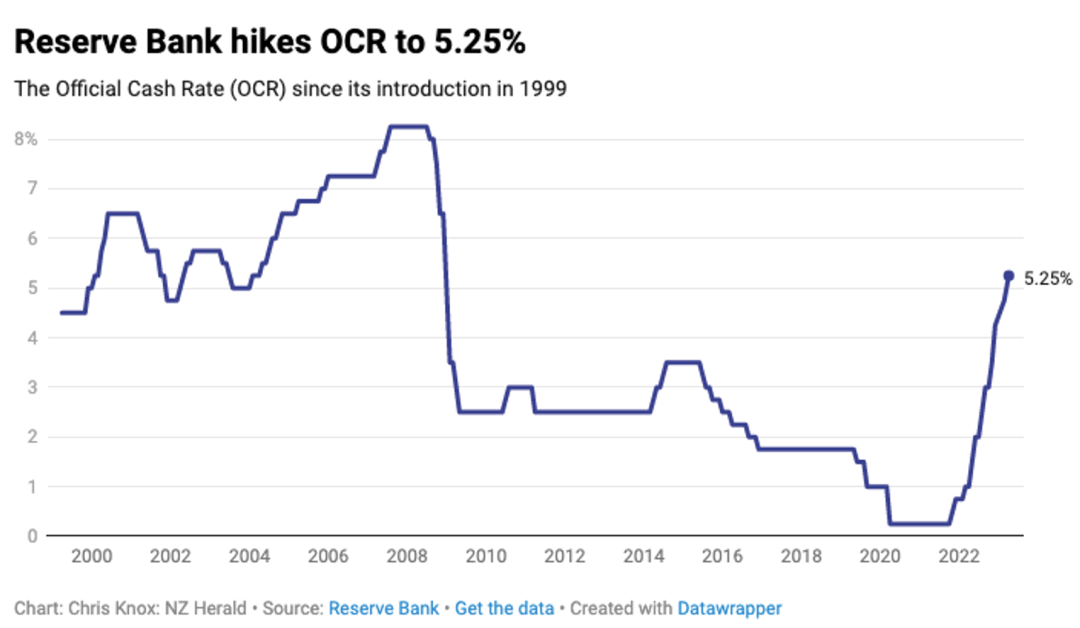
Chart showing changes in the Reserve Bank of New Zealand's OCR
Then, just yesterday (12 April), ANZ became the first to raise its fixed and floating mortgage rates, responding to the Reserve Bank's OCR increase last week.
Specifically, the floating rate rose by 40 basis points to 8.39%. Special fixed mortgage rates for terms of two years or less all increased by varying amounts, with the special fixed rates for June, 1 year, 18 months and 2 years rising to 6.79%, 6.74%, 6.69% and 6.59% respectively.
{ad}
OCR The benefits and drawbacks of an increase
There is no denying that the national economic outlook seems to have darkened since the Reserve Bank delivered another substantial rate rise last week. Media reports have repeatedly warned of an unfavourable outlook for New Zealand's economy, the prospect of recession and greater repayment pressure on mortgage borrowers as home loan rates rise. Indeed, this public sentiment may be precisely what the Reserve Bank of New Zealand wants. The more pessimistic people feel about the economy and their personal finances, the more cautiously they will approach household spending. This means businesses will be even less likely to raise their prices, offering hope that persistently high inflation can be brought under control.
At the same time, we cannot ignore the side effects of the Reserve Bank's continued rate rises. Over the next 12 months, fixed-rate terms on mortgages worth around NZ$170,000,000,000 in total will expire. Borrowers will have to accept their fixed rates rising from a low of 3.5% to around 6.5%, which will inevitably have some negative impact on New Zealand's economy.
Residential construction has also begun to fall sharply and could continue declining over the next two to three years. Construction has been a pillar of New Zealand's economy in recent years, and its decline will affect the development of many other industries and businesses. A construction downturn will therefore have a substantial impact on national economic growth.
What should mortgage holders be worried about?
The latest research released by New Zealand credit bureau Centrix shows that the number of homeowners falling behind on mortgage repayments has recently surged. Around 18,900 mortgages were in arrears in February, up from 18,400 in January and an increase of 23% on the same period last year。
Centrix managing director Keith McLaughlin expects more households to face financial pressure. He said the latest survey data showed mortgage arrears had risen for the seventh consecutive month, indicating that increasing numbers of mortgage holders were unable to afford repayments at higher mortgage rates. This was a very difficult position for anyone to be in.
CoreLogic chief economist Kelvin Davidson said that, in theory, borrowers currently paying rates of 2–3% should be able to cope with a move to 6.5–7%, because many had already passed stress tests at higher interest rates when applying for their loans. In practice, however, not everyone can cope with the financial pressure of a substantial increase in mortgage repayments.
Davidson believes high inflation is amplifying the negative impact of rising mortgage rates. As goods and services become more expensive, many households already under repayment pressure are now being forced to adjust their everyday spending budgets. Although rising mortgage rates are severely squeezing households' disposable income, mortgage holders have so far shown a degree of resilience. Nevertheless, we should still recognise the increase in missed repayments highlighted by Centrix's recent data.
The Reserve Bank of New Zealand expects unemployment to rise over the coming months, but does not anticipate large-scale redundancies. For mortgage holders already in work, this means they will not face unemployment in the period ahead, helping them manage higher repayments. Davidson also said borrowers who had already locked in higher mortgage rates would not face increased repayment pressure: their rates would move from “high to high”, rather than from “low to high”.
New Zealand independent economist Tony Alexander, meanwhile, believes the OCR has peaked and borrowers need not be overly worried. He believes wholesale interest rates have fallen substantially since the Reserve Bank released its new monetary policy statement in February, potentially creating scope for fixed mortgage rates to fall. He also believes borrowers about to refix from low rates of around 3.5% to higher rates need not be overly concerned. In his view, the OCR increase on 5 April does not mean its eventual peak will exceed the 5.5% maximum the Reserve Bank forecast last year. This is because we are now at the peak of the OCR cycle, and he does not consider another 25-basis-point increase likely at the Reserve Bank of New Zealand's next monetary policy review on 24 May.
Will the Reserve Bank raise rates by another 25 basis points at its next monetary policy review on 24 May?
How should mortgage borrowers prepare?
Research released last month by consumer advice website Finder found that 45% of New Zealanders felt “somewhat” or “slightly” affected by mortgage repayment pressure, second only to the pressure of rising food and grocery prices. Meanwhile, Canstar's 2023 Consumer Pulse Report found that two-thirds of mortgage holders had cut, or planned to cut, spending on essential and non-essential living costs to meet higher mortgage repayments.
Gareth Veale, a mortgage broker at EasyStreet Mortgages, said homeowners should prepare financially for higher repayments, rather than allow themselves to fall into financial difficulty through being unable to make regular mortgage interest payments. They should print out their bank statements, examine each expense and decide whether it is necessary. They need to establish clearly which everyday living costs are essential and which spending is discretionary.
Veale said he had been encouraging his clients to ask their employers for pay rises. Some had negotiated increases above the rate of inflation. In one recent case he encountered, a forklift driver negotiated an increase in his hourly wage from NZ$22 to NZ$28. His advice was that if you had worked for an employer for some time without a pay rise, it was time to ask for one.