

Summary: major CCCFA changes begin to deliver results
An article published by YIJU New Zealand on 19 April reported that New Zealand’s Commerce and Consumer Affairs portfolio had announced further major government changes to the Credit Contracts and Consumer Finance Act (CCCFA). The new legislation took effect on 4 May 2023. The latest changes include:
1: Explicitly excluding discretionary expenses from affordability assessments;
2: Giving lenders greater flexibility in calculating loan repayments;
3: Expanding the exemption from full income and expense assessments when refinancing existing credit contracts.
The New Zealand government stated that when a borrower refinances an existing credit contract with one lender (Bank A), another lender (Bank B) does not need to conduct a full assessment of the borrower’s income and expenses. The amendment allows loans to be transferred or restructured where the annual interest rate or regular repayments are equal to or lower than those under the borrower’s current credit contract.
In other words, borrowers switching loans between commercial banks need only meet three conditions to refinance between lenders without a full assessment:
1: No increase in the loan amount
2: A lower interest rate under the new loan agreement
3: Lower repayments under the new loan agreement
Following the announcement, many industry figures said the rule would help strengthen competition between banks’ lending services. However, there could be a long wait between the policy taking effect in May and commercial banks actually implementing it.
Sure enough, after a long five-month wait in the financial market, Westpac, on 2 October, became the first to announce the following:
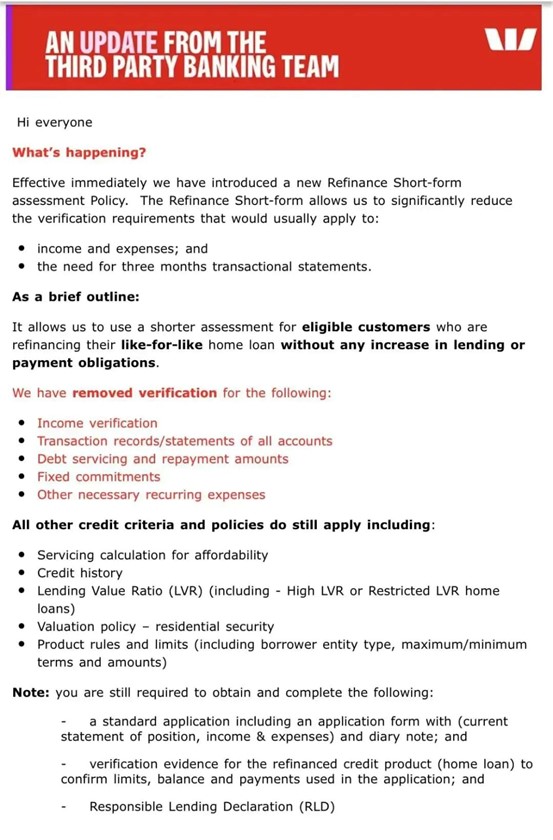
Westpac said it was introducing a new streamlined refinancing assessment policy with immediate effect. The policy would greatly simplify income and expense checks and the review of bank transaction statements for the previous three months, saving borrowers considerable work in preparing their applications.

Westpac further explained that, when refinancing eligible customers’ home loans on a like-for-like basis without increasing the loan amount or repayments, it had removed the following assessment requirements:
—Income verification
—Transaction records and statements for all accounts
—Verification of debt affordability and repayment amounts
—Committed fixed terms
—Other essential recurring living expenses
All other credit criteria and policies still apply, including:
—Assessment of debt-servicing calculations
—Credit history checks
—Checks against loan-to-value ratio (LVR) limits (80% for owner-occupied homes and 65% for investment properties)
—Valuation checks for residential properties used as security
—The bank’s lending product rules and limits also continue to apply

YIJU believes that, with New Zealand’s financial market having endured high interest rates for so long, the major commercial banks urgently need ways to capture market share. As many have said, Westpac may be the first to take the plunge, but will other commercial banks join this “battle” as time goes on? It may simply be a matter of time. This could also be good news for borrowers whose fixed mortgage terms are about to expire and who need to lock in a new rate.
So, would you consider switching banks to refinance?
A: Yes
B: No
C: Unsure
{ad}