

Today, 15 November, the leaders of National, ACT and New Zealand First finally met in Auckland. The meeting did not last long, but according to the ACT leader, it was a “brief but excellent meeting”. If progress continues smoothly, we may soon see the new government formally established.
The Official Cash Rate (OCR) has remained at its peak of 5.5% since May this year. In its previous Monetary Policy Statement, the Reserve Bank of New Zealand also indicated that an OCR adjustment was very unlikely at its final Monetary Policy Statement announcement of the year, scheduled for 29 November.
But will the Reserve Bank still hold the OCR at 5.5% at its meeting on 28 February 2024? Views differ. Some believe the OCR will rise further. Even commentators who previously thought the OCR had peaked say mortgage rates could still increase, because much of banks’ mortgage funding comes from overseas wholesale borrowing and their own deposits, neither of which is directly affected by changes in the OCR.
Indeed, we have continued to see major banks raise mortgage rates. Just recently, BNZ announced increases to three mortgage rates, including its one-year and two-year rates. What happens next? Let’s hear what the experts think.
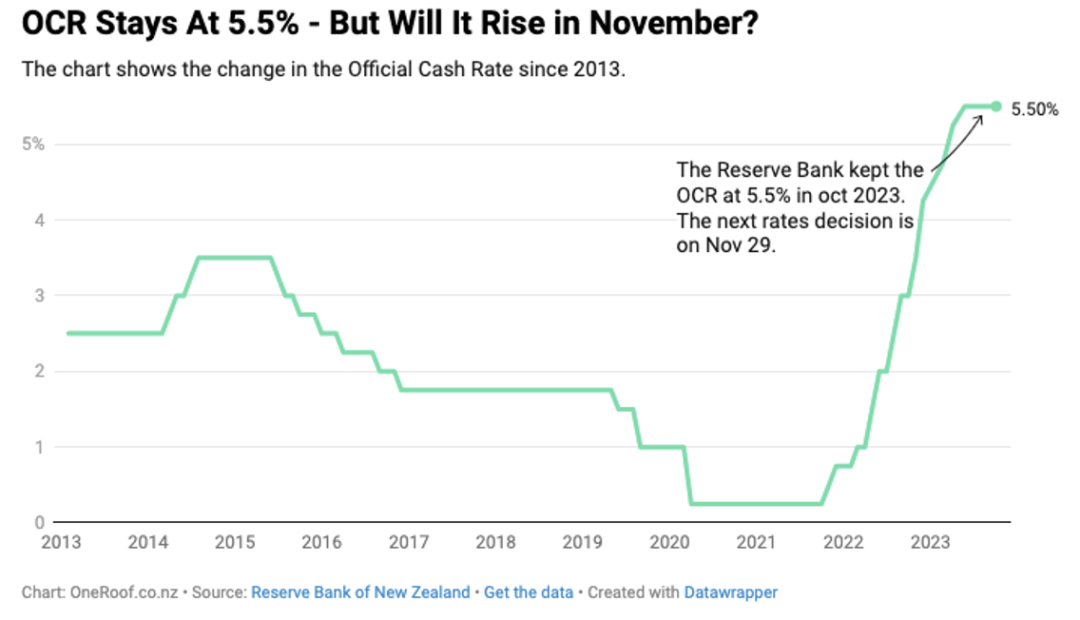 OCR movements from 2013 to the present. Source: Reserve Bank of New Zealand

BNZ recently announced increases to three home loan rates. From Wednesday, its one-year special rate rises from 7.25% to 7.35%. Its 18-month special rate rises from 7.09% to 7.15%, while its two-year special rate increases from 6.99% to 7.05%.
For borrowers who do not qualify for special rates, the one-year rate rises from 7.85% to 7.95%, the 18-month rate from 7.69% to 7.75%, and the two-year rate from 7.59% to 7.65%.
Current interest rates at New Zealand’s major banks are shown below:
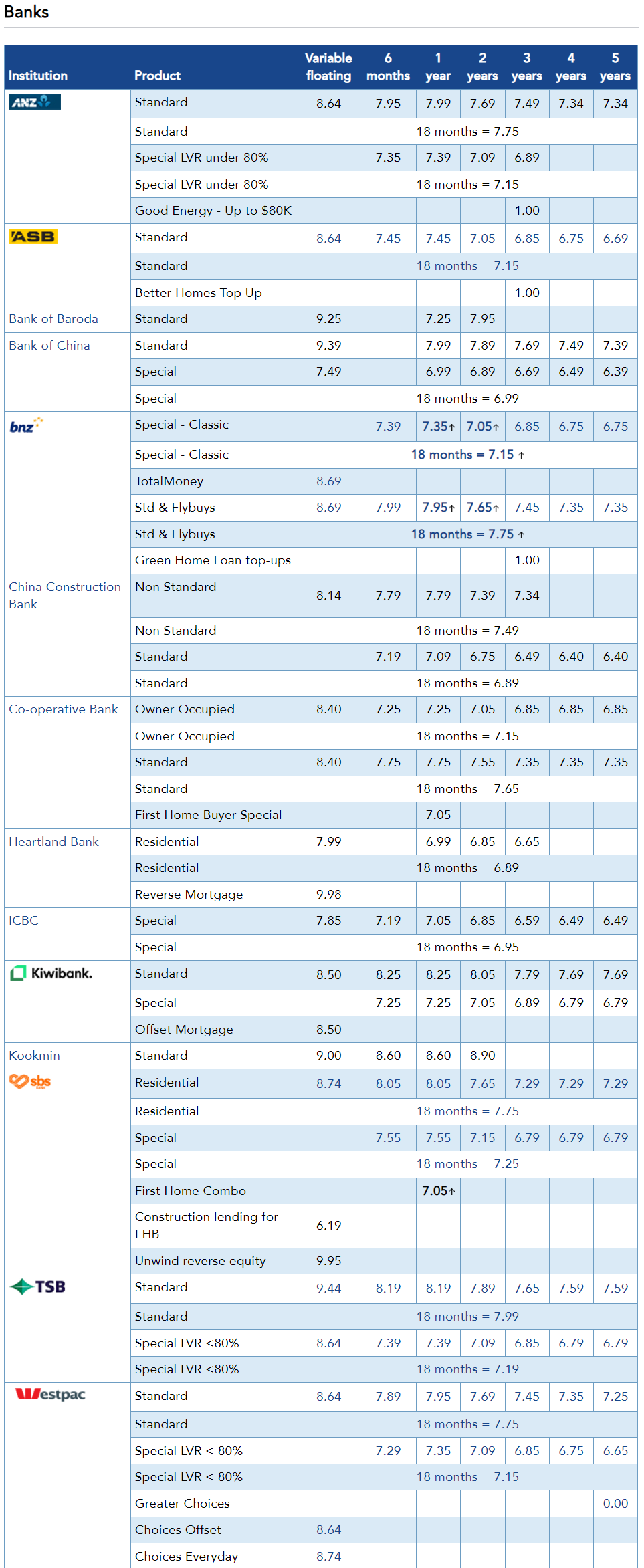
Source: www.interest.co.nz

Kiwibank chief economist Jarrod Kerr explained that mortgage rates could continue rising because global wholesale interest rates had increased sharply and banks were competing intensely for term deposits. In his view, the Reserve Bank of New Zealand was unlikely to raise the OCR in 2024. BNZ chief economist Mike Jones agreed, but economists at Westpac and ANZ believed further OCR increases were highly likely as the Reserve Bank sought to curb high inflation.

Kiwibank chief economist Jarrod Kerr
Kerr stressed that about 30% of borrowers would move onto higher mortgage rates over the coming months. Their rates had been only around 3% two years earlier. The harsh reality facing them was that major commercial banks’ standard two-year fixed mortgage rates were now well above 7%, with Kiwibank’s current rate as high as 8.05%. TSB’s floating rate had also risen to a record 9.44%. These borrowers would therefore face substantial financial and repayment pressure.
New Zealand economist Darren Gibbs wrote in Westpac’s New Zealand First Impressions newsletter that, with rate cuts still some time away, fixing a mortgage for three years was a sensible, forward-looking option, because current short- to medium-term fixed rates for terms of up to three years were exceptionally high.
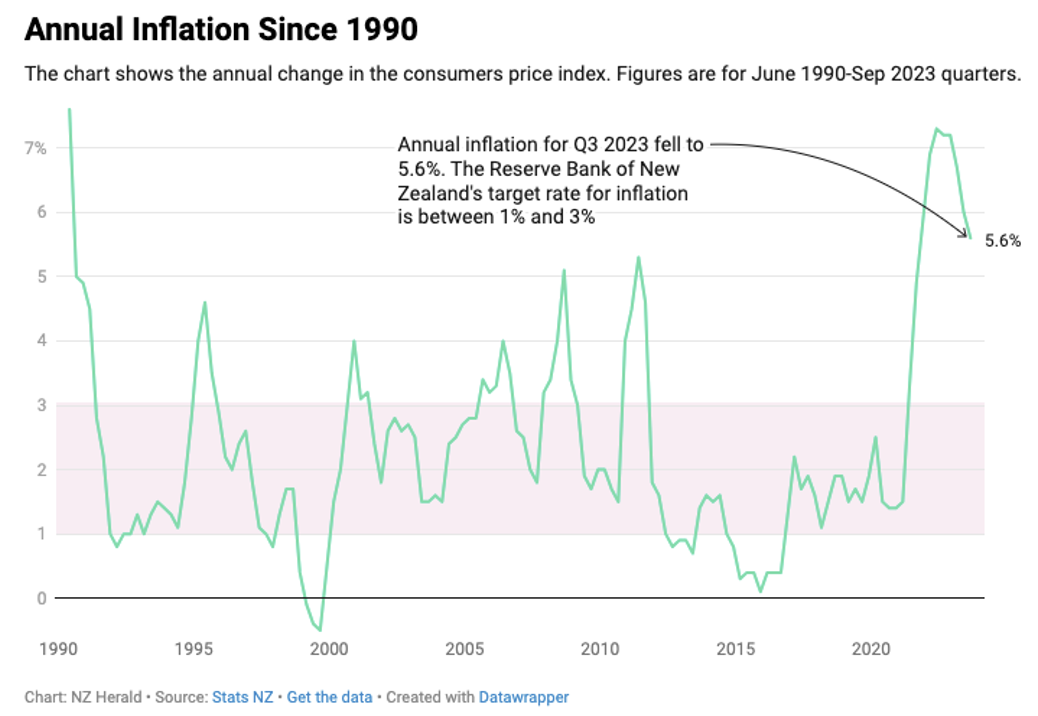
New Zealand’s annual inflation rate from 1990 to the present. Source: Stats NZ
BNZ economist Mike Jones said the Reserve Bank of New Zealand’s efforts over the past two years had brought inflation down. It was currently 5.6%, still outside the 1–3% target range. Although there was still a long way to go to reach that range, some inflation indicators had shown good progress. He and his team believed the Reserve Bank would continue introducing a series of easing policies, meaning banks would not have to rush to raise rates. He noted that food prices had fallen slightly, construction costs were stabilising and building-material supply chain shortages had eased, all contributing to a further decline in inflation. In addition, higher overseas wholesale rates had put pressure on New Zealand commercial banks’ mortgage rates, which also helped restrain inflation. He predicted mortgage rates would begin falling from May 2024 or later.
ANZ economists noted in their monthly Property Focus publication that fixed mortgage rates had edged higher in October, although the changes were small. Mortgage rates continued trending upwards even though the OCR had not changed. Since May, the average mortgage rate on new lending to owner-occupiers and residential investors had risen by around 20 basis points. The main driver was the sharp rise in global interest rates, which had also pulled New Zealand swap rates higher. Swap rates are a key determinant of mortgage rate movements.
Because third-quarter CPI growth was weaker than expected, they forecast that the next OCR increase could be delayed from November until February next year. They explained that although inflation was falling, it was not falling quickly enough, and borrowers still faced upward pressure on mortgage rates. These borrowers had a difficult decision to make: should they fix for longer at a rate near the peak of this cycle, or choose a shorter fixed term at a higher rate? Although neither option was clearly better in the short term, we would like to leave that question with YIJU’s readers.