
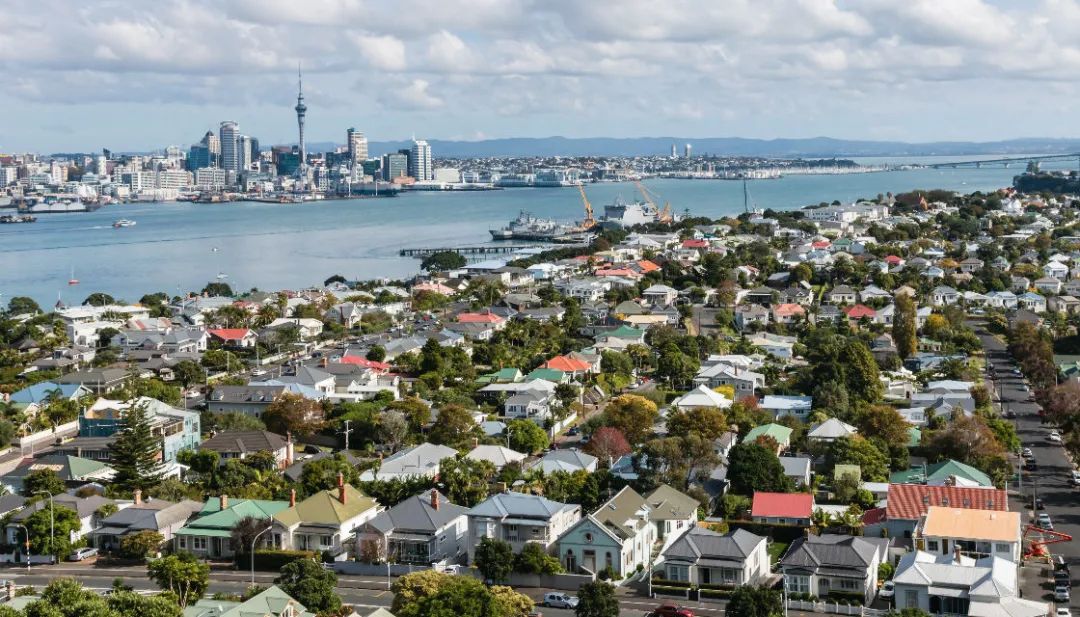
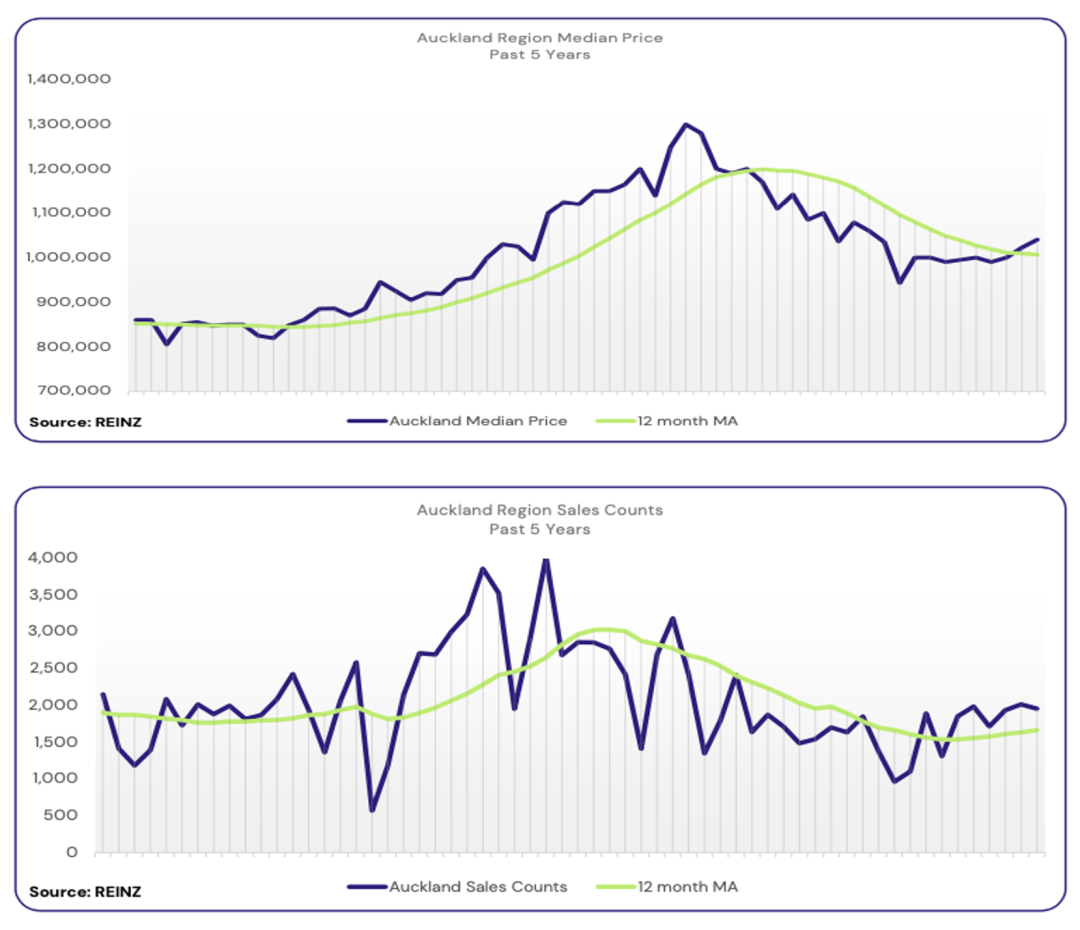
After this year’s price rebound, growth in Auckland’s market has begun to slow. The recovery in house prices is following its traditional path, spreading beyond Auckland to other regions.
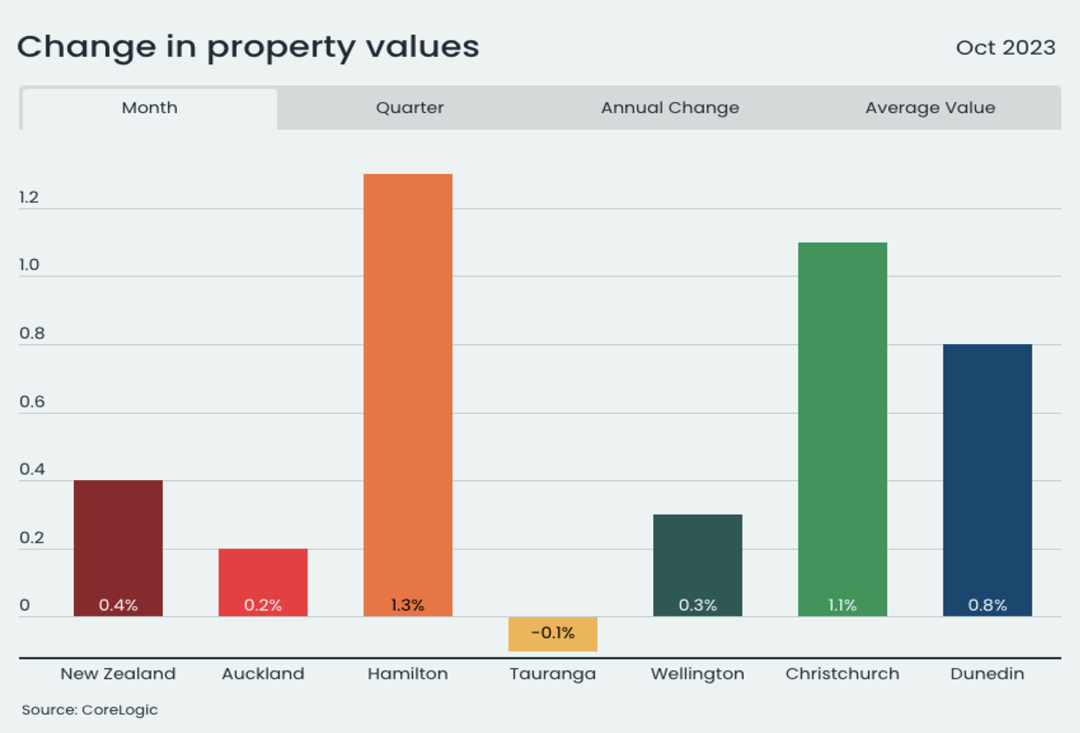
The chart below shows monthly house price statistics for October, which has just ended. Auckland’s monthly growth has begun to lag the national figure by about 0.2%, although its quarterly growth remains about 0.2% ahead of the national figure.
House prices have already bottomed out and begun recovering this year. The question now is: how long can this rise last? First, let’s look at who has continued to buy at the bottom.
 Over the past 12 months, various organisations have observed the important role first-home buyers have played in the market. Their share of purchases reached a record 27% in the latest quarter, with an annual average of 26%, compared with a long-term level of just 21%.
This shows that during the house price downturn caused by this round of interest rate increases, first-home buyers continued to buy at the bottom wherever they could. They therefore played an important role in Auckland house prices finding a floor and recovering.
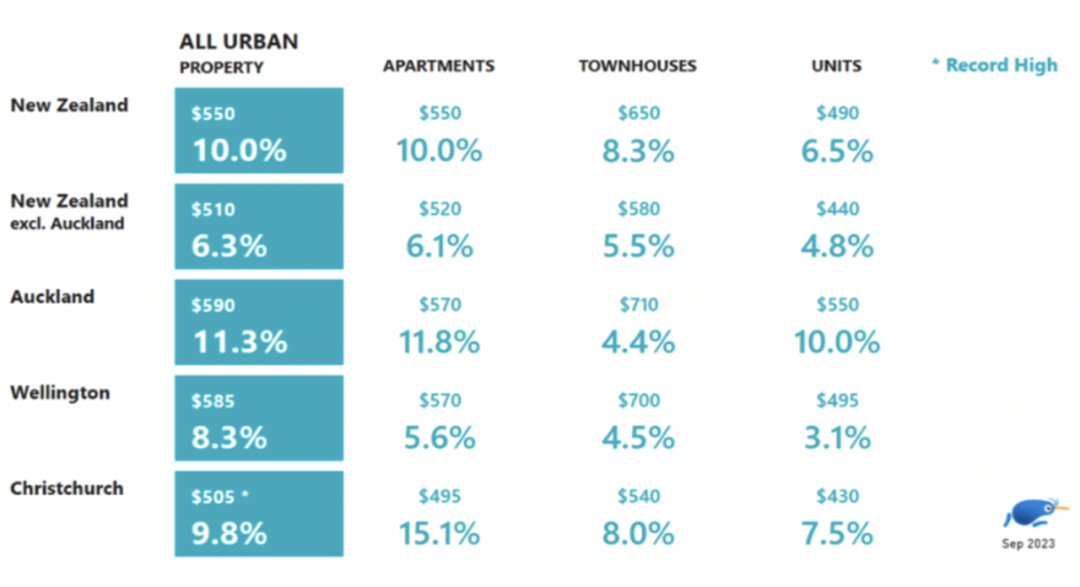
Much of the motivation behind this comes from rapidly rising rents. Trade Me’s latest rental report shows that New Zealand rents rose by 10% over the past 1 year, while Auckland’s annual increase reached 11.3%.

For first-home buyers, rent is an expense that builds no equity, and the same is true of mortgage interest. Comparing these costs is very important for first-home buyers, particularly as an owner-occupied home does not require them to account for management fees, vacancy periods and similar issues.
Auckland’s long-term rental trends show relatively little variation in rents across the urban area. For example, rents for new townhouses in Papakura in the far south may differ from those in central Auckland by just 5%. Within the same area, rents for 3-bedroom townhouses and 3-bedroom standalone houses are also similar. Townhouses and other multi-unit homes often sell at the lower end of an area’s price range, so it makes sense to compare median rents with the sale prices of lower-priced homes.
The chart below shows annual rental yields calculated by dividing annual income at the median rent for 1–3-bedroom homes by sale prices for 1–3-bedroom homes in the lowest 1/4 of the price range. Rising rents and falling house prices over the past 2 years have pushed yields for 1-bedroom, 2-bedroom and 3-bedroom homes steadily upwards to levels that warrant attention. Looking purely at rental yields, Auckland’s 2-bedroom homes currently return more than 6%. This means renting really could be more expensive than buying.
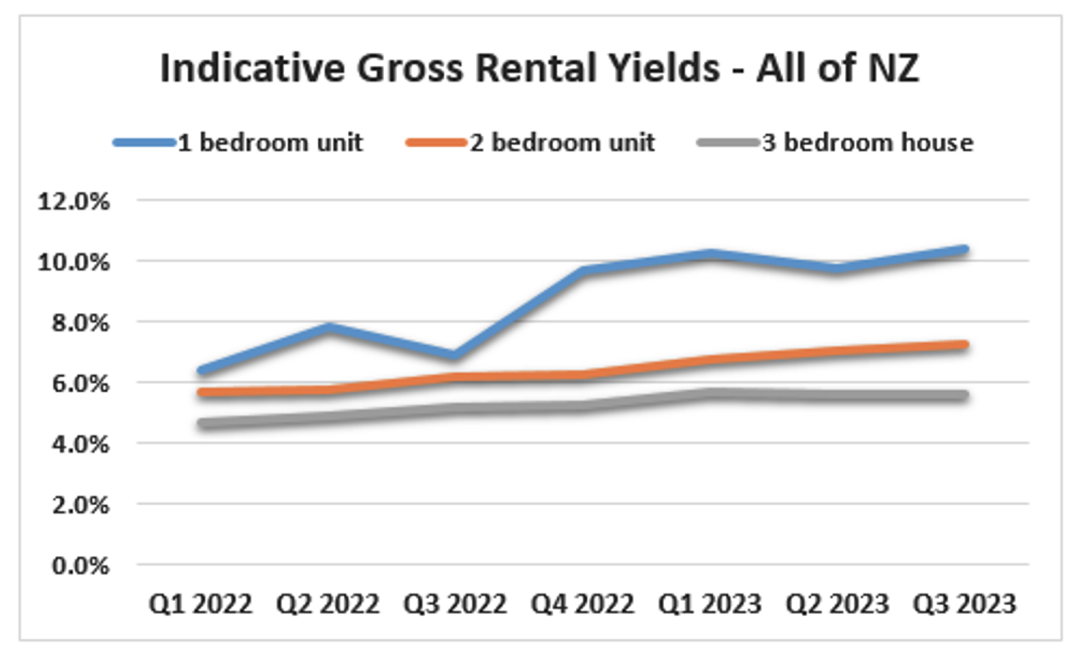 Take a simple example: 3-bedroom homes are the main type of new townhouse in the urban area. Their median rent can reach about NZ$750 a week, generating annual rental income of NZ$39,000. With market sale prices of NZ$900,000–950,000, the annual rental yield is about 4.1–4.4%.
A loan of NZ$600,000 at an interest rate of 6.5% would also cost NZ$39,000 in interest. This means that, for this type of home, first-home buyers who can afford the deposit could use what they would otherwise pay in rent to cover interest on a loan approaching 7 tenths of the property’s value. For first-home buyers, living in their own home offers a very different experience from renting. With rents continuing to rise, buying becomes a very rational choice.
Owner-occupiers buying an existing home to live in also do not need to consider interest deductibility and other tax matters that concern investors.
Purchases by first-home buyers provide the market with liquidity. After weighing profits and risks, developers will begin re-entering the land market, allowing that market to find a floor as well.
If rent-driven purchases by first-home buyers have helped the property market find its floor in this cycle, whether investors follow will be the key to sustaining the rise.
 There are many types of property investor. The largest and most traditional group buys homes to collect rent, and this group provides the main purchasing power for property investment. Other investors, such as those who renovate, subdivide or trade over very short periods, undertake activities with a development element and can use their expertise to earn higher returns.
Over the past 3 years, these traditional property investors have faced 2 obstacles. The first is the effect of mortgage interest expenses no longer being tax-deductible.
On the first issue, National’s election victory has already reassured most people. Although a coalition government has yet to be formed and the timing and details of policies may still change, there is broad agreement that the rules are unlikely to become more restrictive. Once the new government’s policy programme is announced, concrete action will follow. After all, relatively few people committed substantial funds before the election.
The second obstacle is the high cost of bank lending. The direction of interest rates will be a key factor in investors’ decisions.
The news over the past few days is that economists across New Zealand’s banking sector have revised their reports and now believe the Reserve Bank of New Zealand will not raise rates again. Leading market signals, however, had already pointed to this 3 weeks ago. The backdrop to this already outdated ‘news’ is that New Zealand wholesale interest rates peaked between month 9 and October, then fell very rapidly after the end of October.
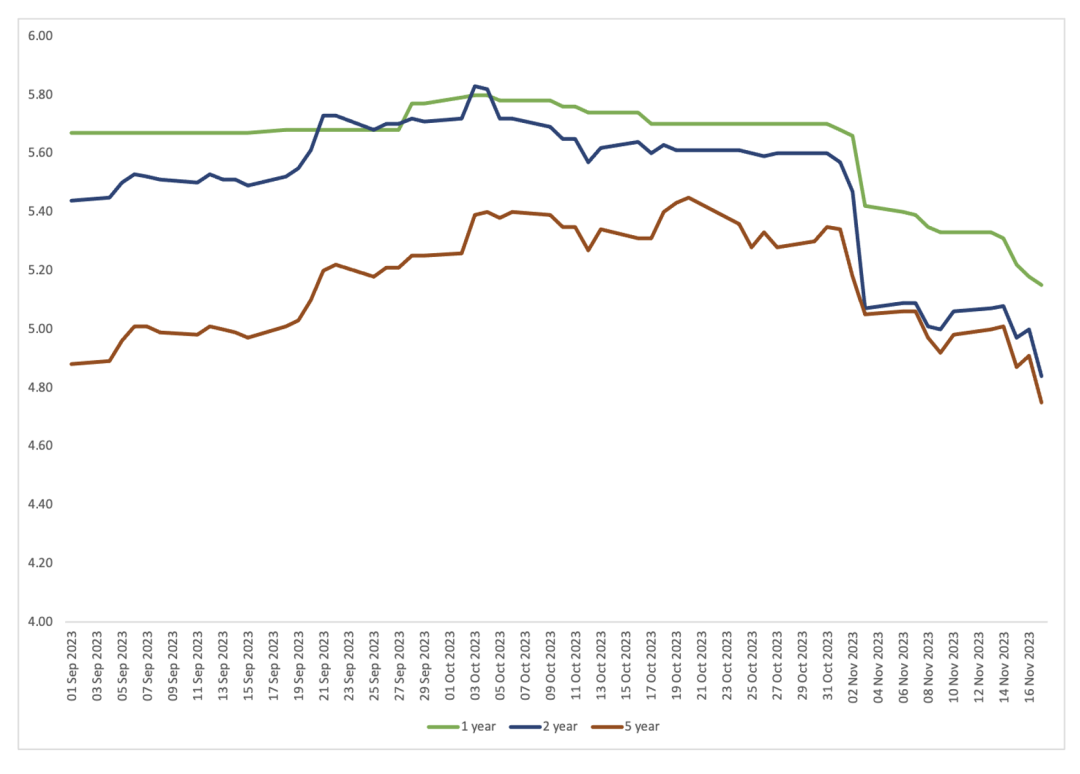
The 2-year wholesale rate, which is crucial for mortgages, has fallen by nearly 0.75–1% in less than 3 weeks. At 0.25% per cut, that is equivalent to 3–4 rate cuts!
The Reserve Bank of New Zealand had already decided early this year not to raise rates further. Yet New Zealand’s commercial banks still increased their rates by 0.25%–0.40% while the OCR remained unchanged, citing steadily rising wholesale rates as their justification.
With inflation data now being released around the world, it is clear that inflation has passed. Last week, CPI figures in both the United States and Europe were weaker than market expectations. European inflation fell directly from 4.3% to 2.9%, returning to the 2 per cent range.
From market trading figures to economic data, everything points to commercial banks soon entering a cycle of proactive rate cuts. This also means credit will become more readily available, with the change coming before any change in the Reserve Bank of New Zealand’s OCR.

The outlook for rising rents and falling interest rates is now very clear. Together, these two forces will bring property investors back into the market over the next 6 months. This also suggests that the current brief pause is simply a window in which purchasing power is shifting between buyer groups, with a busy summer ahead for the market.
With migration the main driver of this rise in rents, Auckland is a clear beneficiary. Unless the new government puts the brakes firmly on immigration, rents will continue to rise. On the supply side, Auckland’s new dwelling building consents have fallen for 18 consecutive months. This will lead to a continuing decline in future new housing supply, keeping upward pressure on rents for longer.
 Image sourced online
Together with growing expectations of rate cuts, these two forces will help Auckland move quickly through the current transition. Summer is traditionally the peak season for property and tourism. Changing expectations will begin to spread as temperatures rise and travel increases, while investors’ decisions will be validated and encouraged once commercial banks begin proactively cutting rates.
Considering the combined effects of the various factors that could influence house prices, the next wave of gains could be far larger than those first-home buyers alone could generate.
If you are looking to buy or sell a home, consider taking this opportunity to contact an experienced Barfoot & Thompson agent for professional assistance.
Barfoot & Thompson is the real estate agency that knows Auckland best
Barfoot & Thompson accounts for 1/3 of Auckland’s home sales,
far ahead of all other real estate agencies.
