

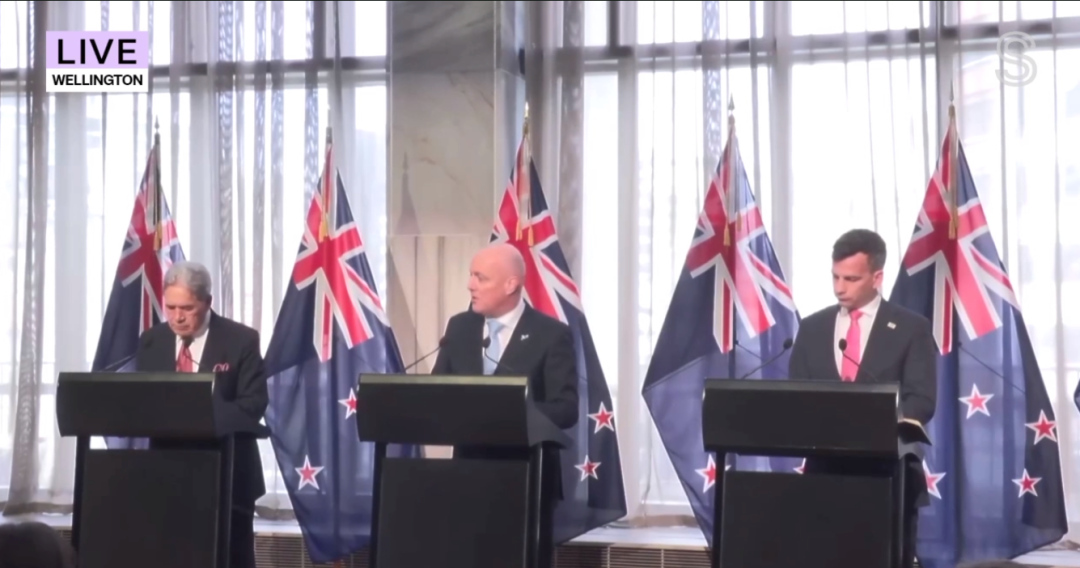
 It has been 40 days since election day, and Christopher Luxon finally officially announced the coalition agreements today. New Zealand’s new government will be formed next week. National, ACT and New Zealand First will govern together, forming the first three-party coalition government under MMP and bringing ACT into government for the first time. The new ministers will be sworn in at Government House on Monday, with the newly formed Cabinet holding a ceremonial meeting later that day.
From today, Christopher Luxon will officially become New Zealand’s Prime Minister. The three parties’ final solution to the Deputy Prime Minister question came as a considerable surprise: New Zealand First leader Winston Peters and ACT leader David Seymour will share the Deputy Prime Minister role, each serving half of the three-year term. Peters will serve as Deputy Prime Minister first, then hand over to Seymour for the second half of the term.
 Peters will also be Minister of Foreign Affairs, while Seymour will be Minister for Regulation.
The 20-member Cabinet will include 14 National ministers, 3 ACT ministers and 3 New Zealand First ministers. Nicola Willis will be Minister of Finance, Brooke van Velden will be Minister for Workplace Relations and Safety, and Hon Shane Jones will be Minister for Regional Development. Outside Cabinet, there will be five ministers from National, two from ACT and one from New Zealand First.
 During the election campaign, National attracted considerable attention with a series of policy promises favourable to the housing market and property investors. Let’s look at them in turn:

|
National promised to shorten the bright-line test to 2 years, meaning investors would pay tax on gains from selling a home within 2 years of buying it. This could take effect in July next year. National has so far given contradictory answers about whether new builds would be exempt, so this cannot yet be confirmed. ACT went further, arguing that the bright-line test should be abolished entirely. If implemented, financially stretched investors would begin selling in large numbers, increasing the supply of properties on the market. The three parties have not yet clearly announced whether this policy will change. |

|
Under current policy, landlords cannot freely deduct mortgage interest expenses from rental income. Instead, they face various restrictions, including those based on property type. National promised to restore interest deductibility in stages for property investors, regardless of whether a property is newly built or existing, its type or its age. It aims to restore full deductibility by 2026. ACT also supports restoring the ability to deduct mortgage interest expenses from rental income. At the meeting, the three parties announced that the restoration of interest deductibility would be accelerated, with 60% restored in 23/24. They pledged to restore mortgage interest deductions for rental properties to 60% in 2023/24, 80% in 2024/25, and 100% in 2025/26. This is very significant good news for property investors, most of whom will pay less tax. For example, an investor, Mr Zhang, owns an investment property with a mortgage of NZ$500,000 and weekly income of NZ$540. Under National’s promised policy, he will save NZ$110,000 over the next 15 years. |

|
Under National’s earlier proposal, overseas buyers might have been allowed to purchase properties worth more than NZ$2,000,000, subject to a corresponding tax. However, New Zealand First firmly supports the foreign buyer ban, so this policy will not go ahead. |
In addition, the much-anticipated tax cuts will officially be delivered in July next year.

There is a lot to take in from today’s news. Take a break and watch a video!
 Property website realestate.co.nz recently introduced a benchmark for measuring housing demand and prospective buyer engagement, based on users’ property search preferences and prices on its website.
The data shows that searches and engagement per listing have risen steadily over the past 12 months. In October, searches per listing increased by 1.9% year on year, while engagement rose by 26.4%. Among the country’s regions, Wellington recorded the largest rise in property demand, with searches up 47.7%, followed by Waikato at 8% and Auckland in third place at 6.4%. New listings also rose substantially in many regions compared with the same period in previous years, increasing by 88.5% in Wellington, 54.7% in the Bay of Plenty, 47.7% in Auckland and 46.3% in Waikato.
Realestate.co.nz spokesperson Vanessa Willkiams said they had observed something of a downturn around the election in September, but conditions were now improving again. Although search volumes were largely unchanged between September and October, user engagement rose substantially. Property searches in the main centres were also increasing. Notably, searches for properties in Gisborne, Otago and Queenstown Lakes had remained higher than in other parts of the country over the past year.
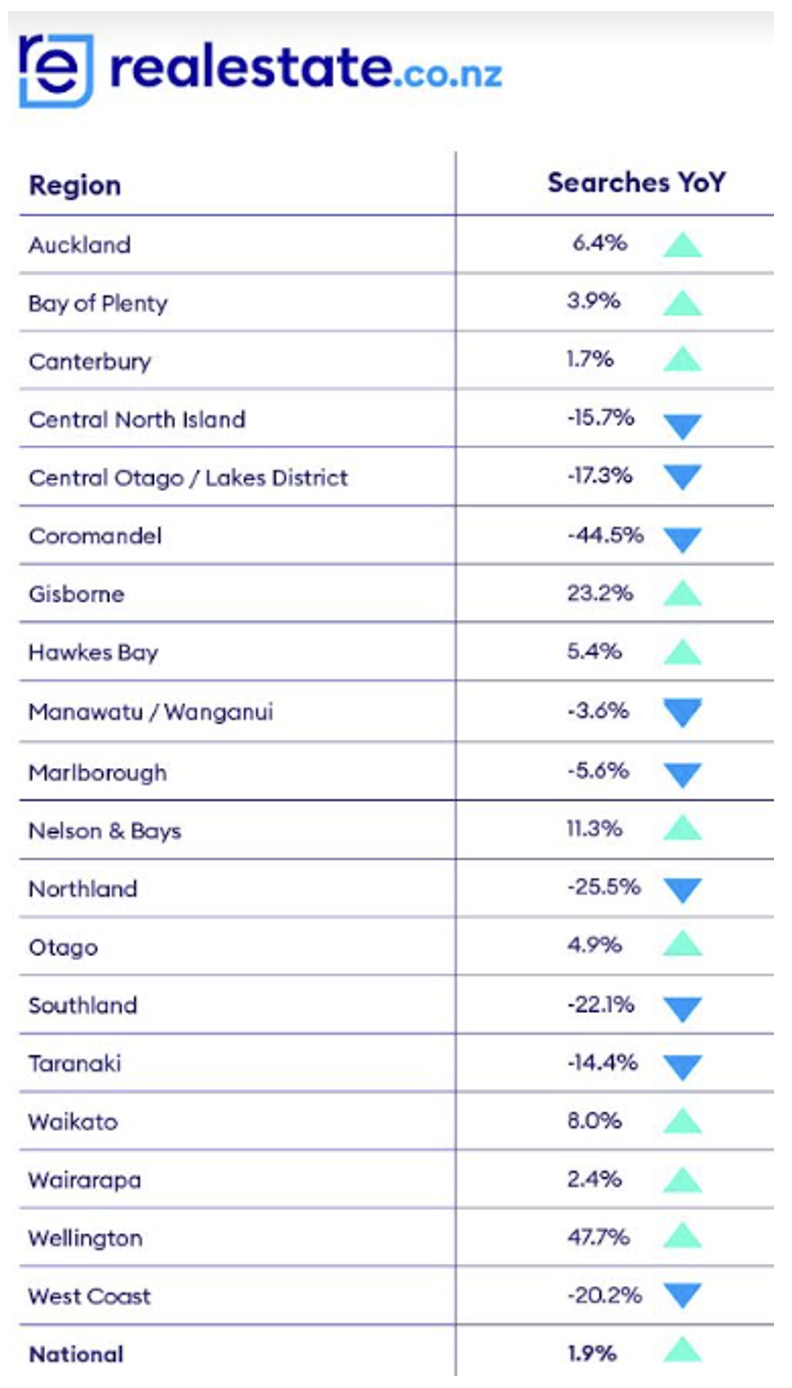 Year-on-year change in average searches per listing across New Zealand’s regions in month 10 (Source: realestate.co.nz)
The website’s latest data shows that average searches per listing nationwide rose by just 1.9% year on year in month 10. This relatively modest increase may not be surprising, because last October recorded the lowest monthly residential sales volume reported by the Real Estate Institute of New Zealand (REINZ) since 2011. Sales this October, however, rose substantially, up 7.8% year on year.
 Search demand for Queenstown Lakes properties has remained high in recent years
Willkiams noted that Aucklanders made the most searches for Queenstown Lakes and Otago in October. Competition for properties in these areas could also be intense. Given their popularity, competing buyers often include overseas buyers and people looking to relocate from elsewhere in New Zealand or purchase a second home.
Infometrics chief executive Brad Olsen expressed a similar view, agreeing that the sharp increase in property searches supported the recovery in the housing market, showing that people were taking a stronger interest in property again. He stressed that statistics on clicks and engagement were more compelling and more useful for housing market research.
 The latest research from realestate.co.nz and REINZ shows a widening gap between the number of properties newly listed for sale and the number sold. In June this year, the gap between listings and sales was just 9.5%. By August, however, new listings were growing strongly, reaching 9529 in October, up 53% from June. Unfortunately, the increase in new listings did not bring an increase in sales, which remained largely unchanged over the same period.
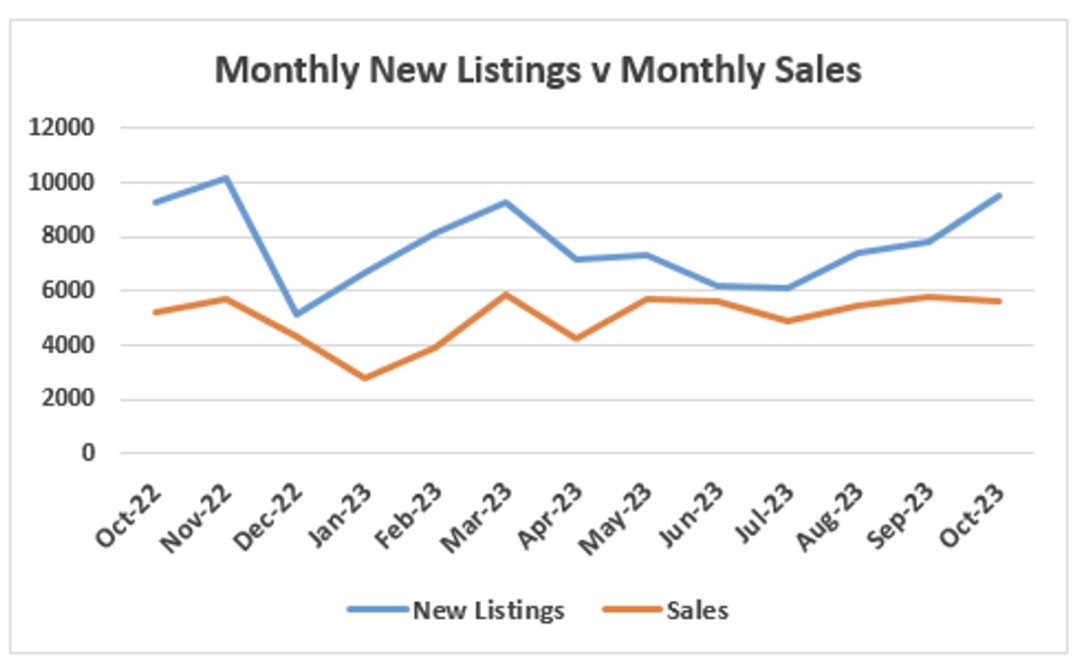 Monthly property sales compared with new listings (Source: REINZ/Realestate)
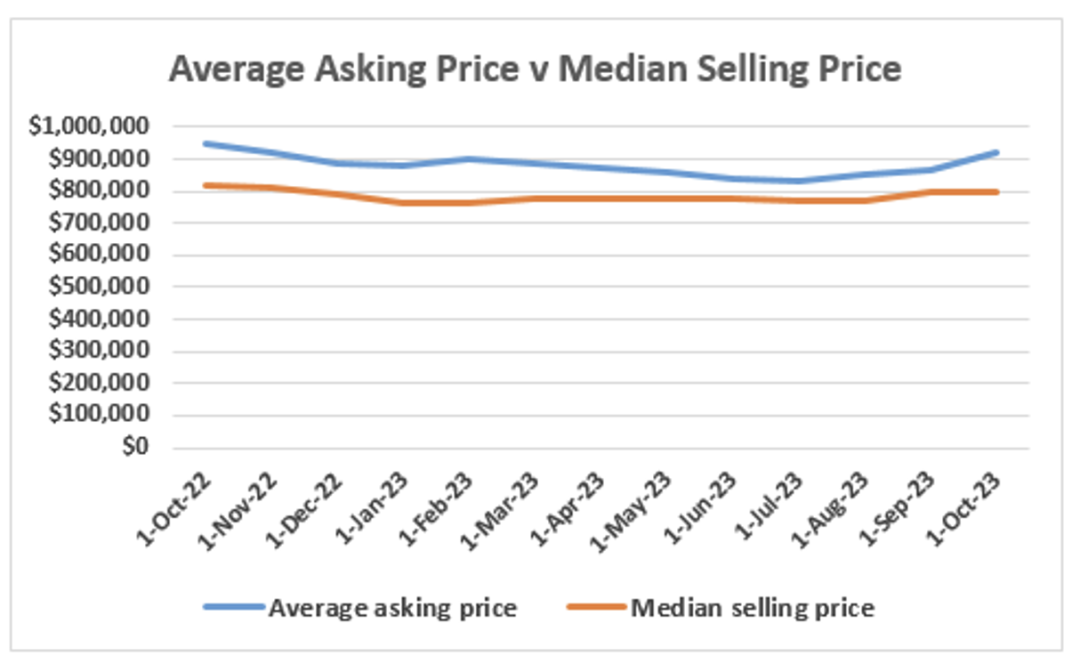
Monthly average asking prices compared with median sale prices (Source: REINZ/Realestate)
Since month 6, the average asking price recorded by realestate.co.nz has risen from NZ$841,688 to NZ$920,678 in October, an increase of NZ$79990. However, REINZ’s median sale price was almost unchanged over the same period, edging up from NZ$780,000 in June to NZ$795,000 in October. This more than doubled the gap between the two measures, from NZ$61,688 in June to NZ$125,678 in October.