




Commercial banks have made some small mortgage rate cuts in recent weeks as wholesale interest rates have fallen in financial markets. For example, Kiwibank is lowering several home loan rates: its two-year special rate is falling from 7.05% to 6.89%, its three-year rate from 6.89% to 6.75%, its four-year rate from 6.79% to 6.69%, and its five-year rate from 6.79% to 6.59%.
In mid-October last year, the best two-year mortgage rate offered by the major commercial banks was still 6.99%, compared with around 6.89% now. Banks’ margins have surged from 1.35% to around 2.2%.
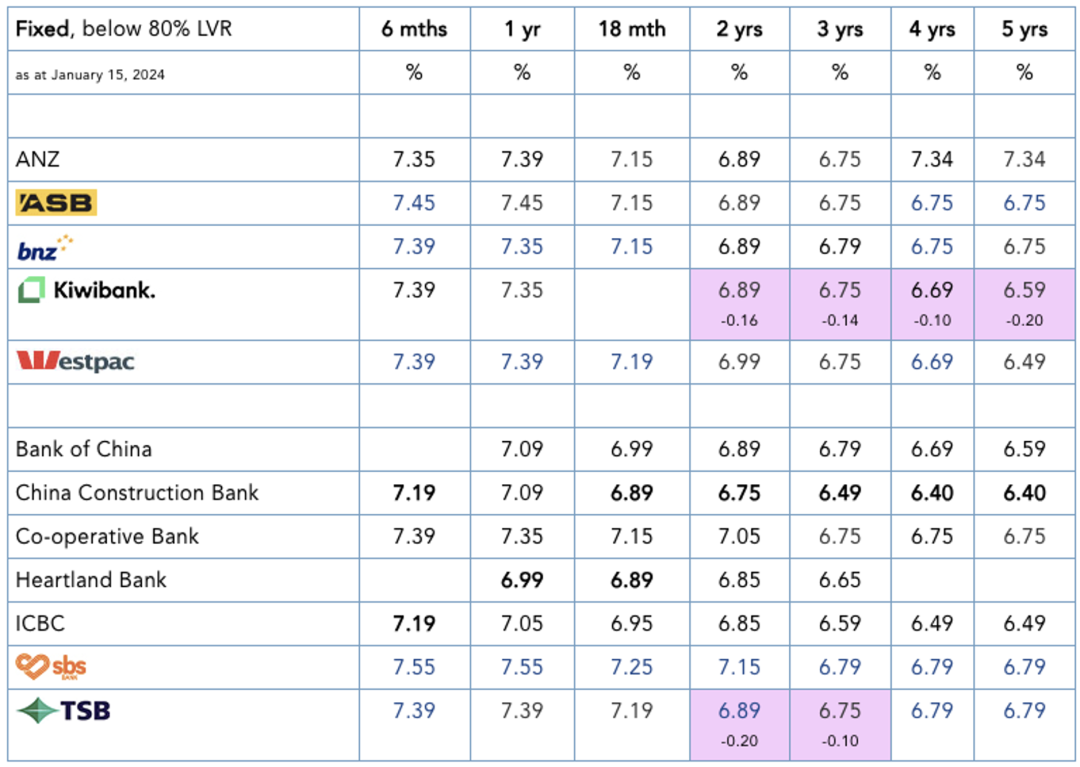 Comparison of commercial banks’ special mortgage rates
David Cunningham, chief executive of well-known lending company Squirrel, recently said publicly that given the sharp fall in wholesale interest rates before Christmas, he expects mortgage rates could drop by around a percentage point over the coming months. With banks currently enjoying very wide margins, most fixed rates could fall by 0.5% to 1% by March.
 Lending company Squirrel’s chief executive —David Cunningham
At current levels, a percentage-point cut would bring two-year fixed mortgage rates below 5.9% and one-year fixed rates to around 6.35%. Cunningham added that he does not expect the Official Cash Rate (OCR) to be cut before the middle of this year, but believes this will not prevent major commercial banks from adjusting fixed rates “very quickly”,wholesale rates had already fallen sharply before Christmas, yet the banks had taken no action. He also believes the Reserve Bank of New Zealand will become increasingly comfortable letting the mortgage market do some of the work itself, just as banks continued raising interest rates after the OCR had peaked. He explained that the Reserve Bank would not immediately lower the OCR to achieve its desired outcome. Instead, it might continue to signal considerable caution about falling interest rates. He stressed that fixed rates are often what matter most to New Zealanders, rather than the OCR controlled by the Reserve Bank.

Cunningham believes the Reserve Bank of New Zealand needs to look forwards rather than backwards. Elsewhere in the world, inflation has slowed much faster than expected. “So why would New Zealand be an exception?”
 New Zealand independent economist Tony Alexander
Independent economist Tony Alexander says the Reserve Bank of New Zealand does not yet want the wave of overseas interest rate cuts to reach the domestic market. This is because it is deeply concerned about New Zealand’s inflation rate, still at 5.6%, and its slow decline. He pointed out that major household living costs continue to rise steadily: council rates are increasing much faster than inflation, insurance premiums are soaring, construction costs continue to rise, and groceries are becoming more expensive. All of this suggests high inflation cannot be eased in the short term. Alongside concerns about global oil prices and supply chain disruptions, the Reserve Bank of New Zealand appears to have ample reason to tell the major banks that substantial OCR cuts are out of the question in the near term.
 BNZ chief economist Mike Jones
ASB economist Chris Tennent-Brown says long-term mortgage rates could fall soon if wholesale interest rates continue to decline. However, BNZ chief economist Mike Jones takes a more cautious view. He believes there will be room for mortgage rates to fall if the sharp decline in wholesale rates seen in December continues, but market expectations of interest rate cuts may be running ahead of reality.
He says the Reserve Bank of New Zealand could deliver substantial monetary easing later this year. However, concerns about persistent inflation make any supportive measures in the near term seem unlikely. It is also worth considering that term deposit rates have yet to fall, despite being a key component of banks’ funding costs. Fixed mortgage rates therefore face limited downside risk, and he expects a sustained downward trend may not emerge until later this year. Alexander also stressed that he believes the Reserve Bank will eventually cut interest rates, but this remains months away. Before then, mortgage rates will edge down before falling more substantially, with current speculation pointing to the middle of this year as the most likely timing.


Cunningham expressed concern that GDP per capita fell by only just under 1% in the third quarter of last year, with rising net migration masking the economic downturn. In this environment, continued house price growth would be difficult to sustain. He said plainly that New Zealand is currently among the few countries where house prices have yet to return to their COVID-era peak. When borrowing was cheap during the pandemic, more home loans with short fixed terms were approved in New Zealand than elsewhere in the world. As a result, New Zealand borrowers have felt the effects and shock of recent interest rate increases particularly strongly.
He acknowledged that, following the sharp rise and fall in house prices, New Zealand’s net price gain is on a par with other countries at around 25%. If wage growth and higher construction costs over this period are also taken into account, house prices appear to have returned to where they should have been three years ago.
He expects house prices to rise again as interest rates start falling and economic conditions improve, but a rapid recovery is unlikely。In the year to November, the number of building consents approved for new homes fell 24% compared with the previous year, possibly partly because developers were concerned about future house price trends. He is confident about the housing market’s future. As house prices stabilise, he believes people will gain greater confidence in new developments, although this positive effect may take years to emerge.