

During the last election campaign, National Party leader Christopher Luxon said that if he formed the next government, he would change housing density rules and prioritise greenfield development — turning farmland into urban areas. Although National had previously supported the Medium Density Residential Standards (MDRS), which allowed three-storey homes on all residential land in major cities, he said he intended to scrap the standards.
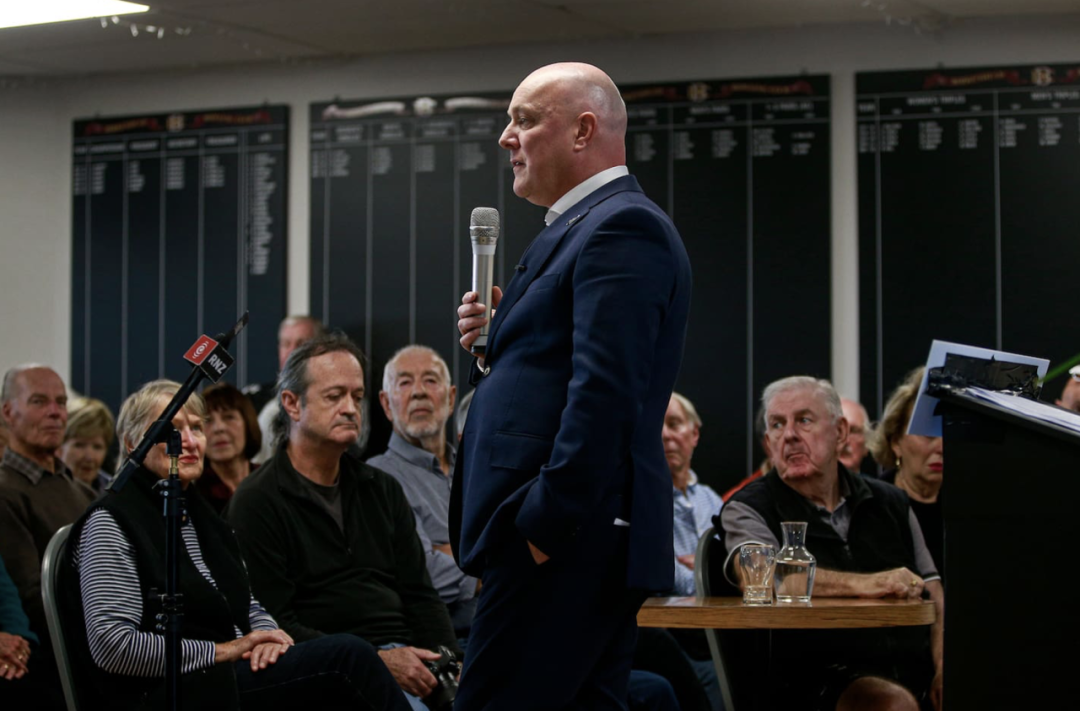
Luxon speaking at a public meeting in Birkenhaed on the North Shore
Then, in May this year, Luxon told a public meeting in Birkenhaed on the North Shore: “We got it wrong on the MDRS.” He also revealed that, although no new policy had been formally announced, he and his party's Housing Minister Chris Bishop would make an announcement within weeks. Bishop also said the Government would require councils to plan for 30 years of housing growth. The reforms would remove local councils' powers over urban boundaries and development standards and make more land available for development in an effort to address the urban housing crisis.
Now, today, 4 July, Chris Bishop has delivered a speech to the Real Estate Institute of New Zealand, announcing a series of changes to New Zealand's planning laws recently agreed by Cabinet. He argued that these changes would bring more affordable land onto the development market and make it cheaper and easier to develop.
Setting out the facts and his reasoning, Bishop highlighted the current housing crisis in his speech:
|
Three main reasons to address housing
Bishop said there were three main reasons why the longstanding housing crisis urgently needed to be addressed:
The first is to promote economic development. Housing drives productivity, and New Zealand has long suffered from poor productivity. Productivity growth can effectively raise our living standards and promote economic prosperity.
The second is to help restore the Government's finances. Last year, central government spent more than NZ$5,000,000,000 on various forms of housing assistance. This included the Accommodation Supplement, social housing rent subsidies, emergency housing grants, transitional housing and initiatives to address homelessness. If that NZ$5,000,000,000 figure remained unchanged, the New Zealand Government would spend more than NZ$20,000,000,000 on housing assistance alone over a four-year Budget cycle.
The third is humanitarian. Many people are currently living in government-funded motels, and the situation will get worse. We need to change this.
Bishop stressed that solving the housing crisis required making it easier to build homes. The Government's housing agenda included five interconnected actions:
|
He then focused on how the three pillars of Going for Housing Growth would address the housing crisis at its roots. These include freeing up land for development and removing unnecessary planning barriers; improving infrastructure funding and financing; and providing incentives for communities and councils to support growth.
Bishop said bluntly: “New Zealand is not a small country in terms of land area, but our planning system makes it difficult for our cities to expand. As a result, our land prices are too high because the market expects a persistent shortage of developable urban land.” This makes it easy to understand why urban land on Auckland's outskirts costs 4.2 to 4.4 times as much per square metre as nearby rural land, and why the zoning premium doubled between 2011 and 2021.
He also stressed that the Government's plan built on the existing National Policy Statement on Urban Development and the Medium Density Residential Standards, both advanced by the previous government. The National Policy Statement on Urban Development, in particular, was a positive step, but its approach was too uniform and needed strengthening and refinement.

Housing Minister Chris Bishop
Bishop announced that Cabinet had agreed to the following six changes:
1
Set housing growth targets for tier one and tier two councils
Every tier one and tier two council will be required to set specific housing growth targets. These will be based on projected housing demand over the next 30 years, and councils must ensure they have enough live-zoned land to meet that demand. Live zoning means the land already has the statutory approvals needed for housing development. This measure will require councils to plan and allocate land more actively to meet future housing needs.
2
New rules to make it easier for cities to expand at their edges
New rules will reduce the planning and regulatory barriers currently preventing cities from expanding outwards. By simplifying land rezoning and development approval processes, the Government will ensure land on urban fringes can more easily be converted to residential use. This includes shortening approval times, reducing bureaucracy and providing clear guidance to encourage developers to build housing on city fringes.
3
Strengthen density provisions in the National Policy Statement on Urban Development
Density provisions in the National Policy Statement on Urban Development will be strengthened to allow higher-density development within existing urban areas. This means more apartments, small homes and townhouses will be permitted in city centres and other key areas. The aim is to use existing infrastructure and public transport, improve land-use efficiency and reduce reliance on land in outer suburbs.
4
New rules requiring city councils to support mixed-use development
Councils will be required to support mixed-use development more actively in their urban planning. Mixed-use development combines housing, commercial premises, offices and recreational facilities in the same area. This planning approach will create more vibrant, convenient and efficient communities, allowing residents to meet their various needs within walking distance or a short commute.
5
Remove minimum floor area and balcony requirements
Many council rules impose strict minimum floor area and balcony size requirements on new homes, often restricting higher-density development. The new rules will remove these minimum requirements, allowing smaller, more compact homes. This will help reduce development costs, make housing more affordable and increase housing supply within cities.
6
New provisions making the Medium Density Residential Standards optional for councils
The Medium Density Residential Standards will become optional for councils. This means councils can decide flexibly whether to adopt them, based on local needs and community characteristics. Although the standards were intended to increase housing supply within cities, their uniform approach may not suit some areas. Councils will therefore have greater autonomy to choose the development strategies best suited to their areas.
Differing views from others

Labour housing spokesperson Kieran McAnulty
Labour housing spokesperson Kieran McAnulty said Labour was “open” to any measures that would increase housing, “but not at the expense of building standards”. Ensuring development opportunities “all looks good”, but “unless the Government provides infrastructure funding, councils' ability to expand will be limited”.

Green Party urban development spokesperson Julie Anne Genter
Green Party urban development spokesperson Julie Anne Genter said that although National's announcement today included some positive measures supporting urban density, this Government's direction, particularly its transport policies, would make our cities continue to sprawl and become less efficient.
She said mixed-use zoning was a positive step towards greater building density, but “disconnected greenfield development and transport policies that prioritise cars will perpetuate the status quo of urban sprawl. If we want to build smart, efficient cities, we must prioritise housing in places with established infrastructure. Compact cities allow people to reach the places their lives revolve around conveniently and affordably.”