
01
Commercial banks cut mortgage rates
New Zealand’s major banks have recently been cutting mortgage rates, but experts warn that chasing lower rates without careful consideration could leave homeowners facing hefty break fees, potentially costing them thousands or even tens of thousands of New Zealand dollars. These “break fees” or “early repayment fees” cover the costs banks incur when customers end their loan contracts early. As interest rates fall, banks will make every effort to recover those costs, so break fees can be very high.
Take a typical example: a homeowner with a mortgage of NZ$600,000 who plans to end a fixed-term loan three years early could face a break fee of up to NZ$50,000. That figure would be enough to deter most people. Even shorter fixed-term loans could carry break fees ranging from NZ$1500 to NZ$3000.
Against this backdrop, decisions about fixing interest rates are particularly important. Although rates are expected to fall further, experts advise homeowners to fully calculate the potential costs and benefits before deciding to repay a loan early. In the current interest rate environment, fixing for a long term may not be a wise choice. Homeowners should consider their circumstances and split their mortgage into two or three portions to spread their risk and avoid hefty break fees resulting from market fluctuations. It is also worth noting that although some banks have attracted new borrowers in previous cycles by paying their break fees, this does not appear to have happened in the current cycle. Instead, banks may offer cashback to retain customers and partially offset break fees. While this may look attractive, homeowners still need to weigh the advantages and disadvantages carefully to avoid financial difficulties caused by impulsive decisions.
02
Could six-month mortgage rates fall to 5.5% next year?
Answers due this Wednesday
At 2 pm this Wednesday, the Reserve Bank of New Zealand will announce its latest Official Cash Rate (OCR) decision. Although markets widely expect the Bank to hold the OCR at 5.5%, the more important issue is how it changes the wording of its Monetary Policy Statement. This will directly affect economic expectations over the coming months, particularly forecasts for inflation, interest rates and house prices.
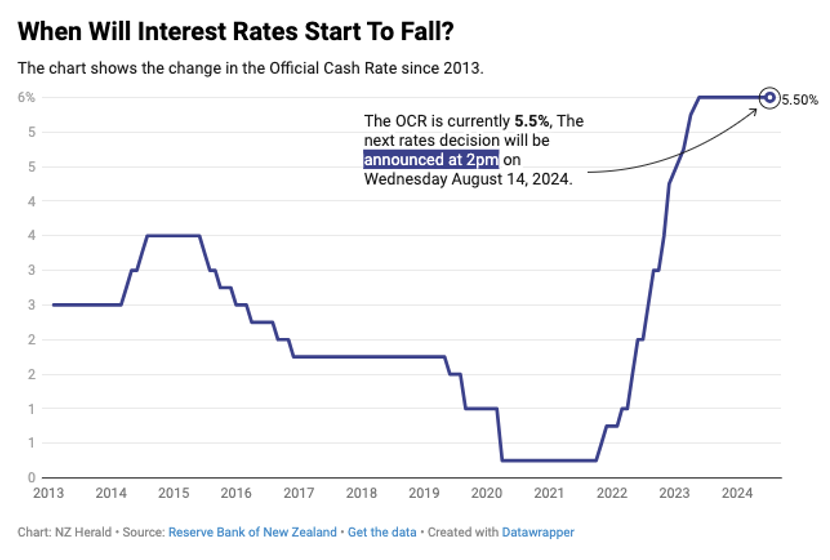
OCR movements from 2013 to the present (Source: RBNZ)
For borrowers hoping to see mortgage rates fall, the Reserve Bank’s forecasts are crucial. Previously, the Bank said it would not cut rates before this time next year. However, the likelihood of cuts is gradually increasing, with the first potentially coming as early as October or November. The OCR could then fall to around 4.5%, meaning typical fixed mortgage rates for terms of 6 to 18 months could drop below 6%, and possibly reach 5.5%, particularly if competition among major banks for market share is intense.
03
Labour market figures “unremarkable”
Labour market figures released last week showed unemployment rising from 4.3% in the first quarter to 4.6% in the second, but this was not enough to prompt an immediate Reserve Bank rate cut. Both the increase in employment and the rise in unemployment were mainly attributable to an expanding labour force rather than widespread redundancies. So, although the labour market figures were less than ideal, they did not significantly affect the OCR outlook.
04
Are homeowners’ property gains increasing or shrinking sharply?
In the property market, CoreLogic’s second-quarter Pain and Gain Report showed that 92% of properties sold for more than their original purchase price. Although this was down from 93% in the first quarter, most sellers still made a gain. However, as buyers gained greater bargaining power over prices, some sellers made losses. This highlights how important the length of property ownership is to the eventual gain.

05
Could net migration and rental growth slow again?
Stats NZ figures due this week include net migration for June on Tuesday and rental prices for July on Thursday. Notably, migration numbers have fallen sharply in recent months, with arrivals declining while departures remain high. In June, month-on-month rental growth was just 2.5% against a long-term average of 3.3%, and July is also very likely to show further signs of weakness.
06
Is economic activity still stagnating?
Stats NZ’s New Zealand Activity Index, due this Friday, also deserves investors’ attention. If the July figures continue the weakness seen in June, when activity fell 1.1% year on year, this will put further pressure on the Reserve Bank to cut rates in the coming months.