

01
The Reserve Bank unexpectedly cuts the OCR: where will the market head?
Last Wednesday, the Reserve Bank of New Zealand cut the Official Cash Rate from 5.5% to 5.25%, earlier than the post-September timing many had expected. The Reserve Bank of New Zealand said the risks that delaying cuts would pose to New Zealand’s struggling economy outweighed any concerns about inflation. Its forecasts suggest the OCR could fall by around another 1.25 percentage points to 4% by the end of 2025.
What has changed since the rate cut?
Banks responded swiftly to last Wednesday’s announcement. Kiwibank cut some rates by 0.25% within minutes of the news, followed quickly by ASB and Westpac. ANZ also cut rates by 0.10%. BNZ was slightly slower, waiting until Thursday to announce a 0.25% cut taking effect on Friday. Economists believe the Official Cash Rate will continue to fall over the next 12 to 18 months. The Kiwibank team, led by chief economist Jarrod Kerr, said Wednesday’s move would be the first in a series of consecutive rate cuts.
What does this mean for mortgages?
When the Reserve Bank of New Zealand moves, banks follow. In this case, an OCR fall of 3% over roughly the next 18 months, as economists predict, would mean mortgage rates falling by a similar amount over the same period.
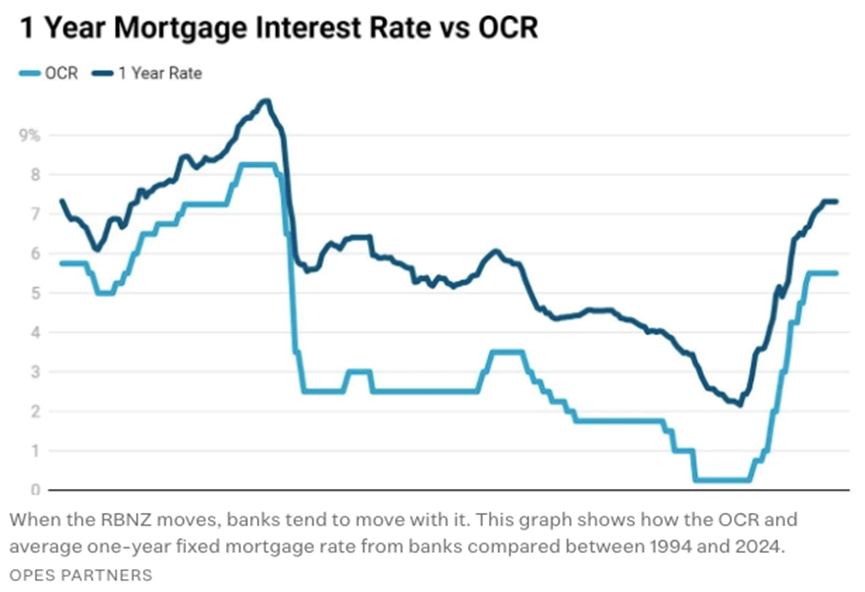
Chart showing movements in 1-year mortgage rates and the OCR from 1994 to 2024 (Source: Opes Partner)
ASB chief economist Nick Tuffley said the pace of cuts would depend on how quickly inflation fell, with the Reserve Bank of New Zealand continuing to monitor the data closely. “Setting aside the pursuit of perfectly predicting every OCR move, the key message for our customers is that lending and deposit rates are heading down, with further to go.” This is good news for borrowers.
What does this mean for the property market?
BNZ chief economist Mike Jones said the property market would likely be among the first sectors to respond to falling retail interest rates. He believes housing statistics will attract more attention than ever as people look for signs of a recovery. Although current survey data shows some fluctuations, he and his team see steady development as more likely than accelerating growth.
02
New Zealand housing affordability report
Although house prices are well below their post-pandemic peak, they remain high relative to New Zealanders’ incomes. CoreLogic’s latest Housing Affordability Report, covering second-quarter property data, highlights the following market pressures:
- New Zealand’s house-price-to-income ratio is 7.7, below the market peak of 10.2 but above the 20-year average of 6.8;
- Saving for a deposit takes 10.2 years, below the 2021 peak of 13.6 years but above the long-term average of 9.1 years;
- Mortgage repayments account for 54% of New Zealand’s median household income, slightly below the worst level of 57% in the second quarter of 2022, but above the long-term average of 43%;
- Rents are also a heavy burden, accounting for 28% of median household income in the second quarter of 2024, hovering near historical highs and above the long-term average of 26%.
Lower interest rates and stable rents will clearly help over the medium term. But wage growth is also slowing, and although house prices may not rise sharply, they are unlikely to fall further either. In other words, housing affordability is likely to remain a major issue, although the government’s current strong push to increase housing supply could deliver positive results over the longer term.
03
Net migration and rent growth may continue to slow
Turning to rents, the latest statistics show that rents for new tenancies rose just 2.5% in the year to July, below the average of 3.3%. This is unsurprising given easing migration pressures, with arrivals growing more slowly and departures continuing to rise. Rents’ already high starting point will also limit further growth. Meanwhile, available rental listings have increased substantially, potentially reflecting a combination of first-home buyers moving from renting into home ownership and newly built investment properties entering the market.
04
Some economic indicators remain weak
The latest card spending and Performance of Manufacturing Index (PMI) figures released last week show that the economy remains weak. This lends further support to the Reserve Bank’s decision to cut rates and suggests expectations of further OCR cuts in the coming months may grow.
05
Will this week bring more bad news?
Alongside the figures above, this week will bring the Performance of Services Index and Stats NZ’s second-quarter retail sales data. These are unlikely to show any strength, providing further evidence that the current economic environment needs support from lower interest rates.