
Over the past 24 hours, ASB has reclaimed the lead in the mortgage interest rate market by cutting rates more frequently. However, this battle is far from over, with other banks responding by offering strikingly low rates. This succession of cuts has given borrowers plenty to keep up with and once again reshaped competition between banks.
In its latest adjustments, ASB has lowered mortgage rates across several fixed terms. Its 6-month fixed rate has fallen to 6.85%, its 1-year fixed rate is 6.39%, and its 18-month fixed rate has dropped to 5.99%, matching ANZ and ICBC. Its 2-year fixed rate has also been reduced to 5.89%, level with SBS Bank. The 3-year fixed rate is 5.79%, while its 4-year and 5-year rates are 5.79% and 5.69% respectively, matching Westpac across the latter two terms.
It is also worth noting that Kiwibank, identified by the New Zealand Commerce Commission as a potential market “disruptor”, does not feature among the lowest rates this time. Although its chief executive has publicly expressed a willingness to take on that role, its current performance has yet to live up to the label.
Competition is currently intense, with mainstream banks refusing to give ground on rates across different terms. For example, ANZ, ASB and ICBC have all lowered their 18-month fixed rates to 5.99%. For the 3-year fixed term, ASB's 5.79% is the lowest in the market. Similarly, ASB and Westpac both offer 5.69% for the 5-year fixed term, illustrating their fierce rivalry.
Heartland Bank finds itself in a particularly awkward position in this round of rate cuts. For years, its online rates set the market benchmark, but it has now lost its edge amid the rapid wave of reductions. Although there is no firm indication yet that Heartland Bank will take further action, restoring its competitiveness appears particularly urgent in such an intensely competitive market.
For consumers, banks' advertised rates are only a guide, as negotiating with a bank or having a favourable financial position can secure a better rate. Borrowers whose loan-to-value ratio (LVR) is close to 80%, however, are likely to find further discounts difficult to obtain.
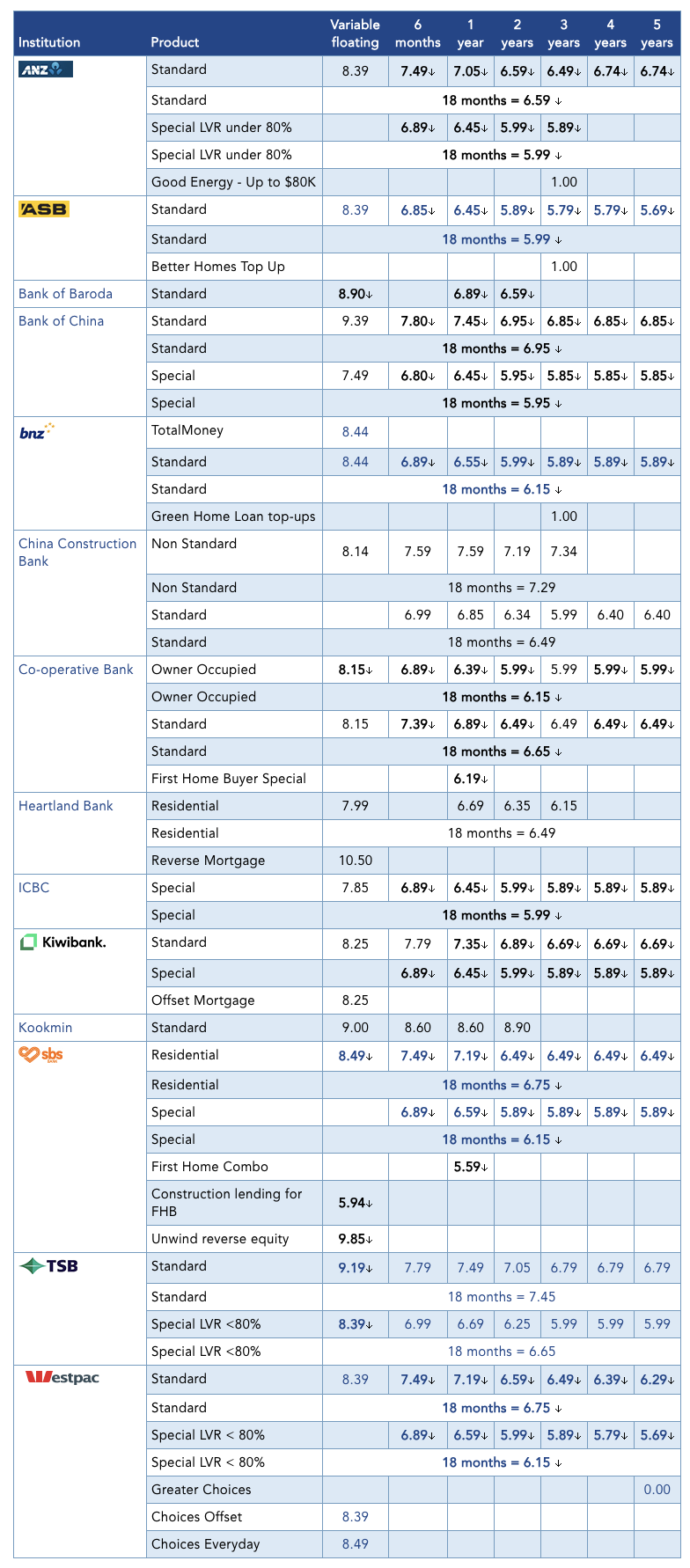
Latest interest rate table: www.interest.co.nz/borrowing
As the banks' interest rate war intensifies,
how can borrowers choose amid the confusion?
As major banks cut rates to compete for a share of the first-home buyer market, the interest rate war is becoming increasingly fierce. Through television advertising and online campaigns alike, banks are doing everything they can to attract more mortgage customers. ANZ has even used The Clash's song Should I Stay or Should I Go as backing music, suggesting it is time for customers with mortgages at other banks to consider switching.
Meanwhile, the speed at which the interest rate environment is changing is astonishing. As recently as May this year, the Reserve Bank of New Zealand was discussing raising the official cash rate (OCR). However, as New Zealand's economy deteriorated and inflation fell unexpectedly in July, expectations of rate cuts gathered pace. The Reserve Bank's official announcement last week that it was lowering the OCR to 5.25% then became the spark for this battle.
Banks responded swiftly by cutting rates. Longer-term rates fell first, and discounts on shorter-term rates are now appearing too. With banks competing fiercely, larger rate cuts and more favourable lending terms are expected over the coming months. For homeowners under pressure from mortgage rates above 7%, this is welcome news.
As ANZ managing director of personal banking Grant Knuckey puts it, “The market is very competitive at the moment.” Homebuyers and homeowners may feel overwhelmed by this rapidly changing market. To help consumers track the latest rate movements, Opes and OneRoof have jointly launched a rate-cut tracker. The tool shows major banks' rate cuts in real time and clearly identifies which banks are cutting most actively.
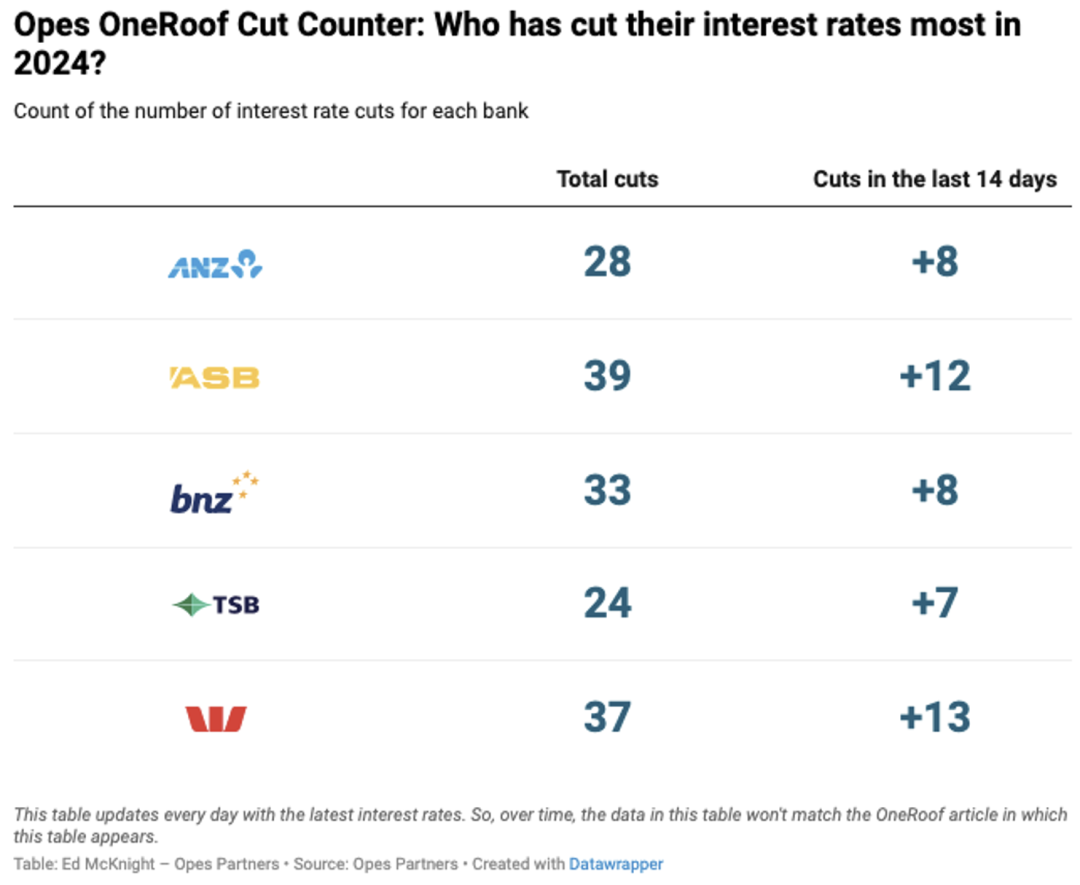
The banks most active in cutting rates in 2024 and their number of cuts (Source: Opes)
At the time of writing, ASB was the most active bank, having announced 39 cuts since the start of 2024, including 12 over the past two weeks. Westpac followed closely with 37 cuts, around a third of them also made in the past two weeks.
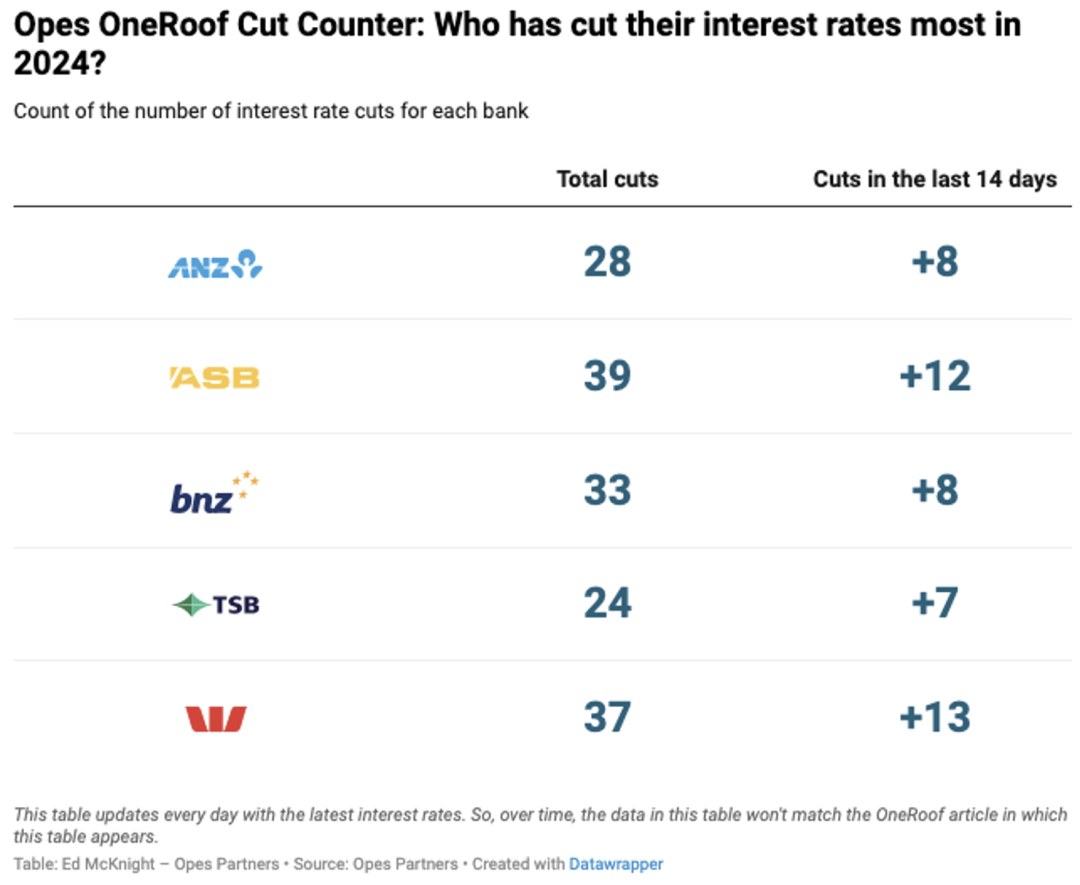
Chart comparing the number of rate cuts across different fixed terms (Source: Opes)
Across individual terms, one-year rates have been cut most often, with banks making 26 cuts so far. Two-year rates follow closely, with 25 cuts in total. However, ANZ's 18-month rate has seen the largest single reduction. At the start of the year, ANZ's 18-month rate was 7.15%; it has now fallen to 5.99%, a total reduction of 1.16 percentage points. On a NZ$500,000 loan over 30 years, this reduction would save borrowers NZ$88 a week.
By comparison, floating rates have seen smaller adjustments. Major banks have cut their floating rates only 6 times in total, mainly over the past two weeks. The largest reduction was just 0.25 percentage points, equivalent to a weekly saving of NZ$20 on a NZ$500,000 loan.
As the next OCR decision in October approaches, the rate-cutting battle will continue. The market's focus will be on which bank ultimately wins this contest and becomes the true “rate slasher”. We will have to wait and see.