

1
Auckland homebuilding suffers a major setback
The latest figures show Auckland Council issued 1332 code compliance certificates (CCCs) for new homes in June, compared with more than 1600 in each of the preceding three months and 1742 in June last year. This is the first fall in home completions over any 12-month period since July 2022. The decline in June completions marks the end of years of rapid growth in Auckland homebuilding, a shift already signalled by falling residential building consents in the region.
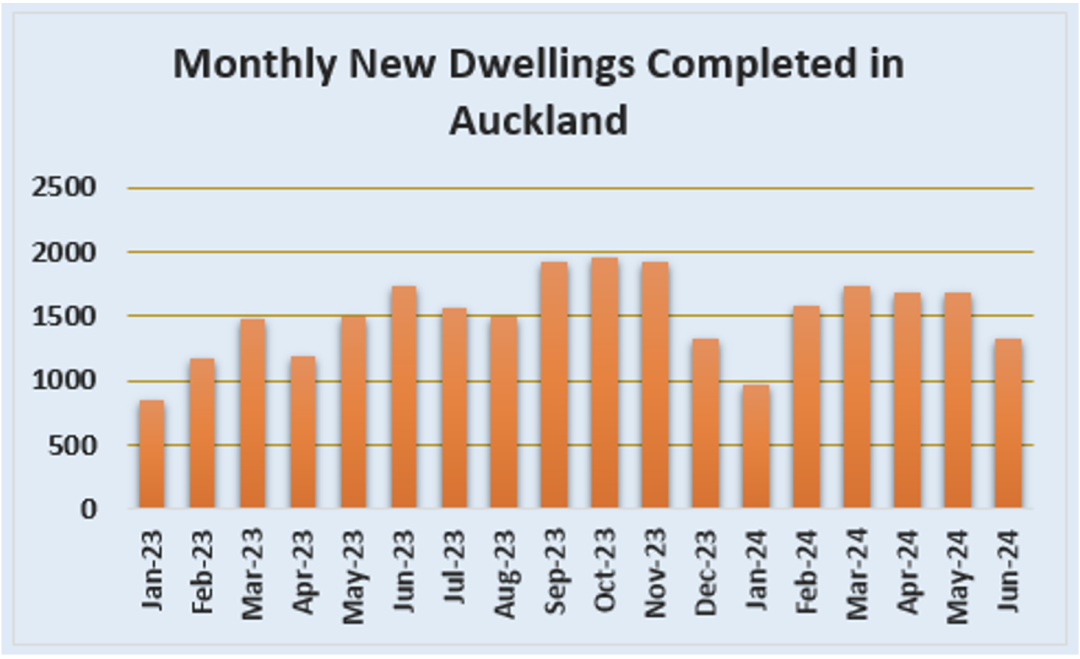
Bar chart showing the number of CCCs issued by Auckland Council from January 2023 to June 2024
(Source: interest.co.nz)
Unlike building consents, code compliance certificates are issued after construction is completed, making them the best measure of new housing supply. Building consents, by contrast, are issued before construction begins and indicate potential building activity. Falling consent numbers mean fewer new projects are starting, although many builders have remained busy working through a large pipeline of projects already under construction. However, the latest figures suggest that as construction activity and new projects decline, many builders may soon face a shortage of work. The June decline represents only a single month, so we need to wait for completion figures over the coming months to assess more accurately where Auckland homebuilding activity may be heading. Even so, the outlook suggested by the latest figures appears unpromising.
2
Property sales rebound after a brief June slump
Around 6300 property transactions were completed in July, including sales through real estate agents and private sales, up approximately 14% on the same period last year. This contrasts sharply with the 14% year-on-year fall in sales in June. Given the preceding 13 months of growth and the renewed increase in July, the June result looks like an unexpected exception, possibly related to the additional public holiday that month. Even so, the overall picture remains one of weak sales activity, with transaction volumes over the first seven months of this year still 15–20% below normal levels. That is hardly surprising, given the weak economy and labour market, and the fact that buyers hold the pricing power.
3
First-home buyers' market share remains historically high
Although the First Home Grant has now been scrapped, this group continues to find ways into the market. According to CoreLogic's latest buyer classification data, first-home buyers accounted for nearly 27% of property purchases in July, slightly above the 26% recorded in the second quarter of this year and still at historically high levels. Meanwhile, the number of first-home buyer purchases is also rising. From January to July this year, this group bought more than 11,000 properties, up from around 9,400 over the same period last year.
Several market factors still favour first-home buyers, including the ability to use KiwiSaver towards part of their deposit, less competition from other buyer groups, a wide range of properties and choices on the market that gives them an advantage in price negotiations, and banks' low-deposit, high loan-to-value ratio (LVR) lending policies. Recently, 75–80% of low-deposit lending has, in fact, gone to first-home buyers.
4
New Zealand economic data weakens further
Figures released last week show the domestic economy continuing to weaken. Retail sales fell again in the second quarter, the New Zealand Performance of Services Index (PSI) showed service sector activity declining for the fifth consecutive month in July, and Stats NZ's New Zealand Activity Index rose only slightly. In this environment, companies are likely to remain cautious about costs and hiring plans, continuing to constrain the housing market.
5
Will DTI restrictions affect the market?
The Reserve Bank of New Zealand will release its monthly mortgage lending figures for July today. These could be particularly interesting, as they are the first figures following the easing of LVR rules and introduction of debt-to-income (DTI) restrictions on 1 July. In practice, there may be little immediate change, but DTI figures will become more important as mortgage rates fall and people begin applying for larger loans. CoreLogic chief property economist Kelvin Davidson's initial estimate is that DTI restrictions will have little impact until mortgage rates fall to 5.5%.

CoreLogic chief property economist
Kelvin Davidson
5
Watch this week's latest employment,
confidence and residential consent figures
A range of other figures will also be released this week, covering July employment and building consents, both from Stats NZ, and August business and consumer confidence, both from ANZ. Davidson expects these figures to highlight weakness and volatility in these areas. Any improvement in positive sentiment will also be starting from a low base.