

Westpac recently announced another round of fixed mortgage rate cuts, covering terms from six months to four years. The move gives Westpac the lowest two-year special rate among New Zealand’s five major commercial banks, while its special rates for other fixed terms also match the lowest in the market.
Specifically, Westpac’s six-month fixed mortgage special rate has fallen by 0.4% to 6.85% per annum; its one-year rate has dropped by 0.14% to 6.45%; its 18-month rate has been cut by 0.16% to 5.99%; and its two-year rate has fallen by 0.20% to 5.79%. Its three-year and four-year rates have also each dropped by 0.10%. Meanwhile, Westpac has made similar adjustments to its standard mortgage rates, cutting its two-year rate by 0.20% to 6.39% per annum. The bank has also reduced some of its term deposit rates。
Sarah Hearn, Westpac New Zealand’s General Manager of Product, Sustainability and Marketing, said the mortgage rate cuts were good news for existing homeowners and first-home buyers alike. She noted: “Our one-year special mortgage rate has fallen by a total of 0.69% over the past two months, delivering tangible cost savings for borrowers.”
BNZ also cut its mortgage rates further earlier this week, following an initial reduction a week earlier. BNZ’s six-month mortgage rate has fallen to 6.85%, its one-year rate to 6.45%, its 18-month rate to 5.99%, and its two-year rate to 5.89%, with cuts ranging from 0.04% to 0.20%. These rate cuts respond to market trends following the reduction in New Zealand’s Official Cash Rate (OCR) from 5.5% to 5.25% earlier this month. Undeniably, as major banks compete to lower mortgage rates, borrowers can expect easier financing conditions.
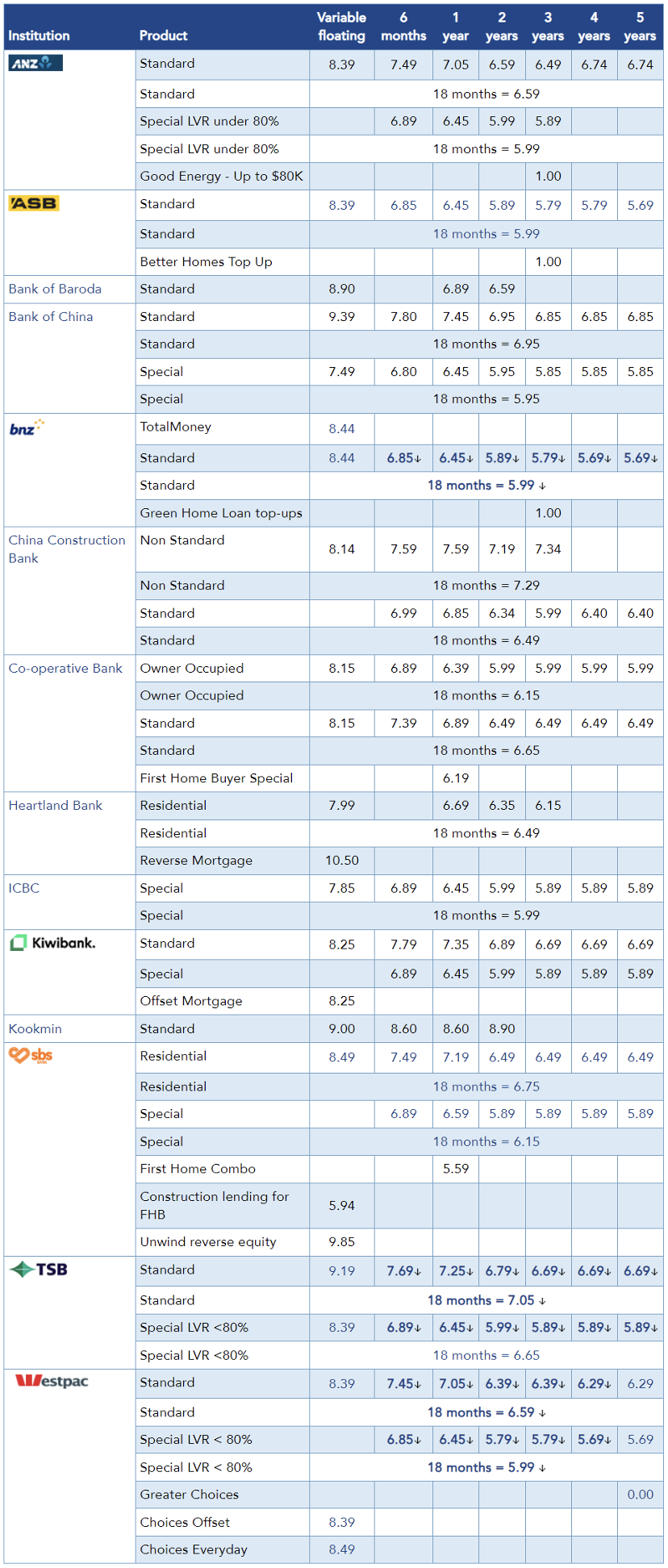
Source: www.interest.co.nz/borrowing
Which parts of New Zealand are the most expensive places to rent?
The question seems straightforward, but the reality is much more complex. The latest survey data from Infometrics shows that New Zealand’s national median rent has risen by as much as 20% over the past three years, while average Kiwi household income has grown by only 15% over the same period. This gap undoubtedly places considerable financial pressure on renters, particularly those living in areas with high rents.
First, let us take Auckland as an example. The city has long been known for its high house prices and rents. A prime example is a luxury home at 542 Remuera Road, Remuera, with a weekly rent of NZ$6000. Six years ago, this five-bedroom mansion made headlines when it sold for NZ$25,500,000. Its owners are said to be a wealthy overseas family.
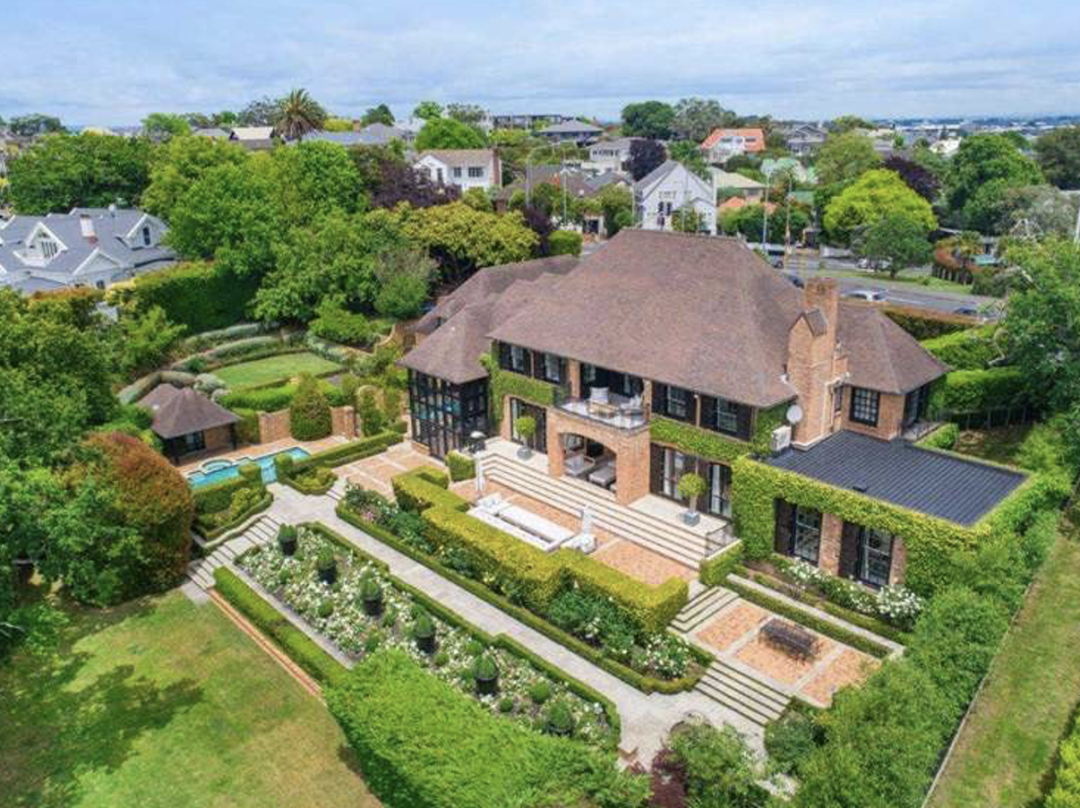
A luxury home at 542 Remuera Road, Remuera, commands a weekly rent of NZ$6000
For many New Zealanders, paying NZ$6000 a week in rent is clearly beyond the reach of an ordinary tenant. Yet even paying NZ$600 a week, the national median rent, is very difficult for some people. For renters, rents in some outlying regions are cheaper than in central areas. For example, Southland’s median rent is NZ$240 a week lower than Auckland’s. In theory, an Aucklander moving south could save NZ$12,480 a year. However, moving to a more remote area may mean a lower income, unless your work location is flexible.
To identify the least affordable regions for renters, we therefore need to consider more than rent levels alone; factors such as living costs also matter. The latest data available for comparing rents with household incomes is from June 2023. Although rents have risen in many regions over the past year, this data still provides a useful guide to rental affordability.
Many people naturally assume Auckland has the highest rents, as it is New Zealand’s largest city and home to the country’s most expensive houses. However, the survey found that although Auckland’s rents are high, it is not New Zealand’s most expensive region for renters. In fact, when rents are compared with incomes, the least affordable regions turn out to be places with lower incomes, such as Bay of Plenty and Northland。
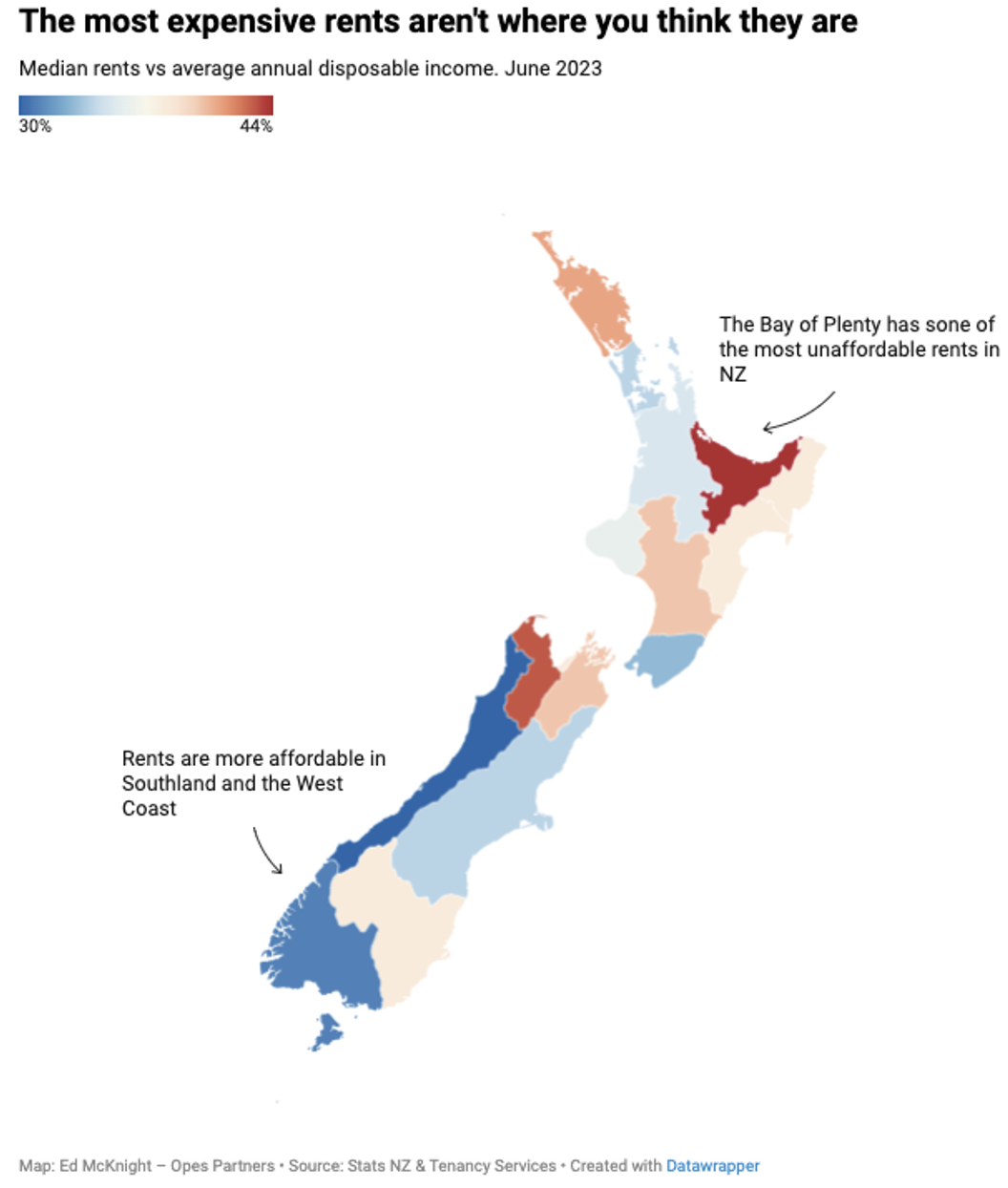
Rental affordability across New Zealand
(Source: Stats NZ & Tenancy Service)
In Bay of Plenty, renters spend an average of 44% of their after-tax income on rent. Although the region’s median rent is 6% lower than Auckland’s, incomes are 27% lower. Renters in Northland face a similar situation, paying an average of 41% of their disposable income to landlords.
So why do these regions, where rents appear lower, turn out to be the least affordable places to rent?
The reason lies in their lower income levels. Moving to these regions may save some money on rent, but if income falls accordingly, quality of life may not improve. Now consider Auckland. Despite a median rent of NZ$640, its relative affordability is surprisingly high. In 2023, Auckland’s median household disposable income was around NZ$97,473, with rent accounting for approximately 34% of income, well below Bay of Plenty and Northland. This means Auckland is actually more competitive nationally when rent is measured against income.
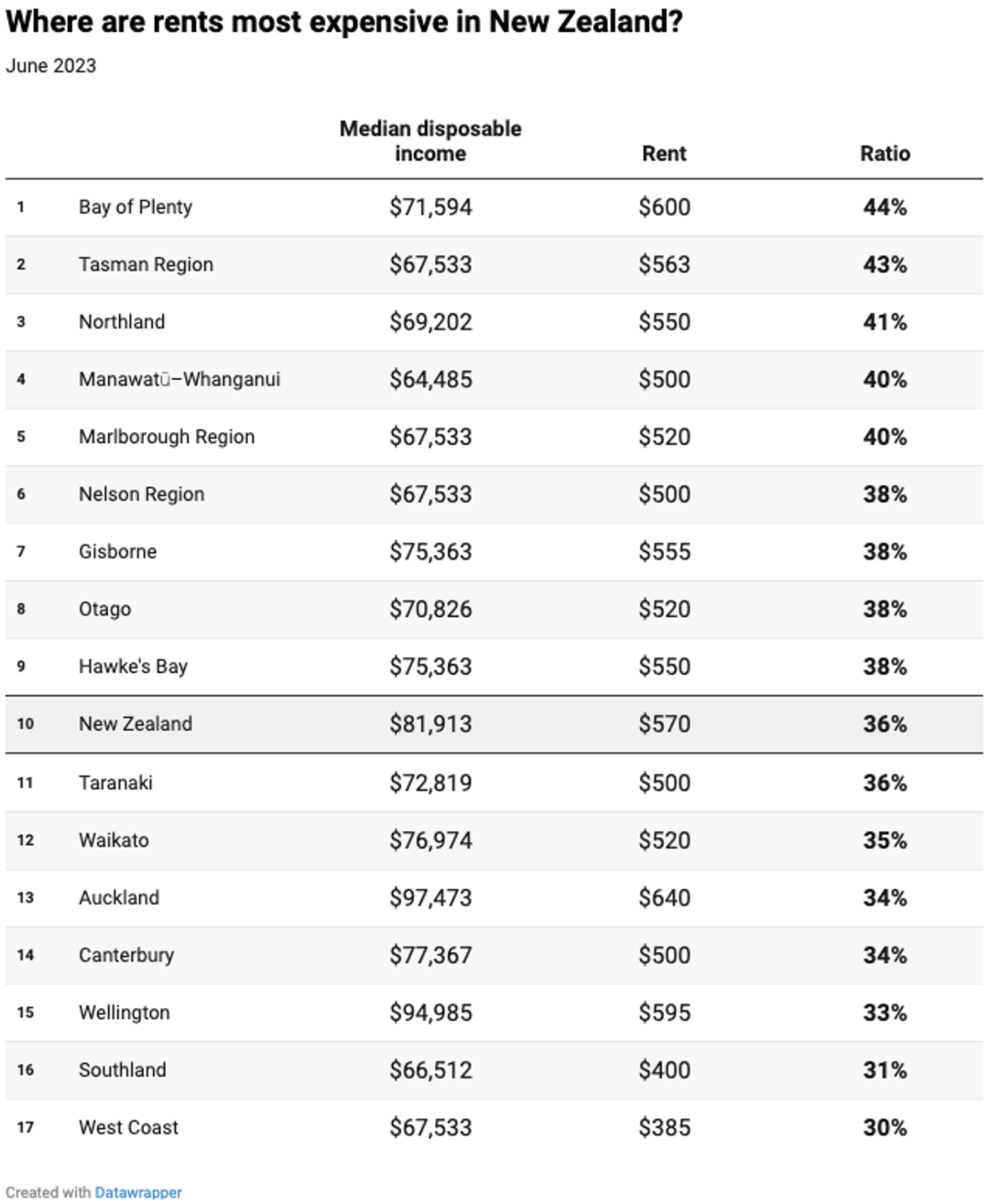
Rent-to-income ratios across New Zealand (Source: Stats NZ)
Some regions have more reasonable rent-to-income ratios. Wellington, for example, has a median rent of NZ$595, while median disposable income is just under NZ$95,000. Rents are relatively affordable partly because the city has a large number of apartments and units. These apartments and studio units tend to be more economical, bringing down the median rent.
On the West Coast, renters pay just NZ$385 a week, accounting for 30% of after-tax income. This balance between rent and income undoubtedly gives renters greater financial freedom and a better quality of life. When choosing where to live, it is therefore not enough to focus solely on rent levels. It is more important to consider rent as a proportion of disposable income. This approach can help us understand the true cost of living in different regions more clearly and make better-informed choices about where to live.
In the current economic environment, renters need to weigh living costs against income more carefully. High rent does not necessarily mean a lower quality of life, nor does low rent necessarily mean a better life. The key is to find a lifestyle and balance that suit your circumstances.