

New Zealand rents far exceed those in many other countries
The Economist recently reported that New Zealand topped an Organisation for Economic Co-operation and Development (OECD) ranking for 2022, with tenants spending more than 40% of their disposable income on rent, ahead of other countries including the United Kingdom, Spain, the United States, Canada, Ireland, Japan, France, Italy, Germany and Austria among OECD members。
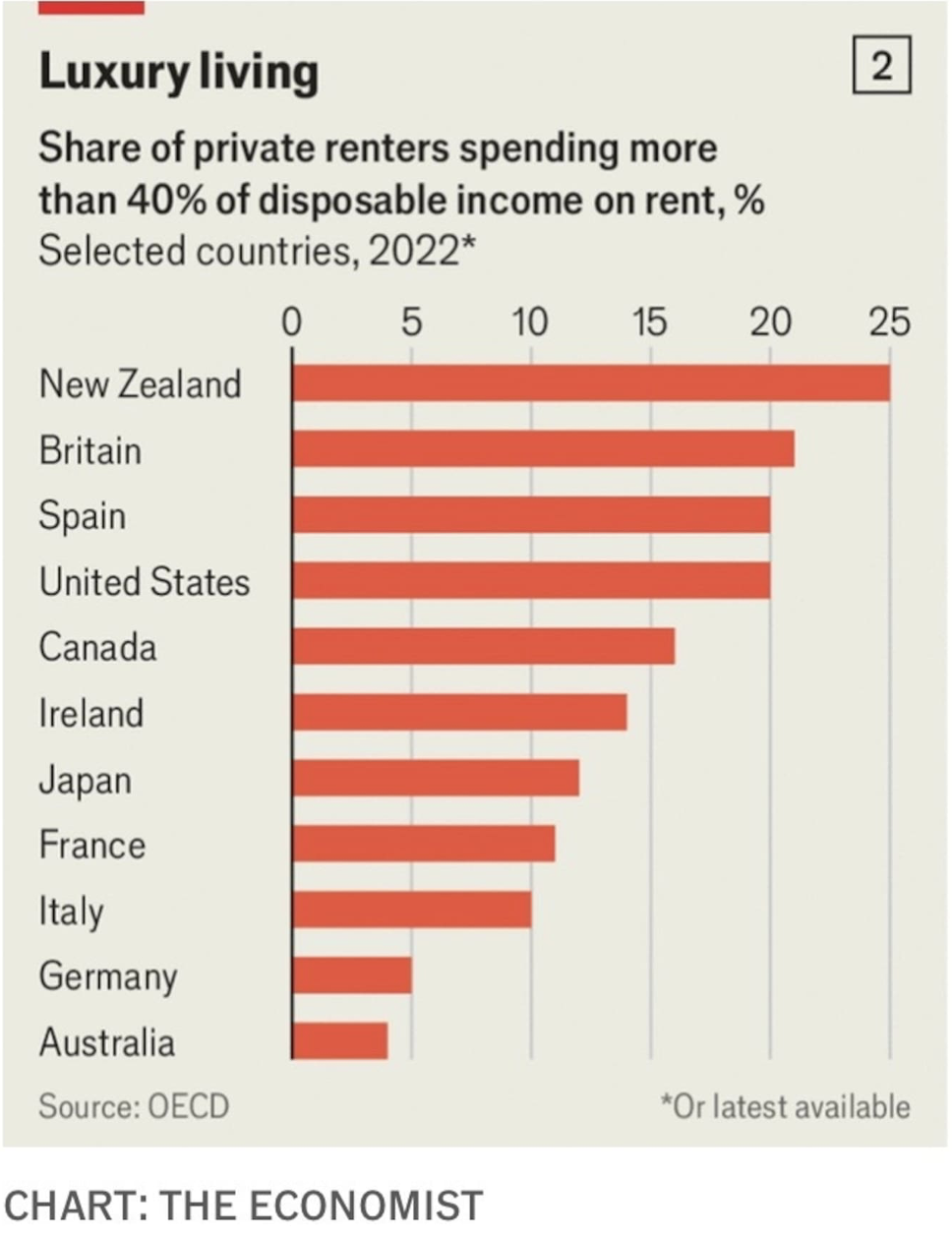
New Zealand ranks highest among OECD countries for rent as a share of income
(Source: The Economist)
Among renters, around a quarter of New Zealanders spend 40% or more of their disposable income on rent. This exceeds the proportions in the United Kingdom, where 22% of renters spend more than 40% of their disposable income on rent, and Spain, at 20%. The magazine commented that this squeeze on tenants extends from social democracies that champion strong tenancy rights to English-speaking countries that favour home ownership, and that the situation is getting worse.
In New Zealand, advocacy group Renters United and the Green Party have proposed rent controls to ease the immense pressure on New Zealanders’ livelihoods caused by high rents and unreasonable increases. However, rent controls are not necessarily an effective solution. In Sweden, powerful tenants’ unions negotiate with landlords to keep rents 50% below market levels. The result has been a severe shortage of rental homes, as those fortunate enough to secure a tenancy refuse to move. This has left “many people missing out”, with an average wait of 20 years to rent in central Stockholm. Rent controls can therefore have the opposite effect to that intended: rather than easing tenants’ burden, they can make it heavier.
Auckland Council has previously said that rents are rising faster than wages and salaries, stretching many households’ budgets and putting tenants under greater housing pressure.
Major reforms to New Zealand tenancy law are coming next year
The New Zealand coalition government’s new policy will make it easier for landlords to evict tenants. Housing Minister Chris Bishop says the aim is to remove “barriers to increasing the supply of private rental housing”.
On 21 May, Bishop said the reforms had passed their first reading. The changes include:
-
Reintroducing 90-day “no-cause” terminations of fixed-term tenancies, allowing landlords to end a fixed-term tenancy without giving a specific reason.
-
Restoring the notice period for landlords ending fixed-term tenancies to 42 days in the following circumstances:
—The landlord wants to move into the property or have a family member move in; or
—The tenancy agreement states that the property is normally used to house employees, and the landlord wants an employee to move in; or
—The property is subject to an unconditional sale agreement requiring vacant possession.
-
Restoring the notice period for tenants ending fixed-term tenancies to 21 days.
-
Introducing a pet bond of up to two weeks’ rent, which can be charged in addition to the existing bond when a tenant wants to keep a pet; requiring tenants to obtain their landlord’s consent to keep a pet, with landlords able to refuse consent only on reasonable grounds.
-
Making tenants responsible for pet damage to the property beyond fair wear and tear.
The government expects most of these reforms to take effect in early 2025, with the pet reforms taking effect once the bond system has been updated, which is expected later in 2025. The coalition government’s Residential Tenancies Amendment Bill was reportedly referred to the Social Services and Community Committee last month, with the committee invited to provide submissions.
Zoning reform helps lower rents

University of Auckland Associate Professor Ryan Greenaway-McGrevy
The Economist cited research by University of Auckland Associate Professor Ryan Greenaway-McGrevy showing that zoning reforms in the 2016 Auckland Unitary Plan sparked an unprecedented housing construction boom.
He found that all this additional housing had made rents almost 30% lower than they would otherwise have been. The research shows that allowing greater housing density through zoning helps reduce rents. He also noted that research by Auckland Council chief economist Gary Blick provided compelling evidence that zoning reform had increased Auckland’s housing supply and lowered rents compared with a scenario in which no zoning reform had occurred.
The research also shows that New Zealand has some of the highest housing costs in the developed world. In 2021, the median share of disposable income spent on housing among renters and owner-occupiers with mortgages was 22%. Among OECD countries, only Australia, Greece and France had higher shares. For renting households, the median share was 28%. Census figures for 2018 showed that more than a third of households (35.5%) rented their homes. Greenaway-McGrevy found that the figure was higher in Auckland, where more than two-fifths of households (40.6%) were renting as of 2018.
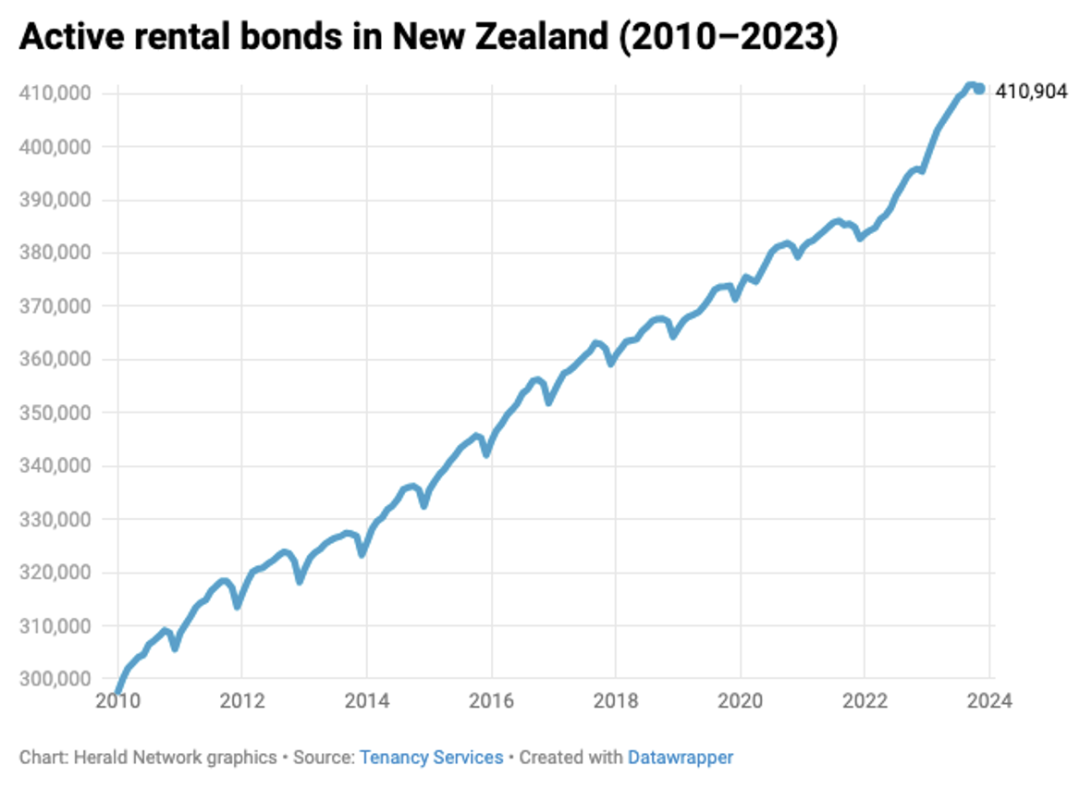
Chart showing changes in the amount of active tenancy bonds nationwide in New Zealand, 2010 to 2023
(Source: Tenancy Services)