
As monetary policy becomes increasingly accommodative worldwide, financial and property markets are focusing on whether the Reserve Bank of New Zealand will cut interest rates substantially before the end of this year. Last week, the US Federal Reserve delivered a sizeable 50 basis point cut, sending shock waves through global financial markets and prompting speculation about the direction of New Zealand's Official Cash Rate (OCR). However, despite growing market expectations of substantial cuts, the Reserve Bank of New Zealand faces a difficult choice between large cuts and gradual adjustments.
Swap rates fall rapidly as expectations of rate cuts rise
Since June this year, New Zealand's swap rates have fallen at a remarkable pace, even exceeding the decline during the global financial crisis in 2008. This sharp fall reflects strong market expectations that the Reserve Bank will cut rates further. Wholesale markets are currently pricing in cuts on 9 October and 27 November of 50 basis points each, with further cuts expected in 2025.
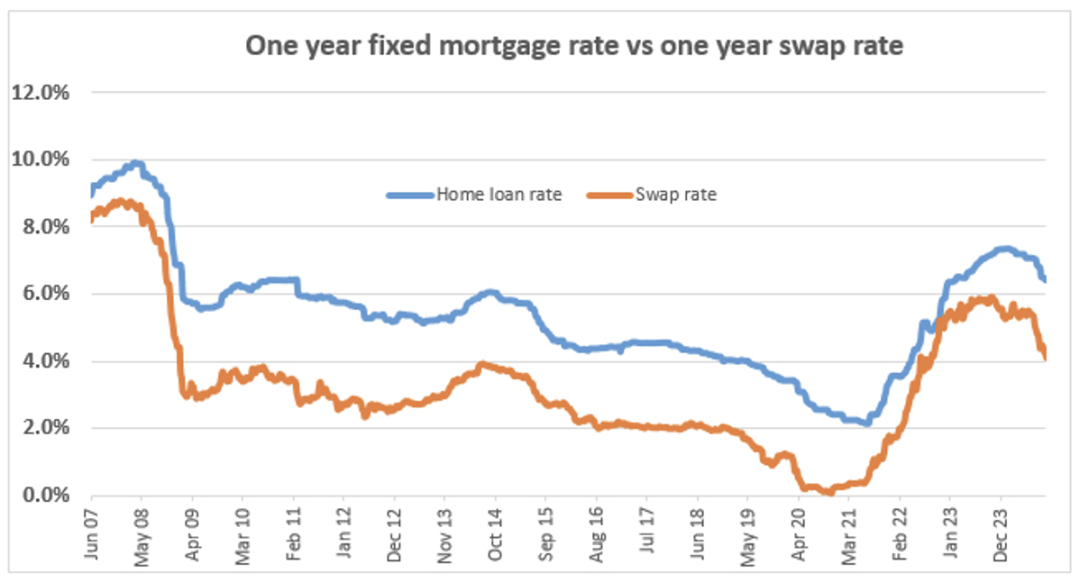
Chart comparing changes in one-year mortgage rates and swap rates (Source: interest website)
Historical comparison: is there room for rates to fall further?
Historically, when swap rates have been at similarly low levels, mortgage and term deposit rates have generally fallen alongside them. However, even during the global financial crisis in 2008, mortgage rates were still 65 basis points higher than they are now. This suggests that even if the Reserve Bank cuts rates by 100 basis points over the coming months, mortgage rates may not fall as far as markets expect.
Based on current swap rates, financial markets expect one-year fixed mortgage rates could fall to around 5.75%. This is certainly good news for borrowers. However, wholesale market pricing is not a precise forecasting tool; it primarily reflects current market sentiment and expectations for the future. The actual path of interest rates will still depend on changes in global and New Zealand economic conditions.
Economists divided: should the Reserve Bank be bolder with rate cuts?
At its August Monetary Policy Statement meeting, the Reserve Bank of New Zealand lowered the OCR to 5.25%, its first rate cut in four years. As economic growth slows, markets widely expect another cut on 9 October of 25 basis points. However, the US Federal Reserve's substantial cut has prompted fresh speculation about whether the Reserve Bank will make a larger reduction.
Kiwibank chief economist Jarrod Kerr said a Reserve Bank rate cut in October was almost certain, but whether it should be 25 or 50 basis points remained open to debate. He believes the Reserve Bank should adopt more aggressive monetary easing in the face of global economic uncertainty. He recommends cuts in October and November of 50 basis points each to provide stronger support for New Zealand's economy. Kerr's views clearly reflect calls from some economists for more aggressive action.
Westpac economists, however, take a different view. They expect the Reserve Bank to cut rates at each of its two remaining meetings this year by 25 basis points, followed in 2025 by a further 100 basis points of cuts. ASB senior economist Kim Mundy believes further cuts could help stimulate economic growth, but multiple global and domestic uncertainties remain, making a rapid recovery difficult. She therefore expects the Reserve Bank to take a more measured approach to rate cuts.
How will mortgage and term deposit rates change?
The rapid decline in swap rates will also affect mortgage and term deposit rates. Current market pricing already reflects expectations of further interest rate falls. Mortgage holders may see rates gradually decline over the coming months, easing repayment pressure. For savers, lower term deposit rates will mean reduced returns.
Although swap rates provide a real-time indicator of changes in retail mortgage rates, they cannot fully predict the future direction of interest rates. Changes in market sentiment, global economic uncertainty and the different paths New Zealand's domestic economy could take may all have a significant effect on interest rates.
The RBNZ's dilemma: substantial cuts or gradual adjustments?
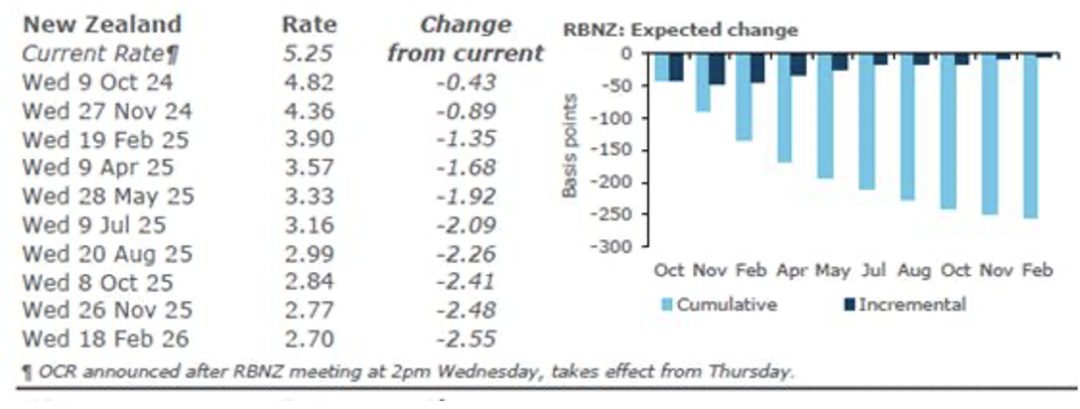
Chart showing changes in OCR forecasts (Source: Interest website)
Overall, the Reserve Bank of New Zealand faces a difficult choice. The US Federal Reserve's substantial rate cut has heightened market expectations of further global monetary easing, while slowing growth and inflationary pressures in New Zealand require the Reserve Bank to proceed cautiously. Overly aggressive cuts could reignite inflation, while an overly conservative approach might fail to stimulate the economy effectively. Over the coming months, the direction of Reserve Bank policy will directly affect the pace and stability of New Zealand's economic recovery. Although financial market and economist forecasts differ, one thing is certain: every move the Reserve Bank makes will be closely watched by financial and property investors.