
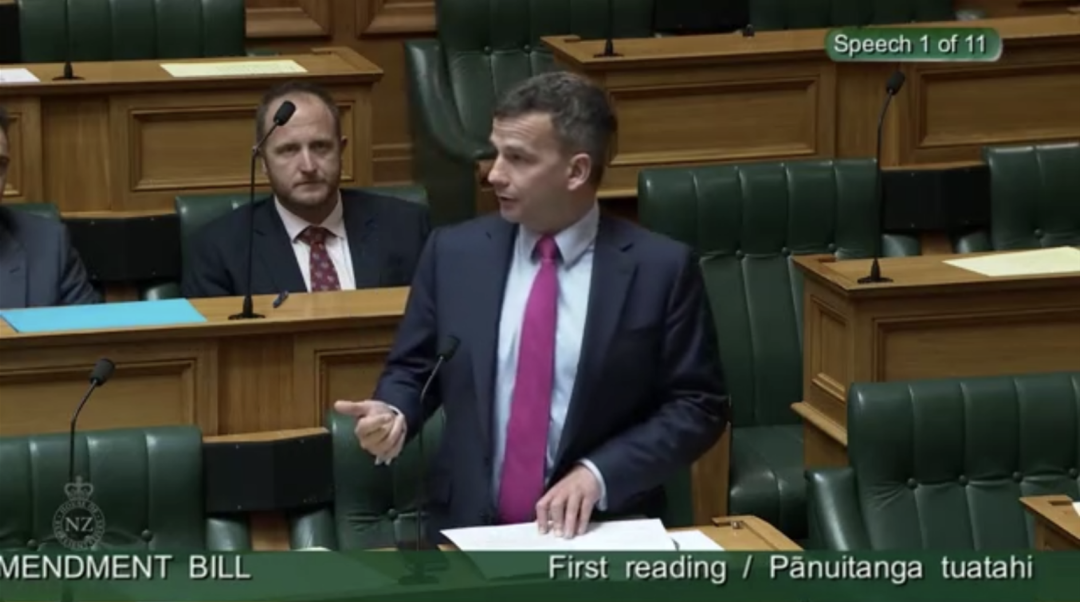
Associate Minister of Finance David Seymour recently announced that New Zealand’s Parliament had passed the first reading of the Overseas Investment (National Interest Test and Other Matters) Amendment Bill. Designed to streamline overseas investment approvals, improve productivity and bring more capital and technology into local businesses, the bill is regarded as a central part of the current Government’s drive for economic growth and reform.
The bill has now been referred for consideration. It is expected to pass into law before the end of 2025 and take effect in early 2026.
Click here to read our earlier coverage
In an exclusive interview with YIJU, David Seymour emphasised that New Zealand needs investors and respects their time.
Overseas Investment Amendment Bill passes first reading
On 24 June, New Zealand’s Parliament passed the first reading of the Overseas Investment (National Interest Test and Other Matters) Amendment Bill.
What is the Overseas Investment Act?
The Overseas Investment Act primarily regulates investment by overseas persons in sensitive assets. These include sensitive land, such as rural land exceeding 5 hectares, islands, land adjoining the sea or lakes, and residential land; significant business assets, generally those worth more than NZ$100,000,000, although higher thresholds apply to investors from countries with free trade agreements with New Zealand; and fishing quota.
During the first reading in Parliament, Associate Minister of Finance David Seymour introduced the bill and moved that it be referred to the Finance and Expenditure Committee for consideration, recommending that the committee report back to Parliament before October 2025.
The minister said the bill represented an important government commitment to an open economy that welcomes global investors. New Zealand has long imposed complex procedures and screening mechanisms on foreign investment, deterring many potential investors. He quoted an international business leader: “New Zealand needs foreign investment, but foreign investment does not necessarily need New Zealand.”
Official figures show that, as of 2023, New Zealand’s stock of foreign direct investment represented just 39% of GDP, well below the OECD average of 52%. David Seymour said: “If we do not actively show global investors what New Zealand has to offer, they will turn to other countries.”
David Seymour reiterated the purpose of the legislative changes: the previous law stressed that “investing in New Zealand is a privilege”, overlooking the positive contribution foreign investment makes to the domestic economy and requiring investors to prove their investment would benefit New Zealand. Under the changes, investors would only need to demonstrate that their investment would do no harm to New Zealand. The amendments would introduce more balanced wording, such as: “Recognising the role of foreign investment in increasing economic opportunities, particularly by enabling more timely approvals for less sensitive investments through an initial national interest risk assessment.”
Specifically, the key reforms include:
-
Introducing a new initial national interest risk assessment: investments in less sensitive assets, such as non-farm land, ordinary businesses and forestry, would no longer undergo the current benefit to New Zealand test and investor test. Instead, they would be screened under a simpler national interest framework.
-
Significantly shortening approval timeframes: apart from sensitive categories such as residential land, farmland and fishing quota, decisions on other investment applications would be required within 15 working days, a substantial improvement on the current statutory maximum of 70 days and average processing time of 30 days.
-
Improving transparency and predictability: the Government would issue an updated Ministerial Directive Letter specifying which assets require closer scrutiny and what risks could run counter to the national interest, giving investors clearer policy guidance.
How would New Zealand benefit?
Comparing two manufacturing businesses, David Seymour said companies that received overseas capital and technology were able to improve automation, product quality and staff pay, while those without such support lagged behind despite their efforts. He emphasised that low productivity lies at the root of the cost-of-living crisis, and that improving productivity requires capital investment.
He also mentioned a large overseas supplier of everyday goods making substantial capital investments in New Zealand to ensure products reach consumers through a reliable cold chain, on time and at reasonable prices. Although he did not name the company, he hinted that it could be a business such as Costco or IKEA, or the rumoured “third supermarket competitor”.
For the public, he said, foreign investment means higher wages for New Zealand workers, more reliable supplies of goods and more reasonable prices. It is also a vote of confidence in New Zealand’s economy and shows that the country welcomes globalisation rather than fears it. He said: “This reform will restore investor confidence in New Zealand, unlock economic potential and show the world that New Zealand welcomes quality capital and is ready to make friends with the world.”
No progress on the foreign homebuyer ban
The foreign homebuyer ban was introduced by the Labour-led coalition government in 2018. During its election campaign, National promised that, if elected, it would amend the ban and instead impose a 15% tax on foreigners buying properties worth more than NZ$200. However, the proposal was shelved as part of its coalition arrangement with New Zealand First.
Labour MP Barbara Edmonds opposed the amendments to the Overseas Investment Act, saying in her speech: “Congratulations to New Zealand First on successfully holding its position on the foreign homebuyer ban in this legislation. It is good to see you maintain that residential land is a sensitive asset in New Zealand and that foreigners should only be able to own homes under specific conditions. This position also reflects the views of many New Zealanders: our land should be held by our own people first.”
In an exclusive interview with YIJU, David Seymour also emphasised: “For transactions involving commercial property, business assets and most other types of assets, overseas investors will be able to obtain approval within three weeks, but residential property investment will remain subject to stricter procedures.”
In other words, restrictions on foreigners buying homes will not be lifted in this round of reforms. The foreign homebuyer ban will remain in place.