
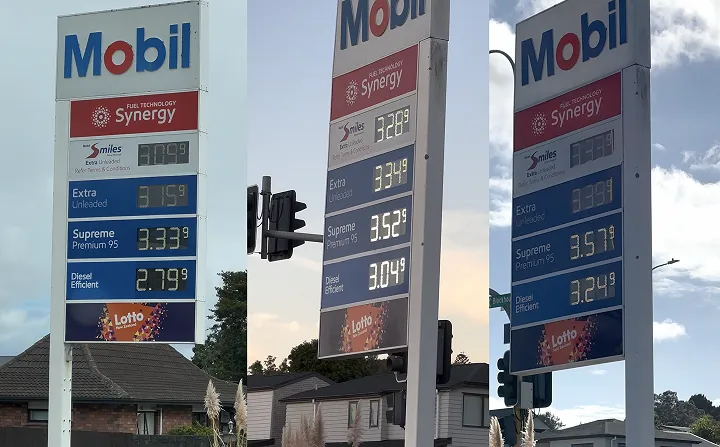
As fuel prices dominate the headlines, some builders are already feeling the impact more directly: projects are disappearing.
Wellington builder Jamie Lloyd recently lost a contract that would have kept his business operating for three months. The reason was straightforward: costs were rising too quickly for the client to accept.
New Zealand fuel prices have fluctuated significantly over the past month. Statistics show petrol rose by about 18.6%, while diesel surged 42.6%, recording its largest monthly increase in nearly 15 years. For a construction industry heavily reliant on transport, changes like these do not stop at the petrol station. They quickly flow through the entire project.
“Prices are going up almost every week,” Lloyd said. His company's overall operating costs rose by about 20% in a short period. With margins already tight, those costs had to be reflected in the quote. The result was that the client walked away.
Just like that, an agreed construction contract was gone.
Costs are flowing through every layer
If rising fuel prices were the only issue, the impact might not be so direct.
But diesel runs through almost every part of construction. From raw materials arriving at factories to finished products being delivered to sites, and the movement of construction equipment and workers, the entire system depends heavily on road transport.
More than 90% of New Zealand's freight moves by road. This means every fluctuation in fuel prices is amplified and embedded in building material prices, freight charges and construction costs.
Recently, many building material suppliers have begun adjusting prices frequently. Some builders describe “a new price every week” as the norm. For projects lasting months or longer, that uncertainty is itself a risk.
The harder problem: many costs cannot be passed on
What is really squeezing the industry is not rising costs alone, but the difficulty of passing them on.
In practice, many construction projects use fixed-price contracts. Once the price is locked in at signing, subsequent changes in material, transport and even energy prices often have to be absorbed by the builder.
Although standard contracts include mechanisms for adjusting costs, many projects have removed or weakened those clauses since the pandemic. As a result, when external costs change rapidly, the contract itself becomes a constraint.
One industry participant said that, in the current environment, profits on some projects had already been eroded, and individual jobs could even be on the verge of making a loss.
Pressure spreads from costs to people
As costs continue to rise, the effects are spreading beyond the figures on the books into everyday realities.
Some builders say staff are struggling to afford fuel for long commutes; others report that filling a diesel work vehicle now costs almost twice as much. For small teams, that extra burden quickly becomes pressure on the business.
Meanwhile, uncertainty over new work is also increasing. Some builders have begun actively seeking projects, but the wider market is becoming more cautious. For businesses that depend on a continuous flow of projects, any gap intensifies cash flow pressure.
The real risks are only beginning
While the current problems are mainly about cost, the next risk may come from supply itself.
With tensions in the Middle East continuing, uncertainty is growing across global energy supply chains. The New Zealand Government has said it is assessing whether adjustments to fuel management arrangements are needed.
In extreme circumstances, fuel use could be restricted. If tighter supply controls are introduced, construction projects will face more than rising costs: their progress will be directly affected.
For an industry so dependent on energy, that uncertainty alone is enough to change project decisions.
Some are adapting; others are absorbing the pressure
As costs continue to rise, some builders have begun trying to adjust their strategies.
Some businesses are adding cost fluctuation clauses to new projects or incorporating fuel-related adjustment mechanisms into quotes to reduce future uncertainty. Others are changing construction arrangements, such as reducing transport frequency and optimising routes, to ease fuel cost pressure wherever possible.
But not every business is in a position to make those adjustments.
For projects already covered by fixed-price contracts, many cost increases simply have to be absorbed. Some builders have little choice but to reduce their margins, or even accept losses on individual projects, to preserve client relationships or keep cash flowing.
One industry participant admitted: “There is not much we can do. Most of the time, we are just trying to keep the losses under control.”
An industry shake-out is under way
This latest shock is exposing differences across the industry.
Some businesses are adjusting contract structures, introducing cost fluctuation mechanisms or reducing fuel use by improving transport arrangements and cutting unnecessary trips. Others are adding fuel surcharge clauses to quotes and discussing the risks with clients in advance.
Meanwhile, businesses that compete on low prices and operate on thin margins are under more obvious pressure. If costs keep fluctuating, these businesses often have little room to absorb the impact.
Seen this way, this is more than a round of cost increases. It is a test of how well construction businesses are run.
Observations and reflections
As fuel prices begin to drive construction costs, can the industry continue operating as it has in the past?
When risk cannot be effectively passed on, contracts no longer provide a buffer and uncertainty becomes the norm, will this shock ultimately remain with builders, or will it gradually flow through to developers and even homebuyers?
Perhaps the real question is not about fuel prices themselves, but whether the industry is ready to face a more volatile environment.