
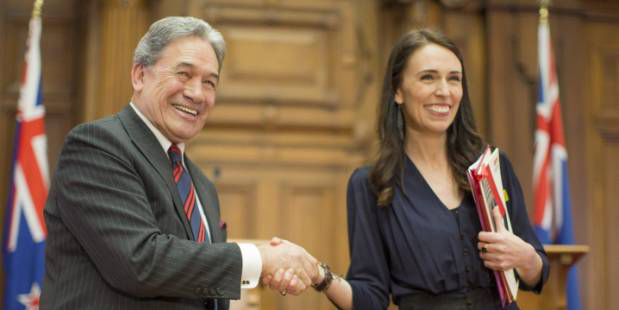
New Zealand's election process concluded at the end of October following the 2017 general election. Labour and New Zealand First formed a coalition government. With Labour having already formed an electoral alliance with the Greens, the three parties now held 63 of Parliament's 120 seats, securing a majority. This meant Labour leader Jacinda Ardern would become Prime Minister. National became the opposition party with the most parliamentary seats.
The domestic outlook: awaiting policy details
Westpac's economics team discussed its first impressions of the new government in a report titled ‘A step to the left’. They noted that very few policy details were available. Compared with National, which had governed for nine years, the new government appeared more likely to intervene in the economy, tighten overseas investment restrictions further and take a more open approach to social spending.
In their view, the new government's short- and long-term economic impact would depend on whether it could improve New Zealand's tax system. The current system was seen as favouring property development, while economic development had become unbalanced.
Labour's rise to power was linked to growing social inequality within New Zealand. Homeowners could sit back and wait for land values to rise, accumulating wealth as house prices increased. Those without property were left far behind, struggling to buy their first home. Housing affordability had become an urgent problem, yet one that was difficult to resolve decisively in the short term.
The policy implications of housing prompted Labour to restrict overseas buyers' investment in residential property. Westpac believed restrictions on foreign direct investment would further isolate New Zealand within global economic and trade networks. The OECD (Organisation for Economic Co-operation and Development) had previously attributed New Zealand's weak productivity to excessive isolation. Stronger connections with major overseas economies would therefore bring greater benefits.
While blocking some overseas capital inflows, the new government would also spend more. Education, health and transport would all receive greater public funding. Labour and the Greens' focus on climate change would also bring changes to agriculture, a foundational industry in New Zealand. Land use could shift from dairy farming to forestry.
{AD}
‘Change itself should not be seen as a bad thing. Society is, after all, paying close attention to these issues,’ ANZ noted in a recent research report. But change would inevitably bring uncertainty, making communication with the public crucial. In 2000, the public did not embrace the government's changes — or, put another way, the government failed to communicate its policies effectively — causing business confidence to fall and economic activity to stall. ASB chief economist Nick Tuffley was concerned that GDP and employment growth could slow as the new government tightened immigration policy. The economists cited above said they would continue to watch for further policy details, particularly on immigration and housing.
Foreign relations: exports come first
The new government's first appearance on the international stage would be at the APEC meeting in Vietnam in November. New Zealand's new Prime Minister, Jacinda Ardern, would arrive with a clear purpose. She would seek to renegotiate trade agreements to include provisions curbing foreign speculation in property, in response to soaring house prices at home. The new Prime Minister had said that controlling domestic house prices and meeting trade objectives were compatible, and that a balance could be found between them.
This would add another uncertainty to the negotiations.
In May this year, Japanese Prime Minister Shinzo Abe and former New Zealand Prime Minister Bill English agreed to work together to conclude the Trans-Pacific Partnership (TPP), despite the United States having abandoned the free trade agreement. His successor, Jacinda Ardern, had also expressed support for the TPP and increasing exports. However, negotiations could stall if she was dissatisfied with the agreement's details.
New Zealand First and the Greens had opposed the TPP in the past. ‘The new government should not rush to sign an agreement that its partners previously opposed,’ University of Auckland law professor Jane Kelsey told RNZ. She noted that Labour had previously called for a cost-benefit analysis of the TPP, and that such an analysis was still needed.
The TPP seeks zero tariffs on trade in goods, going beyond WTO standards and requirements. Its main highlight is trade in services, with protective principles covering intellectual property, labour and the environment. The TPP also includes new rules in areas not addressed by the WTO, or where WTO standards are lower. These cover cross-border services, cross-border e-commerce and government conduct, including state-owned enterprises, government procurement, transparency and anti-corruption.
As New Zealand is an outward-looking country, its economic and trade relationships have a particularly significant impact on the domestic economy. The public can only wait and see how the three parties in the new government will balance and support one another across different policies.