
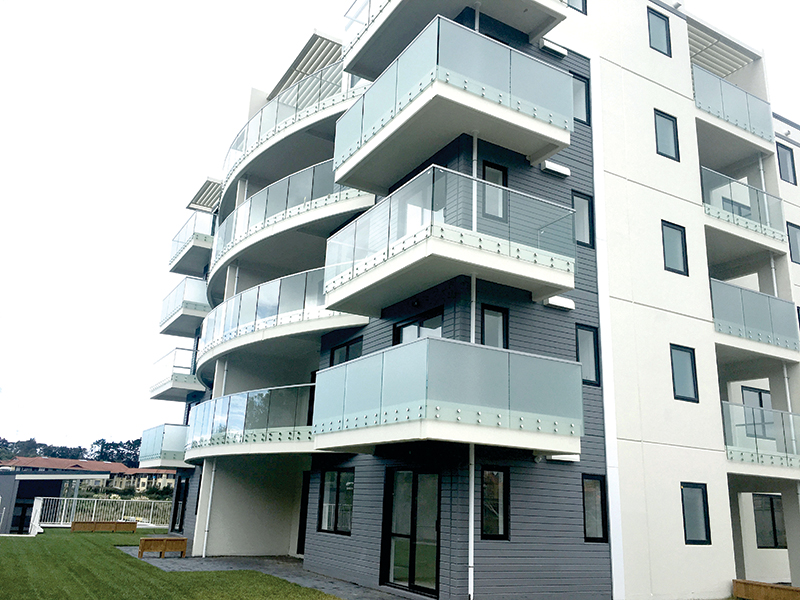
Apollo Square is located on Auckland's North Shore, and its second-stage apartments have now been completed, marking a milestone in the history of New Zealand's construction industry.
An ambitious master plan
Apollo Square is planned to comprise one commercial building and three apartment buildings, with 7500 square metres of outdoor recreation and landscaped space.
The first-stage commercial building fronting the street is three storeys high. It includes 12 commercial spaces, 12 offices, 2 restaurants and a hotel with 38 rooms, covering a total of 4689 square metres. It also has a basement car park with 128 spaces.
The second-stage apartment building is 5 storeys high, with 55 homes and 88 basement parking spaces. One-, two- and three-bedroom apartments come in 11 different layouts, with a swimming pool and gym also provided.
The third stage consists of a 4-storey apartment building and a 5-storey apartment building, with a total of 99 homes and 153 basement parking spaces. The buildings stand 18 metres apart, creating a very pleasant shared courtyard. Both also offer one-, two- and three-bedroom layouts. Once the third stage is complete, it will include a children's play area, an outdoor barbecue area and all landscaped gardens and paths.
Oriental Construction Group is responsible for constructing the entire project. Founded in 1995, the group has earned an excellent reputation for professionalism, honesty, reliability and quality service. Through more than twenty years of steady growth, it has undertaken construction projects of many types and sizes, including commercial, residential and mixed-use developments.
High-quality service, delivery on time and within budget, and attention to detail have earned the company many loyal clients. Members of its site supervision team each have between 10 and 20 years of local experience. Oriental Construction has been a member of New Zealand's Master Builders for 17 years. It maintains strict health and site safety rules and management systems, and has had no major incidents involving serious injury or death in more than 20 years.
Setting a benchmark
Zheng Lu leads the entire Apollo project. A graduate of Tsinghua University, he migrated to New Zealand many years ago and has steadily built his career with a focus on construction. He is now a director of Oriental Construction Group and a board member of the New Zealand Chinese Building Industry Association.
Zheng Lu said: ‘Chinese developers in New Zealand have delivered many successful projects, but quite a few have also gone badly wrong. Those failures do damage the Chinese community's reputation. Delivering any major project well is also something that brings credit to the community.’
Apollo Square is regarded as a project that brings credit to the Chinese community. It has also challenged Chinese-funded clients' entrenched, unquestioning faith in Western companies.
Notably, the project was completed broadly on schedule. Construction was expected to take two years; the actual period from starting work to handing over the homes was two years and three months. Compared with other nearby projects, meeting a timeframe like this deserves more than the simple label ‘successful’.
The difference between the overall budget and the actual construction cost was also kept within 5%, a particularly rare achievement. Over the past two years, many construction companies have suffered losses or gone into liquidation because of rising material and labour costs. Despite prices soaring during construction, the pre-sale prices agreed with buyers remained unchanged, and settlement proceeded at the contracted prices. With 100% of homes handed over, the company fulfilled its commitments to the highest standard.
Uniting Chinese subcontractors and avoiding blame games
Difficulties are inevitable during design and construction. Spending less energy arguing over responsibility and taking a practical, committed approach to solving problems instead leaves very few problems that cannot ultimately be resolved.
The Apollo project also had a particularly high proportion of Chinese subcontractors. Its success depended on their unity, collaboration and close coordination. This helped distinguish the project both from some joint projects involving Chinese and Western businesses and from some undertaken by Western businesses alone. Can disputes over responsibility affect budgets and schedules? The answer is clear.
Loans from Chinese banks also provided substantial support during the early stages of development. Overall, Apollo Square's success is a source of pride not only for Oriental Construction Group, but also for New Zealand's Chinese construction industry!