
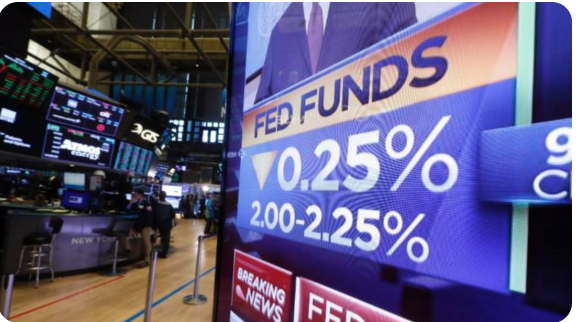
Yesterday, ‘the Fed cuts interest rates’ dominated the headlines and trending lists on major financial websites. This was also the first time in a decade that the US had moved to lower its benchmark interest rate, with the previous cut back in 2008.
So why has the Fed cut interest rates? What are the benefits? And how will it affect New Zealand? Let's work through these questions.
On 1 August, the Fed announced an interest rate cut of 25 basis points.
US rate cut attracts intense attention
It feels as though we see news of interest rate cuts every few days. So why has this particular Fed cut attracted so much extra attention?
Although more than 20 countries around the world have joined the rate-cutting ranks since the start of 2019, this was the first US cut in a decade, lowering the interest rate range by 25 basis points to 2–2.25%.
As mentioned earlier, the last US rate cut came during the financial crisis in 2008! With that experience still fresh in people's minds, it is no wonder everyone sees this as an important signal.
Fed Chair Powell did offer some reassurance: the US economy is still performing well, but some risks appear to be steadily growing. In particular, President Trump keeps resorting to punitive tariffs and trade wars, making the outlook highly uncertain;
Globally, meanwhile, economies from Europe to China seem to have weakened recently, so the idea is to cut rates now to head off a recession.
What are the benefits of cutting interest rates?
Put simply, a rate cut means banks lower both deposit and lending rates. For ordinary people, the bad news is that money in the bank earns less interest. The good news is that if you want to buy a house or a car, your loan repayments will be lower. Businesses can borrow more cheaply and expand their investment;
By now, you can probably see the beauty of this cycle: lower rates encourage people to spend more and businesses to invest more. Stronger spending improves the real economy, allowing employers to pay higher wages and keeping the good times rolling for everyone a little longer.
But if everyone tightens their belts and is afraid to spend, the economy can fall into the so-called ‘low-inflation trap’, just as Japan has, still unable to climb out after more than 20 years.
{Ad}
US investors, however, seemed less than satisfied with the size of this cut, particularly as Powell did not indicate that further cuts would follow. Before the press conference had even ended, the Dow Jones index had fallen nearly 300 points in response.
How will it affect New Zealand?
As soon as news of the US rate cut broke, our colleague interviewed Frank Chen, CEO of Singapore's Ansheng Group. Here is what he had to say:
Good news, but little impact in the short term
The US rate cut is unlikely to have a particularly noticeable effect on New Zealand in the short term.
If some funding channels used by the Reserve Bank of New Zealand and commercial banks are linked to the Fed, it may reduce funding costs to some extent.
Given the circumstances behind the US rate cut and how its effects flow through markets, it will not feed through to New Zealand quickly. Past experience suggests that rate cuts take at least around half a year to affect the property sector;
For the effects to reach the real economy, they also need support from New Zealand's own government financial policies. If the central bank cuts rates but financial policies do not support that move—for example, if banks do not ease lending conditions—the effects will still not flow through to the real economy.
Overall, a rate cut is positive news, but it will not deliver a powerful stimulus quickly.
Global investment confidence will increase
The Fed's rate cut will stimulate and influence global investment indicators to some extent. For example, increased investment confidence will strengthen global investment indices and help investment institutions or investors achieve their objectives sooner, boosting market confidence.
Rate cuts may also trigger asset bubbles
Of course, we also need to consider both sides of rate cuts. To some extent, a rate cut is not necessarily entirely positive: it may create asset bubbles.
New Zealand is a highly indebted country. If asset bubbles grow, their combination with high debt could lead to financial instability.
Other factors will determine the ultimate impact
Whether subsequent Fed rate cuts have the most direct impact on New Zealand's market will depend mainly on the following three factors:
-
The absence of major problems in the global macroeconomic environment;
-
Supportive financial policies across countries;
-
For New Zealand, healthy growth in its own economy and GDP.
Let me take the liberty of summing up Frank's views:
- In the short term, the US rate cut will essentially have little major impact on New Zealand;
- It is too early to say whether there will be a major long-term impact. That will need to be assessed alongside the responses of countries with close ties to New Zealand, such as China, Australia and the UK;
- Overall, the rate cut will most likely be good news—for example, wealthy people may invest more. Of course, less likely outcomes, such as asset bubbles, are also possible;
- Whether or not the US cuts rates, what matters most is healthy GDP growth in New Zealand itself, giving the country a better chance of withstanding risks!