
Construction companies’ problems continued in 2019: in February, Arrow International, established in 1984 and generating annual revenue of more than NZ$350,000,000, entered voluntary administration;
On 15 April, another Auckland construction company, BHSSR, formerly known as MR8 Construction, went into liquidation after 25 years in the industry.
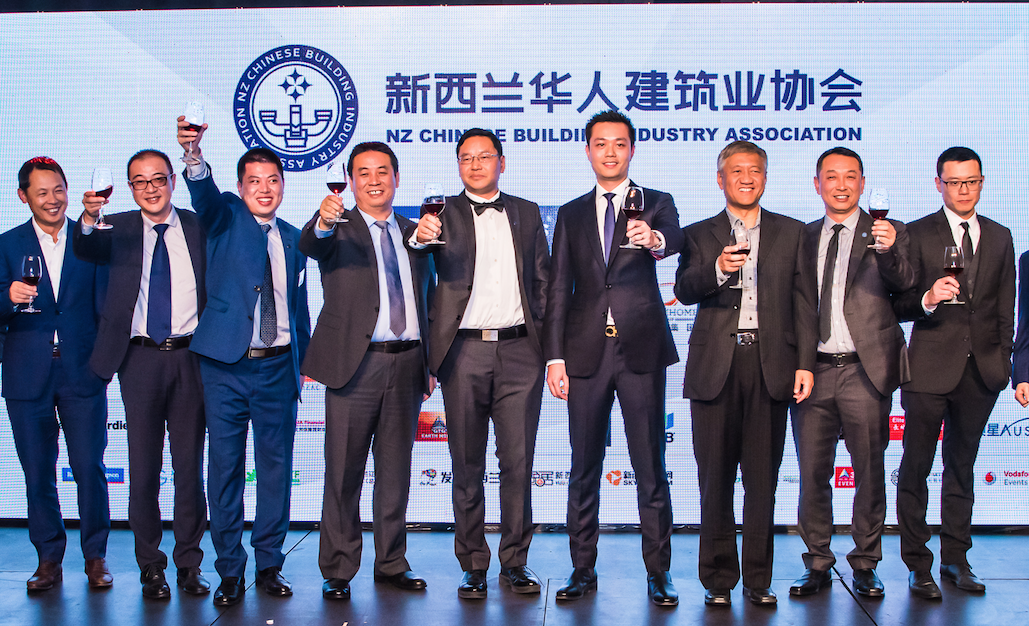
Now, as New Zealand enters winter, its Chinese construction sector is bucking the trend and growing rapidly. Asked why, Frank Xu, president of the New Zealand Chinese Building Industry Association (NZCBIA), points to innovation, efficiency and collaboration as the foundations of the sector’s success in New Zealand.
Chinese construction businesses rise against the tide
NZCBIA recently surveyed 26 companies from China. Its report found that these 26 companies had invested a total of NZ$14,600,000,000, all in property development, with 83.53% going into residential projects and 90.22% concentrated in Auckland.
Of the total NZ$14,600,000,000 investment, projects worth nearly NZ$1,800,000,000 had been completed, accounting for 12.14%;
Projects under way, including Fu Wah Group’s Park Hyatt hotel on Auckland’s waterfront and the third stage of the NZ$300,000,000 Sugar Tree apartment development in Auckland’s central business district, totalled as much as NZ$2,100,000,000, accounting for 14.75%;
Over the next 8 years, Chinese developers expect to undertake a further NZ$10,690,000,000 in construction projects. It would be fair to say that Chinese property development and construction is New Zealand’s fastest-growing industry, bar none!
Property Council New Zealand chief executive Leonie Freeman welcomed investment on this scale. “New Zealand, particularly Auckland, has a housing shortage. Our cities need large numbers of new homes, including apartments, townhouses and standalone houses.”
She added: “We need many highly skilled people and organisations to help address the housing shortage. The developer community, including Chinese companies, is a key part of addressing housing quality for New Zealanders.
Looking ahead, Frank Xu said: “Chinese people are known for their diligence. Property development and construction companies from mainland China, together with local Chinese businesses in New Zealand, will continue to play an increasingly prominent role in New Zealand’s development and construction markets.”
The substantial contribution of Chinese construction businesses
The claim that Chinese property speculation has driven up house prices in Auckland and across New Zealand has long been disproved by various official statistics. Former prime minister John Key also publicly stated during his time in office that investors living in China accounted for only a small proportion of home purchases. Even so, discussions of Chinese people, who make up around 6% of New Zealand’s population, always seem inseparable from housing.
“Chinese people build far more houses than they buy.” When Frank Xu spoke about Chinese people and housing, his voice was full of pride.
The data is the fairest judge.
On home buying, in the year ending in December 2018, 2.6% of buyers in all New Zealand property transactions held neither New Zealand citizenship nor a resident visa, similar to the previous year’s 2.4%.
In other words, the so-called “Chinese investors driving up Auckland house prices” accounted for no more than 2.6% at most—and that was the total share of purchases by all overseas investors!
On house building, according to figures compiled by BNZ chief economist Tony Alexander, Chinese investors had already invested around NZ$7,000,000,000 in the New Zealand market. Chinese builders, investors and other Chinese-associated groups had been involved in building more than 30% of completed properties in Auckland.
{Ad}
Indeed, Chinese people’s efforts in construction have made a major contribution to New Zealand while also providing important support for raising the standing and influence of the country’s Chinese community.
NZCBIA’s survey report found that Chinese companies’ investments in New Zealand property were mostly in large residential developments, including apartments and large residential subdivisions, or commercial property. The most direct beneficiaries were large architectural design firms and building contractors;
These projects had a total floor area of 2,565,000 square metres, helping to ease Auckland’s housing shortage. They also created 928 direct jobs, alongside indirect employment for many consultants, contractors, building material suppliers, real estate agents and others, bringing substantial employment and considerable income to New Zealand.
Beyond property investment, these Chinese companies also contribute to charitable causes and community development in New Zealand. Their support and sponsorship extend to community events, New Zealand’s Olympic team, schools, Māori cultural research and the Westpac rescue helicopter, among other causes. Chinese people have long since moved beyond the single traditional image of being “hard-working and courageous”. They are not only industrious but also have substantial financial resources, and wholeheartedly support the sustainable development of New Zealand society and its communities!
Joining forces for shared success through the winter
Innovation, efficiency and collaboration are shaping New Zealand society’s new impression of Chinese people in construction. Opportunities inevitably bring challenges. Despite their considerable achievements, no one can remain untouched by the current winter in New Zealand construction. Chinese companies need to join forces for shared success if they are to weather it together.
“Traditional local construction projects involve layer upon layer of subcontracting, too many managers and excessive management costs…” “The designer took a full 13 months to produce a drawing.” “Deadlines are tight, workloads are heavy and there aren’t enough skilled people…” Developers and builders have plenty of grievances about the cost overruns and construction delays causing losses in New Zealand’s construction industry.
“Projects going over budget and falling behind schedule indicate problems throughout the chain,” said Sean Pan, director and CEO of Pengxin property company Top Harbour Limited. “The solution is cooperation. By working openly and transparently at every link in the industry chain, we can get through this winter together.”
Frank Xu agreed: “In New Zealand construction, there is no relationship in which one side wins and the other loses. Either both win or both lose, so every part of the industry chain must cooperate sincerely.”
Guided by this principle, the New Zealand International Building Expo & Summit (NZIBES), which has run for four consecutive years, has introduced a Collaboration Award to its Excellence Awards for the first time this year.
According to Frank Xu, the Collaboration Award is also among the most fiercely contested awards of 2019. Several outstanding teams are competing, and the eventual winner is attracting widespread interest.
Alongside collaboration, innovation is also key to breaking the impasse.
A study commissioned by Fletcher and conducted by Deloitte found that, over the past 10 years, building materials in New Zealand had been cheaper than in Australia for most types of residential construction. Construction workers’ pay was not the main reason for expensive housing in New Zealand either.
In an interview with YIJU, NZCBIA secretary-general Dylan Huang said Australia had clear advantages over New Zealand in building material prices, the extent of modular construction and house-building efficiency. Overall, New Zealand’s construction costs were much higher than Australia’s.
As high-density housing gains momentum in Auckland, prefabricated housing, or prefab, is undoubtedly a fitting solution, being naturally suited to large-scale, high-density residential construction. “Mass production and mass assembly can greatly reduce both time and labour costs.”
That was Dylan Huang’s assessment, although he also identified several weaknesses in New Zealand’s prefabricated housing sector:
1) Capacity and price. New Zealand’s own factories have limited production capacity. Without higher volumes, prices cannot come down;
2) An incomplete industry chain, particularly in relation to logistics costs.
However, Chinese builders in New Zealand are drawing on the advantages of manufacturing in China as they continue to seek the best solutions.
Construction projects in New Zealand are relatively small, making economies of scale difficult to achieve. Despite this small scale, New Zealand’s urban planning and architectural requirements emphasise individuality, so standardised, modular designs are rare. This further fragments an already small industry.
That makes producing prefabricated products, which depend heavily on scale, even more difficult.
The 2019 New Zealand International Building Expo & Summit (NZIBES), held from 16 August to 18 August, will take “OFF SITE, OFF SHORE”—off-site assembly and offshore prefabrication—as this year’s theme.
At the event, property and construction industry leaders, including senior representatives of government agencies, the public sector and banks, will explore this theme, exchanging views, discussing and debating related issues, ideas, trends and opportunities.
One of New Zealand’s largest property and construction exhibitions, NZIBES enters its fourth year in 2019.
As always, NZIBES will offer industry professionals valuable opportunities to communicate, learn and develop their professional skills. It will provide leading manufacturers and suppliers with a platform to collaborate, exchange ideas and showcase products and services, while giving consumers access to information on the best products and brands.
If you plan to develop business in New Zealand’s property and construction markets, particularly its Chinese property and construction sector, and establish direct connections with local developers, designers, suppliers, contractors and other project specialists, the 2019 NZIBES annual event is one you cannot miss.