
The Report states that New Zealand's total construction output will peak in 2021, while Auckland's total construction output in 2024 will be 40% higher than in 2018.
How are Chinese builders performing in the booming construction industry?
And how large a share can they secure in Auckland's rapidly expanding residential construction sector?
YIJU New Zealand interviewed Frank Xu, president of the New Zealand Chinese Building Industry Association, for an in-depth interpretation of this government report in light of the current state of the Chinese construction sector.
An analysis of the National Construction Pipeline Report 2019
The New Zealand Government recently released its 2019 national construction report (The National Construction Pipeline Report 2019), referred to below as the Report.
The Report states that New Zealand's total construction output will peak in 2021, while Auckland's total construction output in 2024 will be 40% higher than in 2018.
How are Chinese builders performing in the booming construction industry? And how large a share can they secure in Auckland's rapidly expanding residential construction sector?
YIJU New Zealand interviewed Frank Xu, president of the New Zealand Chinese Building Industry Association, for an in-depth interpretation of this government report in light of the current state of the Chinese construction sector.
{Ad}
Housing is the largest contributor to national construction output
In 2018, New Zealand's total construction output increased by 5% to NZ$39,000,000,000.
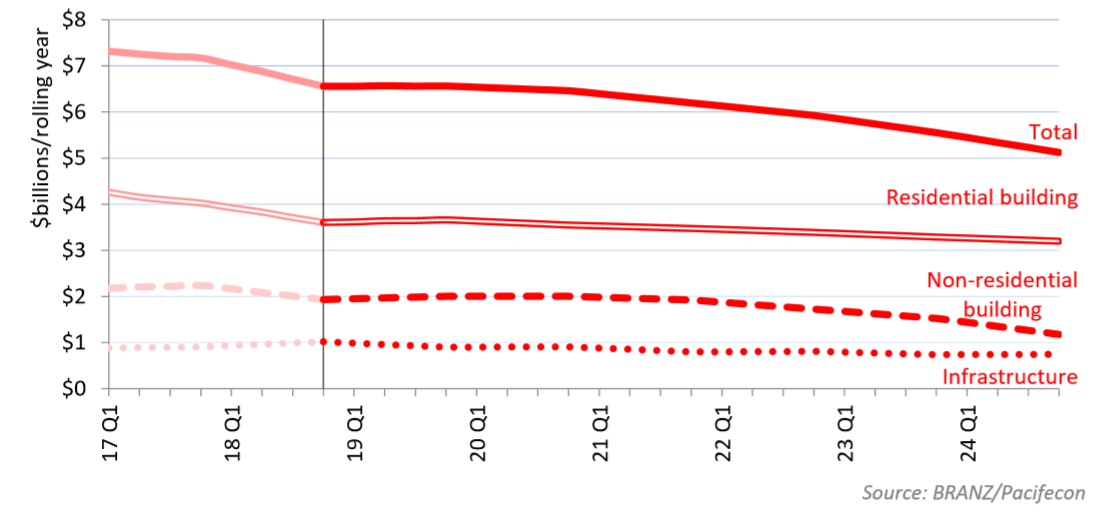
The Report states that total national construction output will continue to grow, reaching NZ$43,000,000,000 in 2021.
After peaking in 2021, total construction output will decline slightly, and is expected to fall to NZ$42,000,000,000 by 2024.
These estimates are all higher than the figures published in 2018, when the report projected total construction output of only NZ$41,400,000,000 in 2023.
Total national construction output
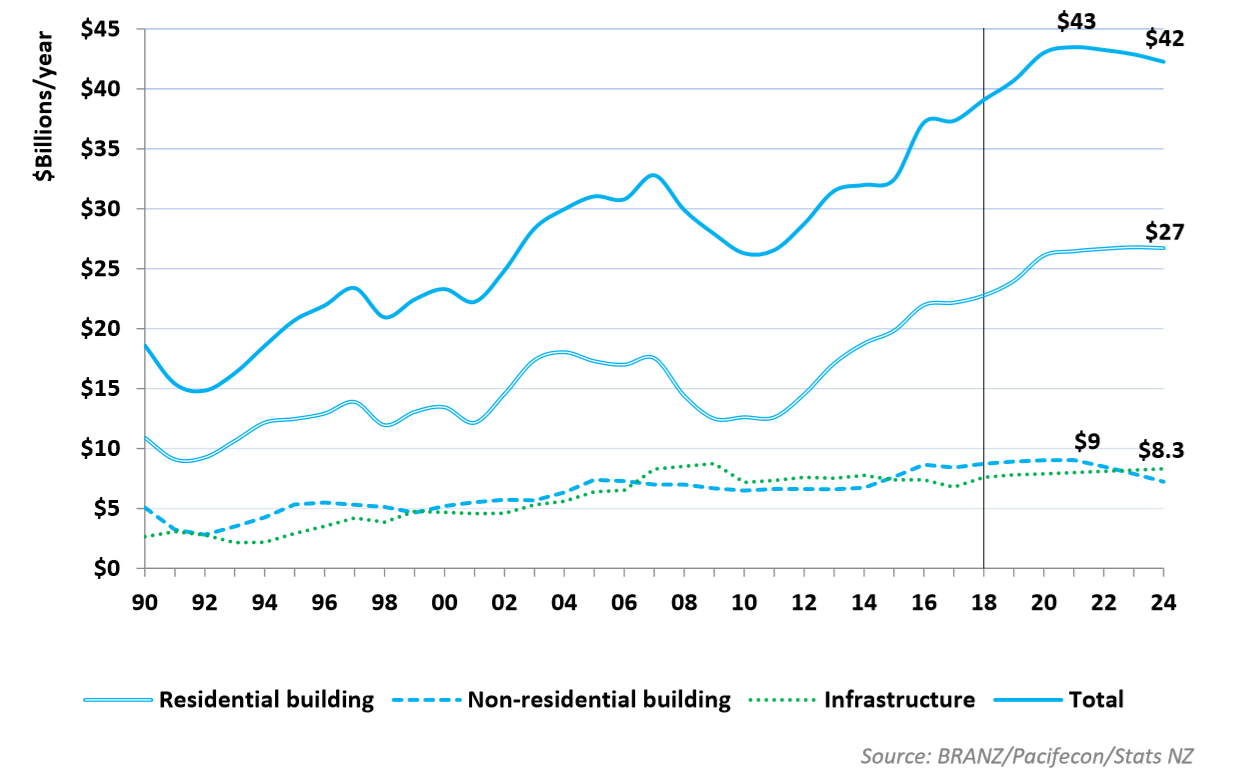
The Report states that residential construction accounted for 58% of total national construction output in 2018.
Over the forecast period, residential construction is expected to begin levelling off from 2020, growing to NZ$26,800,000,000 by 2023;
Non-residential construction, currently accounting for 22% of total output, is expected to peak at NZ$9,000,000,000 in 2021;
Urban infrastructure construction, currently accounting for 20% of total output, is expected to increase moderately throughout the forecast period, reaching NZ$8,300,000,000 by 2024.
Output forecasts by construction category
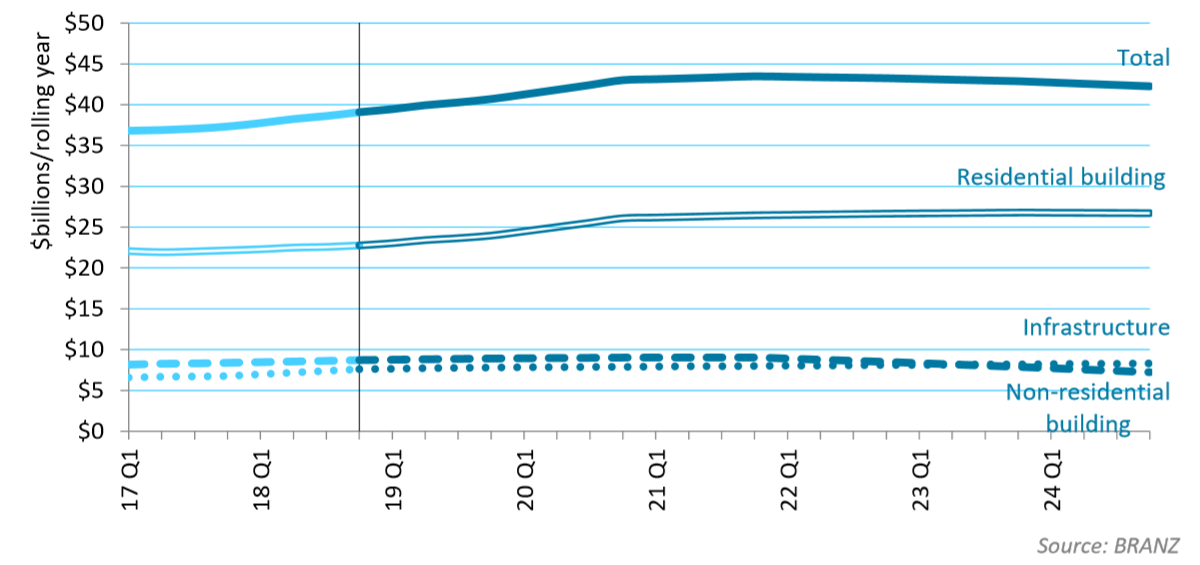
The Report's projection that growth in residential construction output will begin levelling off in 2020 does not apply to Auckland.
Auckland will continue to grow strongly. By the end of 2024, its total output will be 40% higher than in 2018, surging from NZ$8,800,000,000 to NZ$12,200,000,000.
Residential consent forecasts
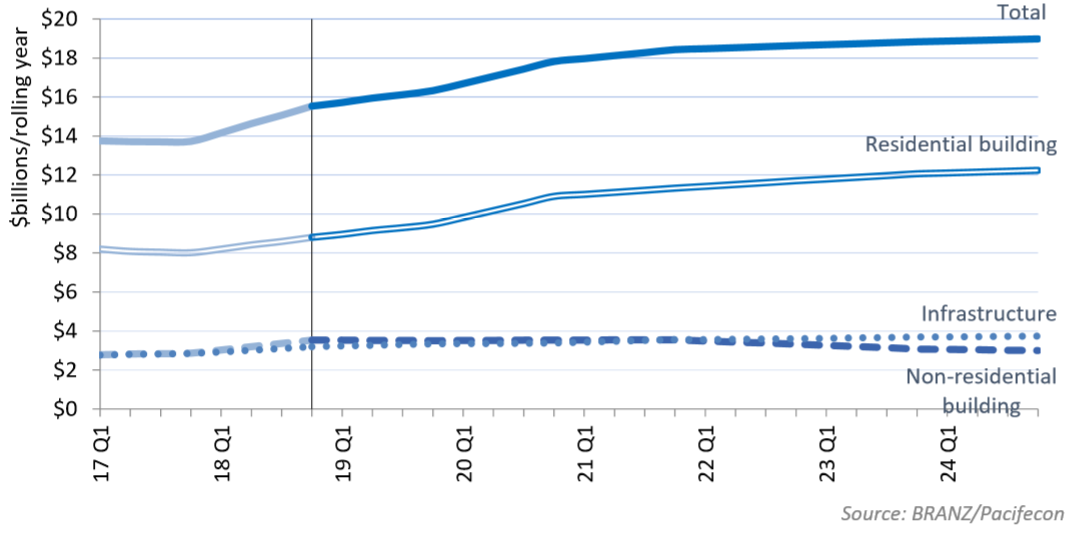
Nationwide, residential consents increased by 6% in 2018 compared with 2017, with a further 9% increase expected in 2019.
Over the next six years, 224,500 new homes are forecast to receive consent, averaging more than 37,000 a year.
The number of homes receiving building consent in Auckland will also rise from the current 14,500 to 17,100 in 2024, with 96,000 additional homes expected over the six years.
National consents by dwelling type
The Report also specifically notes that construction activity in Canterbury is declining. Total output fell by 9% year on year in 2018 and is expected to continue falling over the next six years.

Frank Xu's analysis:
Chinese builders have expanded very rapidly over the past four or five years, particularly in Auckland. The Report also notes that Auckland's residential construction output was NZ$8,800,000,000 in 2018, with Chinese builders accounting for a third.
That share continues to grow and is expected to exceed 40% by 2024. In other words, Chinese builders could account for NZ$5,000,000,000 or more of the NZ$12,200,000,000 in residential output projected in the Report.
One reason Chinese builders are making an increasingly large contribution to the industry is that growing amounts of capital from China are seeking investment opportunities overseas;
Another is that the construction industry has relatively low barriers to entry. It is a sector that Chinese people can enter relatively easily and that currently offers good earnings.
The rising share of multi-unit housing has far-reaching effects
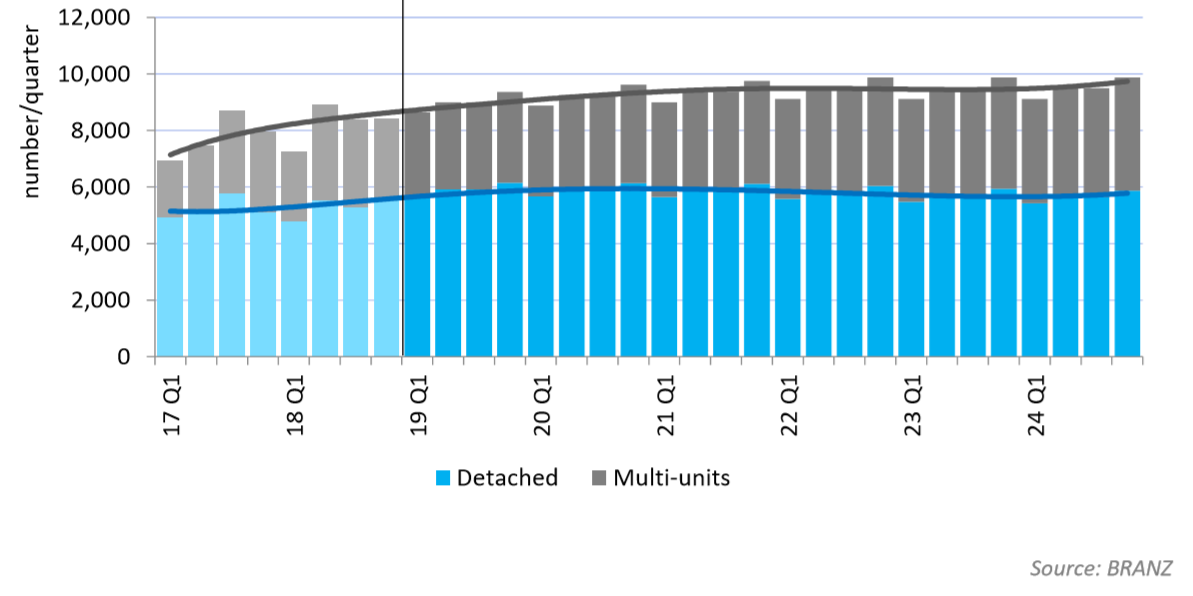
The government report also notes that multi-unit housing accounted for 36% of all homes in 2018, a share expected to rise to 41% by 2024.
National consents by dwelling type
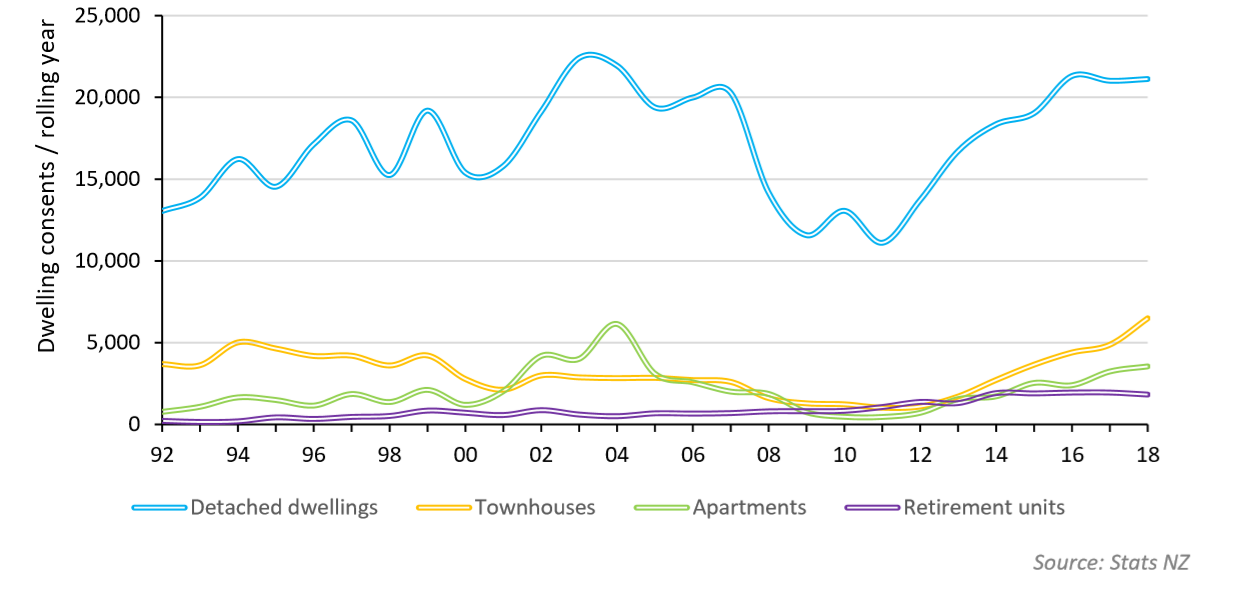
Data indicates that the increase in the proportion of multi-unit housing is being driven mainly by Auckland, where housing is in short supply.
In an interview with Stuff, Warwick Quinn, chief executive of construction training organisation BCITO, said Auckland had experienced a severe housing shortage following the global financial crisis.
Even now, Auckland is still working to close the gap between supply and demand.
According to an earlier report by Colliers International, Auckland currently has 36 apartment projects alone under construction, with more than 5500 apartments expected to come onto the market within two years.
Frank Xu's analysis:
From our observations, multi-unit housing is indeed concentrated mainly in Auckland.
I recall seeing figures from Stats NZ showing that, among properties granted building consent in Auckland in 2018, the proportion of multi-unit homes exceeded that of standalone homes for the first time.
The rising proportion of multi-unit housing has far-reaching effects:
First, because multi-unit homes generally sell for less, their growing share also indirectly affects the average sale price.
I believe this has contributed to the decline in Auckland's average house sale price over the past year or two, because prices for standalone homes alone may still be rising.
Second, behind the construction industry's continuing boom is a shortage of skilled workers.
As I understand it, 20,000–30,000 Chinese people work in construction in Auckland alone, but most are still building standalone homes.
As multi-unit housing increasingly becomes mainstream, there is also a severe shortage of professionals capable of building it. Those in the industry need to improve their skills as soon as possible and learn to build multi-unit developments, including townhouses and apartments.
The Chinese Building Industry Association is also organising talks, training courses, forums and summits, both to give Chinese builders a voice and to strengthen and improve their professional skills.
Auckland leads the country in non-residential projects
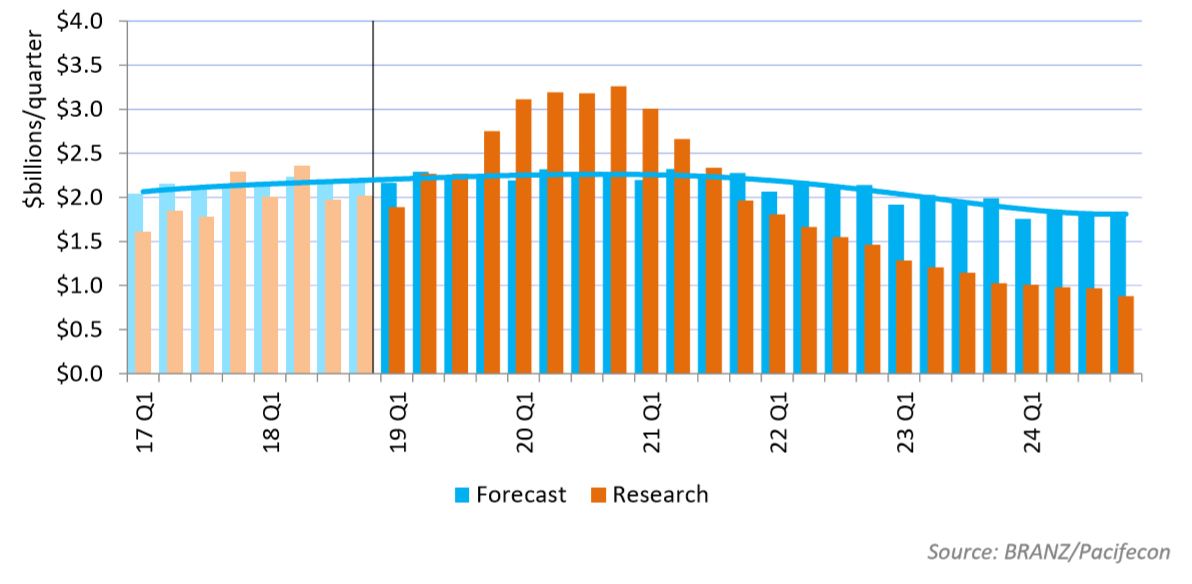
The Report states that national non-residential construction output is expected to peak at NZ$9,000,000,000 in 2021, driven mainly by construction growth in Auckland, before gradually declining after 2021;
Non-residential construction volumes in Waikato/Bay of Plenty and the rest of New Zealand will remain relatively stable.
National non-residential construction forecasts
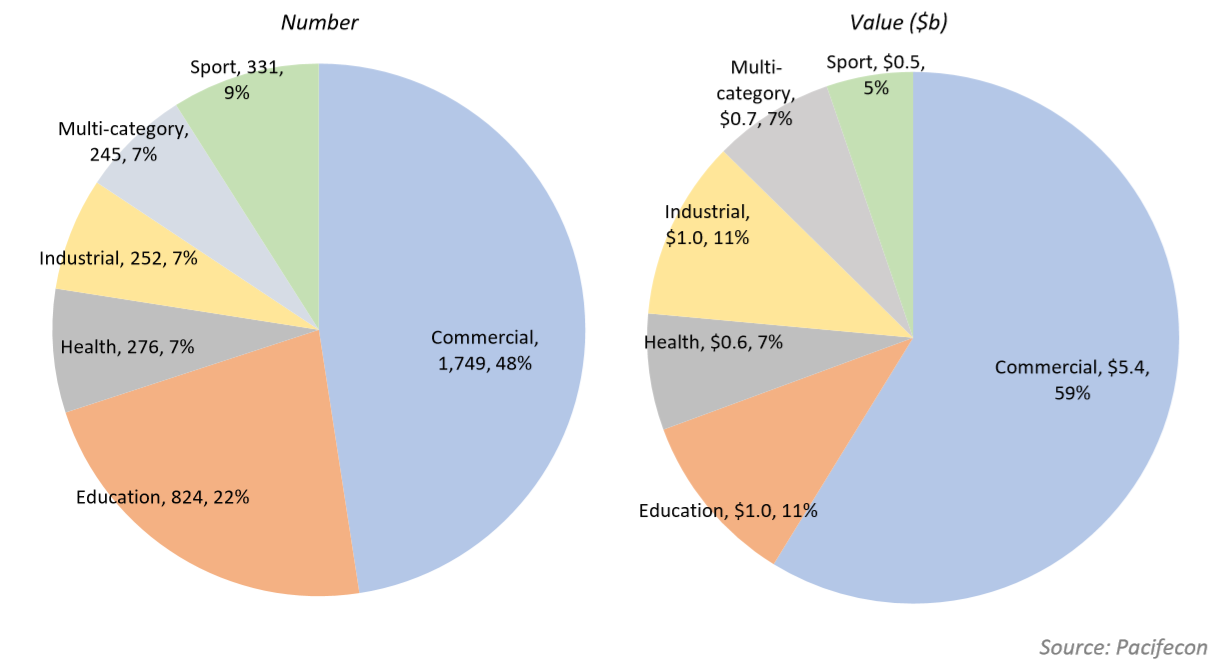
Commercial buildings dominate non-residential construction starting before December 2019, accounting for around 48% of all projects and approximately 59% of total output.
Education projects are numerous, accounting for 22% of all projects, but their share of total output is similar to that of industrial buildings, with each accounting for 11%.
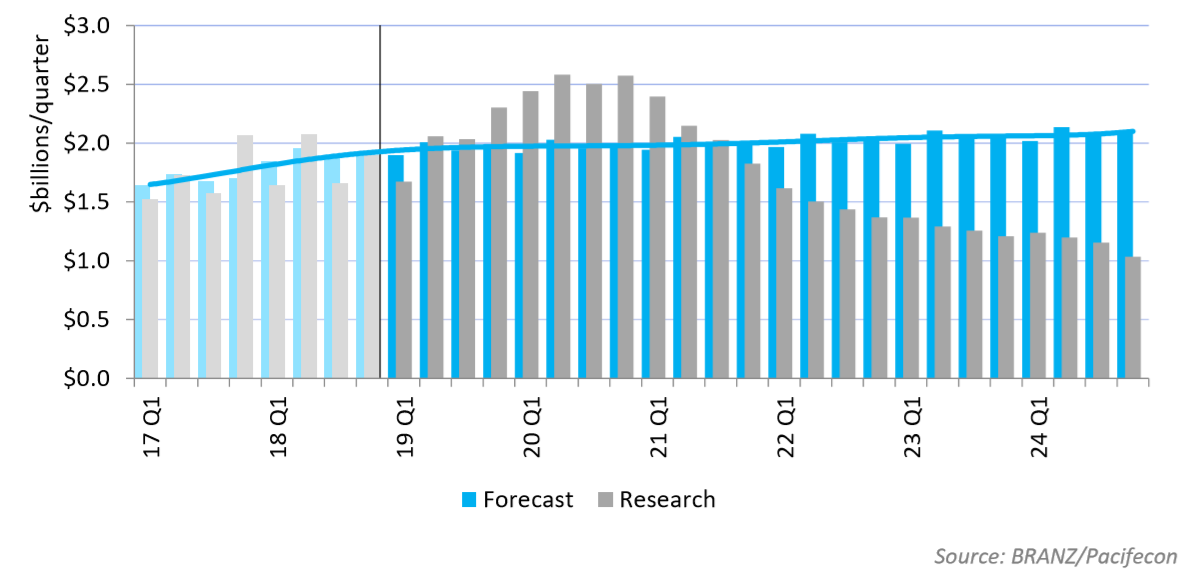
In 2018, infrastructure accounted for 1/5 of total national construction output, increasing by 12% from 2017 to NZ$7,600,000,000.
This figure is expected to grow steadily throughout the forecast period, reaching NZ$8,300,000,000 by 2024.
The data indicates that new infrastructure projects are very likely to get under way across the country in future.
National infrastructure construction forecasts
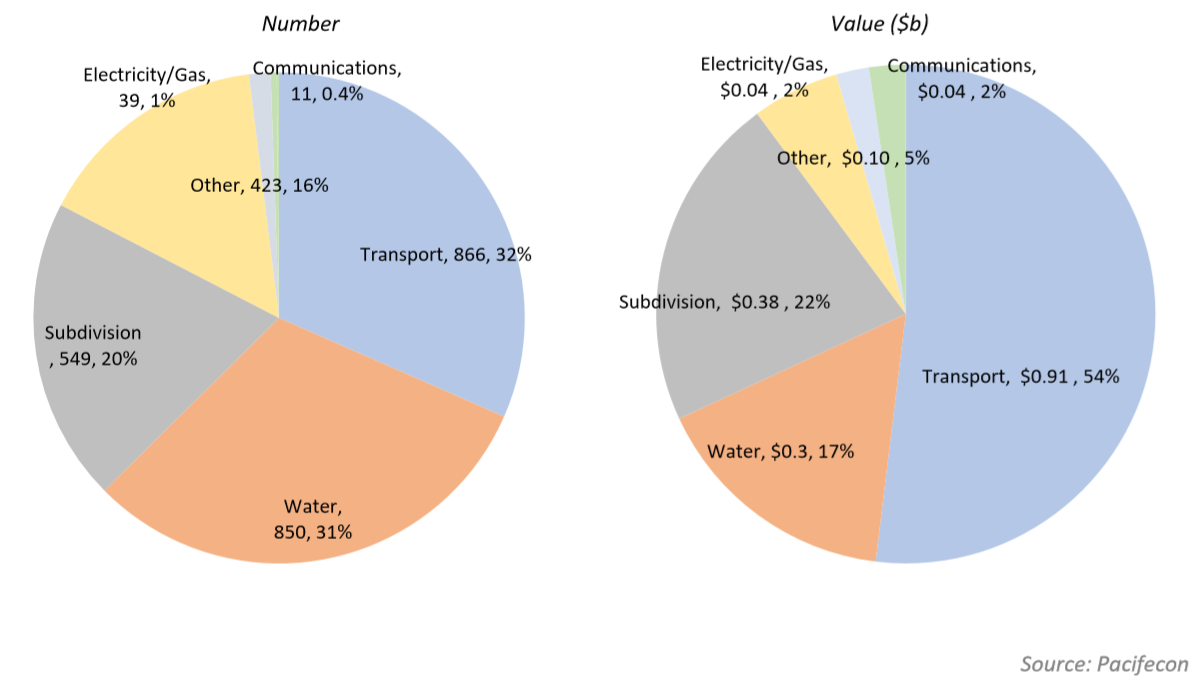
In 2019, transport, water supply and subdivision projects will dominate new infrastructure construction, accounting for around 83% of all projects and 93% of total output.
Transport projects feature prominently among planned projects and have a high output value, accounting for approximately 54% of output and 32% of project numbers.
Types of infrastructure projects expected to start in 2019
Frank Xu's analysis:
The Report's non-residential section covers commercial, education, industrial and other buildings, without listing tourism, hotels or offices separately.
Chinese contributions to non-residential construction are concentrated in hotels and tourism property, particularly investment in tourism destinations such as Auckland, Queenstown and Rotorua.
Also, although many apartments developed by Chinese developers are classified as residential, many apartment projects include associated commercial premises. These also form part of Chinese builders' contribution to non-residential construction.
Given the cyclical nature of the residential market, I believe Chinese businesses are also very likely to shift some of their residential investment into commercial property in future.
The Report says commercial property will peak at NZ$9,000,000,000 in 2021.
This is because Auckland will host many major events in 2021, including the America's Cup, the APEC Economic Leaders' Meeting, the Women's Cricket World Cup, the Men's Softball World Championship and the Te Matatini festival.
A series of non-residential projects will be completed beforehand, bringing the contribution of non-residential construction as a whole to a peak.
We also understand that New Zealand's forthcoming Watercare project, a wastewater pipeline upgrade programme, involves investment of NZ$3,000,000,000;
The international airport plans to invest NZ$5,000,000,000 in a second runway, along with hotels, car parks and departure lounges. Prisons will also account for a substantial share of investment.